
You probably have a small graveyard of planners somewhere. A drawer, a shelf, a stack on the nightstand, each one used hard for about nine days and then abandoned. The first week felt great. Then a day got missed, then a week, and the blank pages started to feel like proof of something about you.
If you are an adult with ADHD, most planners are working against how your brain runs. They are built for brains that remember appointments on their own and feel time passing in the background. ADHD brains run on a different system, so the standard ADHD planner sold to you often does nothing for the real problem and just becomes one more thing you are behind on. I have bought and quit more of them than I want to admit.
So here is the version I actually believe. Below is why planners fail the way ADHD works, the features worth looking for, seven picks I would point a friend toward, and the part almost nobody covers: how to keep using one after the novelty wears off.
TL;DR
Here is the short version of what makes an ADHD planner work, because skimming first is a very ADHD way to read an article:
- Planners fail ADHD brains for specific, nameable reasons: time blindness, out of sight out of mind, delay aversion, and the novelty-then-quit cycle. Each one has a feature that answers it.
- The features that matter most: visible and flexible time, one-page visibility, a brain-dump space, undated pages, small built-in wins, and a layout simple enough that using it is not a second job.
- Paper, digital, or undated, the best planner is the lowest-friction one you will actually open tomorrow.
- Seven picks by need: Panda Planner, Clever Fox, Passion Planner, and Laurel Denise on paper; Tiimo, Structured, and Future ADHD for digital. Plus Dani Donovan’s Anti-Planner for the days you cannot start at all.
- The real move is not one perfect planner. It is keeping whatever you pick visible, undated, and low-guilt so one missed day does not end the system.
This is general executive function and organization guidance, not medical or clinical advice. If you are working on this with a professional, use it alongside that conversation, not instead of it.
Why Most Planners Fail the ADHD Brain
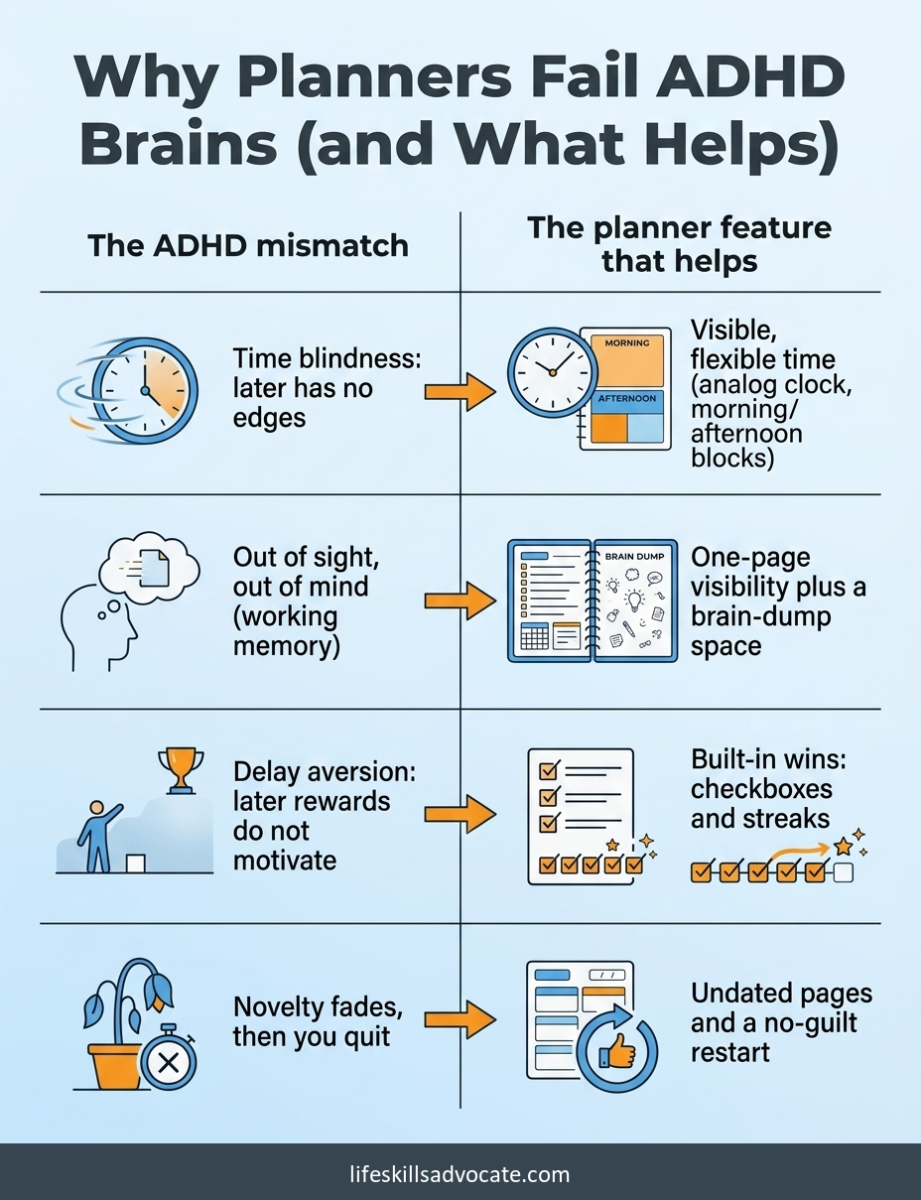
The abandoned ADHD planner in your drawer failed for reasons you can actually name. Standard planners assume you can hold a plan in your head, feel how much time is left, and stay interested in one system for a year. Those three assumptions are exactly where ADHD works differently, so it helps to pair each mismatch with the planner feature that answers it.
The first mismatch is time. A lot of ADHD adults experience what is loosely called time blindness: “later” has no edges, and it is hard to feel how long a task takes or how much of the afternoon is gone. A rigid hourly grid collapses the moment one thing runs long, and a bare to-do list gives time no shape at all.
What helps is time you can see, plus flexible blocks (morning, afternoon, evening) instead of a locked 2:00 slot you will resent by 2:15. If that flexible approach clicks, our guide to time blocking for ADHD goes deeper.
The second mismatch is memory. Working memory is the mental sticky note that holds what you are doing right now, and for ADHD brains it drops things fast. Research on memory offloading is clear that writing an intention down and getting a cue for it beats holding it in your head.
A 2015 study in the Quarterly Journal of Experimental Psychology found that setting external reminders improved how reliably people carried out their intentions, and that they leaned on reminders more as memory load rose. In planner terms, that means a page you can see at a glance and a place to dump the thought the second it arrives. A closed planner is a forgotten planner, which is why “out of sight, out of mind” is the most common reason people say a planner stopped working.
The third mismatch is reward. ADHD brains tend to discount delayed payoffs and chase the interesting thing now, so “future you will be organized” is a weak motivator for present you. That is also why a brand-new planner works for a week: it is novel, and novelty is its own hit of interest.
When the novelty fades, the friction stays, and one guilty look at a missed page ends it. A planner with small visible wins, a checkbox, a streak, a spot to note one good thing, gives present-you a reason to open it today.
What Makes a Planner ADHD-Friendly? The Features That Matter
Once you know what you are working with, the shopping list gets short. An ADHD friendly planner is not the one with the most sections. It is the one with the fewest things standing between you and writing something down. These six features do the heavy lifting:
- Visible, flexible time. Clock faces, weekly spreads with hours, or loose morning and afternoon blocks. Time you can see, not a rigid grid that breaks when life runs long.
- One-page visibility. The week and the running list in view at once, so nothing important lives on a page you have to remember to flip to.
- A brain-dump space. An open area to capture every task and stray idea the moment it shows up, before it evaporates.
- Undated pages. No pre-printed dates means no wasted spreads and no catch-up guilt when you skip a week. You start again on any random Tuesday.
- Built-in wins. Checkboxes, habit or streak trackers, a small spot for a win. Present-you needs a payoff today, not in six months.
- A layout that stays simple. If setup feels like a chore, it gets abandoned. Twelve trackers you will never use are not features, they are friction.
Notice what is missing: aesthetics for their own sake, a productivity philosophy, a hundred specialized log pages. Those are fine if they make you want to open the thing, and harmful if they make it feel like homework.
Paper, Digital, or Undated: Which Type of ADHD Planner Fits You
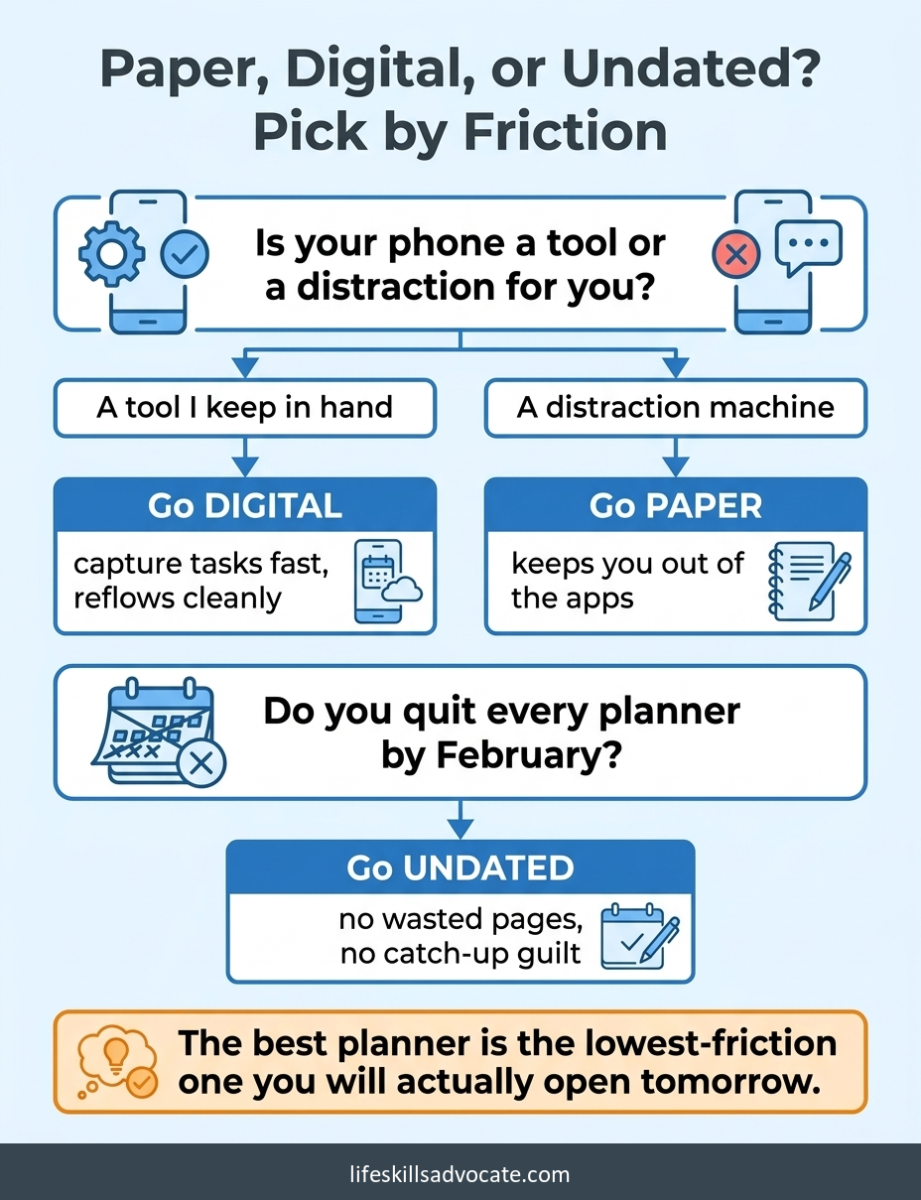
For an ADHD planner, format matters less than you would think. It is a distant second to friction. Still, each type suits a different reader.
Paper wins when writing by hand helps you think and remember, and when your phone is a distraction machine you would rather not open forty times a day. The catch is that paper only works if it stays open and in front of you. A paper planner closed in a bag is worse than nothing.
Digital wins when your phone is already a tool you keep in hand, because the biggest predictor of a planner sticking is whether you can capture a task the second you think of it. Digital also reflows: move a task and everything reshuffles, where paper turns into arrows and cross-outs. The trade is that the same phone holds every distraction ever invented.
A bullet journal is a build-your-own paper system, great if you find setup genuinely fun and a trap if you want elaborate spreads more than a working system.
Undated is less a format than a property, and it is the one I would nudge most ADHD adults toward. Undated pages remove the buried cost of a dated planner: the visible record of every day you skipped. You can put it down for three weeks and pick it back up with no penalty, which for a brain that runs on novelty and shame is the difference between a tool and a relic.
7 ADHD Planners That Actually Work (Independent Picks)
These are picks I would stand behind for an adult, not a top-ten scraped from whatever pays the most. Life Skills Advocate does not sell a planner, so there is no house favorite to push. A couple of the links below are affiliate links, which means we may earn a small commission if you buy through them at no cost to you. That does not change the picks. Find the row that sounds like you, then read that write-up.
Every pick here is undated on purpose, so a skipped day never leaves you with a wasted page to catch up on. The “Key ADHD feature” column names the one thing each planner does best, using the same six features from the section above.
:root{–link-color:#00a1ff;–border-color:#e1e5ea;–cell-padding:0.75rem;–font-base:0.95rem;–hover-bg:#f9fbfc;}.table-container{overflow-x:auto;-webkit-overflow-scrolling:touch;margin-bottom:1rem;border:0 !important;}.cmp-table{width:100%;font-size:var(–font-base);table-layout:fixed;border-collapse:separate !important;border-spacing:0;border:0 !important;outline:0 !important;box-shadow:none !important;font-family:inherit;}.cmp-table–adhd-planners col.col-planner{width:15%;}.cmp-table–adhd-planners col.col-format{width:12%;}.cmp-table–adhd-planners col.col-keyfeature{width:21%;}.cmp-table–adhd-planners col.col-price{width:12%;}.cmp-table–adhd-planners col.col-bestfor{width:40%;}.cmp-table thead th{background:#fafafa;font-weight:600;padding:var(–cell-padding);border:1px solid var(–border-color);text-align:left;line-height:1.45;white-space:normal !important;overflow-wrap:normal !important;word-break:normal !important;hyphens:none !important;overflow:hidden;}.cmp-table thead th .technique-note{font-weight:400;font-size:0.85em;}.cmp-table td{padding:var(–cell-padding);border:1px solid var(–border-color);vertical-align:top;background:#fff;line-height:1.55;white-space:normal !important;overflow-wrap:break-word;word-break:normal;hyphens:auto;overflow:hidden;font-family:inherit;}.cmp-table td[data-label=”Price”]{white-space:nowrap;overflow-wrap:normal;word-break:normal;hyphens:none;}.cmp-table–adhd-planners td>p{margin:0;padding:0;}.cmp-table tbody tr:hover td{background:var(–hover-bg);}.cmp-table a{color:var(–link-color);}@media (min-width:769px){.cmp-table–adhd-planners td::before{content:none;}}@media (max-width:768px){.table-container{overflow-x:visible;}.cmp-table–adhd-planners colgroup,.cmp-table–adhd-planners thead{display:none;}.cmp-table–adhd-planners,.cmp-table–adhd-planners tbody{display:block;width:100%;}.cmp-table–adhd-planners tr{display:block;margin-bottom:1rem;border:1px solid var(–border-color);border-radius:0.35rem;overflow:hidden;}.cmp-table–adhd-planners td{display:block;border-left:0;border-right:0;border-top:0;border-bottom:1px solid var(–border-color);}.cmp-table–adhd-planners td:last-child{border-bottom:0;}.cmp-table–adhd-planners td::before{content:attr(data-label);display:block;font-weight:600;margin-bottom:0.25rem;color:#5e6a72;}.cmp-table–adhd-planners td[data-label=”Planner”]{background:#fafafa;font-weight:600;}.cmp-table–adhd-planners td[data-label=”Planner”]::before{font-size:0.8em;text-transform:uppercase;letter-spacing:0.04em;}.cmp-table–adhd-planners tbody tr:hover td{background:#fff;}}@media (max-width:480px){.cmp-table{font-size:0.9rem;}}
| Planner | Format | Key ADHD feature | Price | Best for |
|---|---|---|---|---|
| Panda Planner | Paper | Built-in wins | ~$20 | People who have quit three dated planners and want a low-stakes test run |
| Clever Fox | Paper | A layout that stays simple | ~$25 | People who get overwhelmed by busy layouts and want structure without clutter |
| Passion Planner | Paper | Visible, flexible time | ~$35 | People who want daily tasks tied to bigger goals and like time-blocking |
| Laurel Denise | Paper | One-page visibility | ~$59 | People who lose tasks the second a page turns and need month and week in view together |
| Tiimo | Digital app | Visible, flexible time | ~$8/mo | Phone-attached people who need to see time passing and get nudged |
| Structured | Digital app | A layout that stays simple | Free / ~$30 one-time | Budget-minded people who want a simple visual day without a subscription |
| Future ADHD | Digital PDF | A brain-dump space | ~$20 | Tablet users who want digital flexibility plus the feel of handwriting |
Prices are approximate and can change; check the current price on each product page before you buy.
1. Panda Planner
Panda Planner is the one I point quitters toward first. It is undated, so no calendar is staring at you, and each day pairs an hourly schedule with a short to-do list, a habit tracker, and a spot to note a win. The built-in gratitude and wins prompts are lovely for some and a bit much if you want bare bones.
Best for: someone who has quit three dated planners and wants a low-stakes, guilt-free test run with wins built in.
2. Clever Fox
Clever Fox is the undated weekly and monthly option for people who want structure without visual chaos. The layout is clean and does not bury you in trackers. It does lean toward goal-setting and review pages, so if that framing is not your thing you will skip a few spreads.
Best for: readers who get overwhelmed by busy, over-designed planners and want clean structure.
3. Passion Planner
Passion Planner is the pick when you want your day tied to something bigger and you like to block out time. Its weekly spread pairs hour-by-hour time blocks with space for goals. The flip side is a dense page, so if a busy layout stresses you out, a simpler pick will serve you better.
Best for: people who want daily tasks connected to longer-term goals and enjoy time-blocking.
4. Laurel Denise
Laurel Denise solves one specific ADHD problem better than anything else here: it shows the month and the week at the same time, so a task does not vanish the instant you turn a page. That single design choice is the whole pitch, and it is a strong one. The catch is the price, around $59.
Best for: readers who lose track of anything not currently in view and need the month and week visible together.
5. Tiimo
Tiimo is a visual planning app built for neurodivergent users, and its strength is making time visible. It shows your day as a moving timeline and nudges you toward the next thing, which answers time blindness directly. It runs on a subscription, roughly $8 to $10 a month, so it costs more over a year than paper but does something paper cannot.
Best for: phone-attached readers who need to see time passing and get prompts through the day.
6. Structured
Structured gives you a clean visual timeline of the day with a usable free tier and a one-time upgrade instead of a subscription, which is rare and worth calling out. It is lighter on features than Tiimo, so power users may want more, but for a simple see-your-day layout it is hard to beat on price.
Best for: budget-minded readers who want a simple visual day and no monthly bill.
7. Future ADHD
Future ADHD is a digital planner designed around ADHD, meant to be used on a tablet in a notes app like GoodNotes. You get the flexibility of digital plus the memory benefit of handwriting. It does assume you own a tablet and a notes app, so it is not the pick if you work from paper or a phone alone.
Best for: iPad users who want digital flexibility and the feel of writing by hand.
The Anti-Planner: For the Days You Cannot Start at All
One more is worth knowing about, and it gets its own section because it is not a planner. The Anti-Planner by Dani Donovan is an activity book for the days when the problem is not scheduling, it is that you physically cannot start the thing.
It is a set of illustrated, choose-your-own-path pages for getting unstuck, organized by why you are stuck rather than by date. It came up on its own in every ADHD thread I read while researching this. Do not buy it expecting a place to write next Tuesday’s meetings. Buy it for the wall of task initiation that a normal planner cannot touch.
Why You Keep Quitting Planners (and How to Actually Stick)
The last piece is the one that actually keeps a planner in use, and it is the piece most product pages have no reason to mention. You keep buying and quitting planners because novelty-seeking is baked into how ADHD works, and no object stays novel forever.
The most upvoted idea I saw across the ADHD threads was someone half-joking that they wanted a planner that changes format the moment they lose interest in the last one. That is the actual insight. There is no forever-planner, so stop hunting for one and build a system that survives your interest fading.
A few things make that far more likely to work:
- Go undated. A dated planner turns every skipped day into evidence. Undated pages let you restart on any random day with a clean slate.
- Attach it to something you already do. A planner you have to remember to check is one more thing to forget. Stack it onto an existing anchor, like your morning coffee or your first sit-down at your desk. Our guide to habit stacking walks through how.
- Keep it in your face. Out of sight really is out of mind. Leave the book open on your desk, or put the app widget on your phone’s home screen. If you have to open a drawer to see your plan, you will not.
- Expect to rotate. Switching planners is not failing. Sometimes a fresh format is the hit of novelty that gets you planning again. Discbound systems make this cheap, since you can swap pages instead of buying a whole new book.
- Have a no-guilt restart. Missed a week? You do not owe those pages anything. Open to today and write down one thing. That is the whole recovery protocol.
Underneath all of it sits one habit that does more than any planner: getting everything out of your head and onto a page. When the running list in your head gets loud enough to tip into real ADHD overwhelm, emptying it onto paper is what brings the volume down.
The system I have kept the longest is a running brain-dump most Sunday nights: everything rattling around in my head onto one sheet, then I pick a small handful to schedule. If that sounds useful, our free Brain Dump Strategy worksheet gives you the space and the steps. A planner is where the top few tasks land after the brain dump does the real work.
Make Your Own ADHD Planner (Free and Cheap Options)
You do not have to buy anything to test whether an ADHD planner will help. Some of the most durable systems I have seen were built from a binder and a stack of printed pages, swapped out whenever they stopped working. Building your own also scratches the novelty itch for free.
The cheapest starting point is a single printable page you copy as often as you need. Our free Daily Planner Worksheet gives you a top-priorities section, time blocks, and a brain-dump area on one sheet, which covers most of the six features above. Print a week, clip it to a binder, and see what you actually use before spending $60 on the fancy version.
What the Research Says Behind an ADHD Planner
If you want to point someone to the why behind an ADHD planner, here are the load-bearing findings in one place.
:root{–link-color:#00a1ff;–border-color:#e1e5ea;–cell-padding:0.75rem;–font-base:0.95rem;–hover-bg:#f9fbfc;}.table-container{overflow-x:auto;-webkit-overflow-scrolling:touch;margin-bottom:1rem;border:0 !important;}.cmp-table{width:100%;font-size:var(–font-base);table-layout:fixed;border-collapse:separate !important;border-spacing:0;border:0 !important;outline:0 !important;box-shadow:none !important;font-family:inherit;}.cmp-table–adhd-research col.col-finding{width:34%;}.cmp-table–adhd-research col.col-means{width:44%;}.cmp-table–adhd-research col.col-source{width:22%;}.cmp-table thead th{background:#fafafa;font-weight:600;padding:var(–cell-padding);border:1px solid var(–border-color);text-align:left;line-height:1.45;white-space:normal !important;overflow-wrap:normal !important;word-break:normal !important;hyphens:none !important;overflow:hidden;}.cmp-table thead th .technique-note{font-weight:400;font-size:0.85em;}.cmp-table td{padding:var(–cell-padding);border:1px solid var(–border-color);vertical-align:top;background:#fff;line-height:1.55;white-space:normal !important;overflow-wrap:break-word;word-break:normal;hyphens:auto;overflow:hidden;font-family:inherit;}.cmp-table–adhd-research td>p{margin:0;padding:0;}.cmp-table tbody tr:hover td{background:var(–hover-bg);}.cmp-table a{color:var(–link-color);}@media (min-width:769px){.cmp-table–adhd-research td::before{content:none;}}@media (max-width:768px){.table-container{overflow-x:visible;}.cmp-table–adhd-research colgroup,.cmp-table–adhd-research thead{display:none;}.cmp-table–adhd-research,.cmp-table–adhd-research tbody{display:block;width:100%;}.cmp-table–adhd-research tr{display:block;margin-bottom:1rem;border:1px solid var(–border-color);border-radius:0.35rem;overflow:hidden;}.cmp-table–adhd-research td{display:block;border-left:0;border-right:0;border-top:0;border-bottom:1px solid var(–border-color);}.cmp-table–adhd-research td:last-child{border-bottom:0;}.cmp-table–adhd-research td::before{content:attr(data-label);display:block;font-weight:600;margin-bottom:0.25rem;color:#5e6a72;}.cmp-table–adhd-research td[data-label=”Finding”]{background:#fafafa;font-weight:600;}.cmp-table–adhd-research td[data-label=”Finding”]::before{font-size:0.8em;text-transform:uppercase;letter-spacing:0.04em;}.cmp-table–adhd-research tbody tr:hover td{background:#fff;}}@media (max-width:480px){.cmp-table{font-size:0.9rem;}}
| Finding | What it means for an ADHD planner | Source |
|---|---|---|
| People remember far more when they offload an intention to an external cue instead of holding it in memory. | Writing the task down and getting a reminder is not a crutch, it is the mechanism. A planner works by getting the plan out of your head. | Gilbert et al., 2015 (QJEP) |
| Working memory has a small, limited capacity that everyone, and especially ADHD brains, exceeds quickly. | You are not meant to hold a full day of tasks in your head. Externalizing them onto a visible page is the whole job of an ADHD planner, working with the brain instead of around it. | Nyberg and Eriksson, 2015 (CSH Perspectives) |
| ADHD affects several domains of thinking beyond attention, including motivation and how reliably the brain tracks and estimates time. | The time and follow-through struggles behind an ADHD planner are part of that broader profile, so a planner that makes time visible helps more than a bare list. | Faraone et al., 2015 (Nat Rev Dis Primers) |
| ADHD is associated with a stronger preference for smaller-sooner rewards over larger-later ones. | “Future you will be organized” does not motivate present-you, so built-in small wins (checkboxes, streaks) matter more than a long-term payoff. | Marco et al., 2009 (Neuropsychology) |
ADHD Planner FAQ
Do ADHD planners actually work?
They work for a lot of people, but not by magic and not for everyone. A planner helps when it stays visible and low-friction enough that you actually use it, and it fails when it lives closed in a bag. The planner is only half of it. The habit of externalizing your plan is the part that does the work.
What makes a planner ADHD-friendly?
An ADHD friendly planner keeps friction low and the important stuff visible. The features that matter most are visible and flexible time, one-page visibility of your week and running list, a brain-dump space, undated pages, small built-in wins, and a layout simple enough that using it is not a chore.
Why do I keep buying ADHD planners and never sticking with them?
Because ADHD brains are wired to chase novelty, and every new planner is novel for about a week. When the newness wears off, the effort of using it stays, and one missed day can tip the whole thing into the drawer.
The fix is not more willpower. It is designing around the pattern: go undated so a skipped day costs nothing, and keep the planner physically in view.
Attach checking it to something you already do, like your morning coffee, and expect to rotate to a new format sometimes. Switching is not failing. For a lot of ADHD adults, rotating between a couple of formats is just how the system stays alive, and a discbound binder makes it cheap because you swap pages instead of buying a whole new book.
Is a paper or digital planner better for ADHD?
It depends on whether your phone is mostly a tool or mostly a distraction for you. If you can capture a task the moment you think of it without falling into a scroll, digital wins on speed. If your phone pulls you under, paper keeps you out of the app store and the writing itself can help things stick.
Are undated planners better for ADHD?
Usually, yes. Undated pages remove the catch-up guilt that ends most planners, so you can skip a week and start again with no wasted pages and no visible record of the gap.
Is the Anti-Planner a real planner?
No, and that is the point. The Anti-Planner is an activity book for getting unstuck when you cannot start a task, organized by the reason you are stuck rather than by date. It pairs with a regular planner rather than replacing one.
Next Steps
The fastest way to know what will help is to notice where your current system actually breaks, then match a fix to it.
- Name your one breaking point. Is it forgetting to open the planner, running out of time, or losing tasks off the page? Pick the biggest one and let it choose your feature.
- Test before you invest. Print the Daily Planner Worksheet and run it for one week before spending money on a book or an app.
- Do a brain dump tonight. Get everything out of your head onto one page, then pick the three things that matter tomorrow.
- Find out where the friction really is. If planners keep failing no matter what you try, the gap may be an executive function skill rather than the tool. The free Executive Functioning Assessment can help you see which skill is the sticking point.
If the real problem is that you need another person in the loop, someone to help you set the system up and check in, that is what executive function coaching for adults is for. Coaching is educational and skills-focused, not therapy, and for a lot of ADHD adults the accountability is the piece no planner can supply on its own.
Further Reading
- Strategic offloading of delayed intentions – Gilbert et al., 2015, Quarterly Journal of Experimental Psychology
- Working memory: maintenance, updating, and the realization of intentions – Nyberg and Eriksson, 2015, Cold Spring Harbor Perspectives in Biology
- Attention-deficit/hyperactivity disorder – Faraone et al., 2015, Nature Reviews Disease Primers
- Delay and reward choice in ADHD – Marco et al., 2009, Neuropsychology
- Passion Planner – undated weekly planner with time blocks
- Laurel Denise – undated planner with month and week in view
- Tiimo – visual planning app for neurodivergent users
- Structured – visual daily planner app
- Future ADHD – ADHD-designed digital planner
- The Anti-Planner – Dani Donovan
- Time Blocking for ADHD – Life Skills Advocate
- 12 Tips to Take Control of ADHD Overwhelm – Life Skills Advocate
- 9 Signs of Executive Dysfunction and Ways to Work With It – Life Skills Advocate
- Habit Stacking: A Simple Way to Build Consistent Routines – Life Skills Advocate
- Brain Dump Strategy worksheet – Life Skills Advocate
- Daily Planner Worksheet – Life Skills Advocate
- Free Executive Functioning Assessment – Life Skills Advocate
- Executive Function Coaching for Adults – Life Skills Advocate