
If you have ever shoved everything off the kitchen counter into one giant heap five minutes before company arrived, you have made a DOOM pile. Maybe it lived in a laundry basket. Maybe it migrated to a closet. Maybe it is still there, six weeks later, quietly negotiating with your willpower.
The first thing worth saying is this: DOOM piles are not a sign of laziness, and they are not a personal failing. They are a recognizable pattern in how executive function works under pressure. Once you can see that pattern, the pile gets a little less scary, and a lot more workable.
This article walks through what DOOM piles really are, why your brain keeps making them, and a calmer way to actually clear one.
TL;DR
- DOOM piles get their name from “Didn’t Organize, Only Moved.” The pile is a heap of unsorted items relocated together to clear visible space.
- It is an executive function load problem, not a character flaw, and it shows up across ADHD, autism, AuDHD, depression, and burnout.
- The fastest way to clear one is a 15-minute timer plus four sorting bins.
- Prevention is environment design: fewer flat surfaces, a daily five-minute reset.
This article is educational, not a substitute for professional evaluation. If clutter is affecting your safety or daily life in serious ways, working with a coach or clinician alongside this kind of guide is a reasonable next step.
| Term | Meaning | Source |
|---|---|---|
| DOOM pile | Short for "Didn't Organize, Only Moved." A heap of unsorted items moved together to clear visible space, common in ADHD and other executive function profiles. | ADDitude, 2023 |
| EF subskills involved | Organization, task initiation, working memory, decision-making. | Harvard Center on the Developing Child |
| Who it affects | People with ADHD, autism, AuDHD, depression, or executive dysfunction from any cause. | NAMI-QN, 2023 |
| Why it matters | DOOM piles are not a sign of laziness. They are a predictable response to decision fatigue and limited working memory. | Psychology Today, 2023 |
What DOOM Piles Actually Are (and What They Aren’t)
DOOM piles are the physical residue of a sorting decision your brain could not finish. You cleared the surface, but you did not actually decide where anything goes. The pile is the holding pattern.
People build them into bags, drawers, closets, baskets, the back seat of a car, the chair in the bedroom that was supposed to be for sitting. Some folks live with a “doom room,” an entire space that has become the catch-all. The container changes; the pattern is the same.
They are different from hoarding, which involves significant distress at discarding objects and is a recognized clinical condition. A doom pile is mostly about avoidance and exhaustion, not emotional attachment to the items inside it. The contents are usually a chaotic mix: mail, electronics, clothes, art supplies, that one screwdriver. The mix is what makes the pile feel impossible. None of it is moral. It is organization as an executive function skill meeting a hard day.
Why DOOM Piles Form: The Executive Function Picture
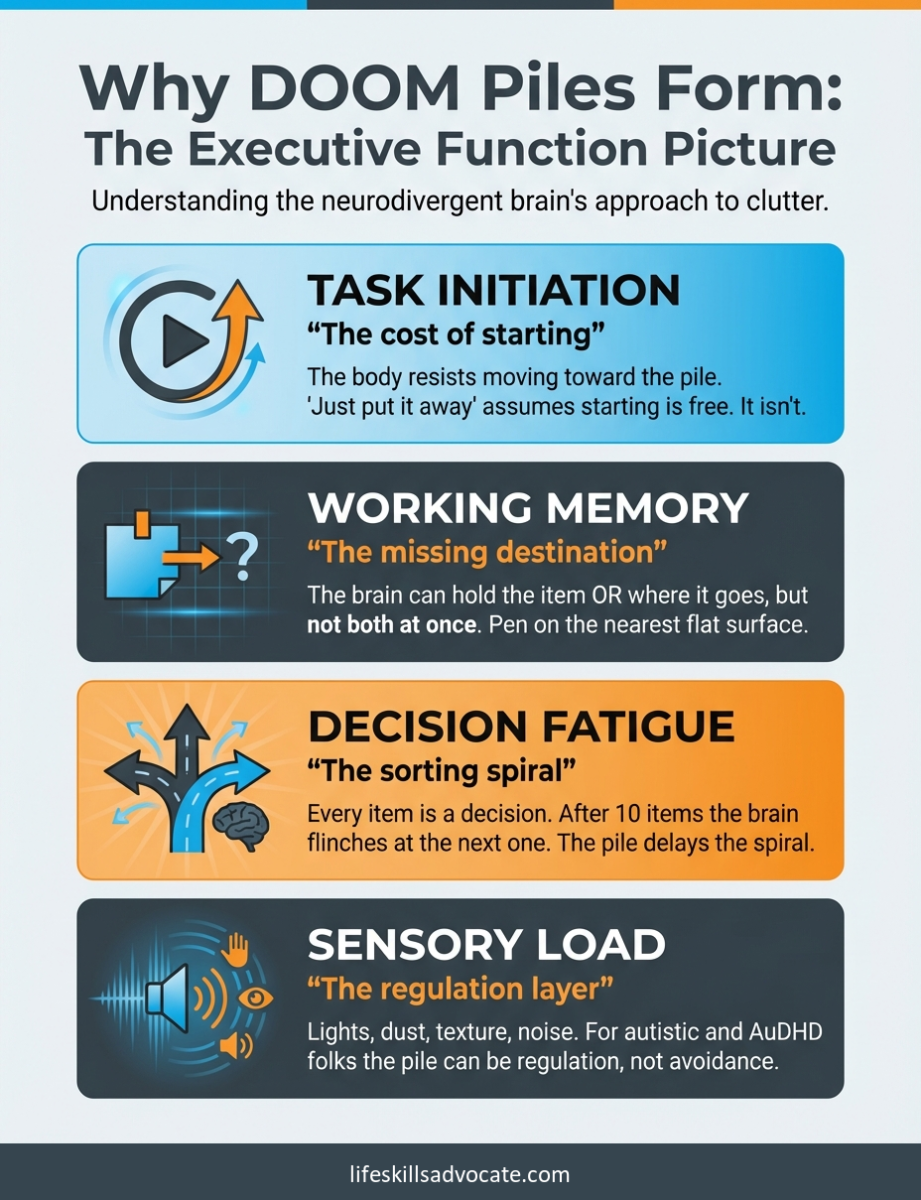
DOOM piles form because clearing a surface is one task, but truly putting things away is four or five. Each item asks the brain to make a series of micro-decisions: Do I keep this? Where does it live? Is it clean? Does it need a battery? Multiply that by sixty items and a ringing phone, and a heap on the counter starts to look like the merciful option.
Disorganization is one of the most commonly reported daily struggles for adults with ADHD, as documented across ADDitude and clinical sources. None of that is about effort. It is about which mental systems are doing the work.
Task Initiation and the Cost of Starting
Getting started is its own executive function skill, and it has a cost. People with ADHD or autism often experience that cost as physical resistance: the body simply will not move toward the pile. Advice to “just put it away as you go” assumes the cost of starting is zero. For many people, it is the highest cost in the entire chain. Building task initiation into a workable plan matters more than buying another bin.
Working Memory and the Missing Destination
Working memory is the brain’s mental scratchpad. It can hold the item in your hand, or the destination it belongs in, but holding both at once is harder than it sounds. When working memory is taxed, you pick up a pen, walk three feet, forget why you stood up, and put the pen on the nearest flat surface. That flat surface is now the start of a pile.
Decision Fatigue and the Sorting Spiral
Every item is at least one decision: keep, toss, relocate, deal with later. Decision fatigue compounds quickly. After ten or twelve items, the brain starts to flinch at the next one. The pile then becomes a way to delay the next decision, which feels like relief in the moment and grows the heap in the long run. The same loop is covered in the post on the decision fatigue spiral.
AuDHD, Autism, and the Sensory Layer
For autistic and AuDHD folks, there is often a sensory layer on top of the EF load. Bright lights, dust, certain textures, the noise of the dishwasher running, all of it can push the nervous system past the point where sorting is possible. When that happens, a pile is not avoidance. It is regulation.
A Low-Friction Way to Clear a DOOM Pile
Clearing DOOM piles works when the approach lowers the cost of starting and shrinks the number of decisions per minute. The eight moves below are designed for that, not for perfection. You will not finish every pile in one session. That is the design, not a failure of it.
Pick the Smallest Possible Pile
Be honest about scale. The bedroom chair is smaller than the dining room table. The basket on the dryer is smaller than the chair. Start with the smallest one in your line of sight. Momentum from one finished small pile is worth more than half-progress on a large one.
Set a Visual Countdown Timer for 15 Minutes
Fifteen minutes is short enough that the brain will agree to it and long enough to make real progress. A visual countdown timer beats a phone timer for most ND folks because the time remaining is visible without unlocking anything. When it goes off, stop.
Use Four Bins, Not Eight
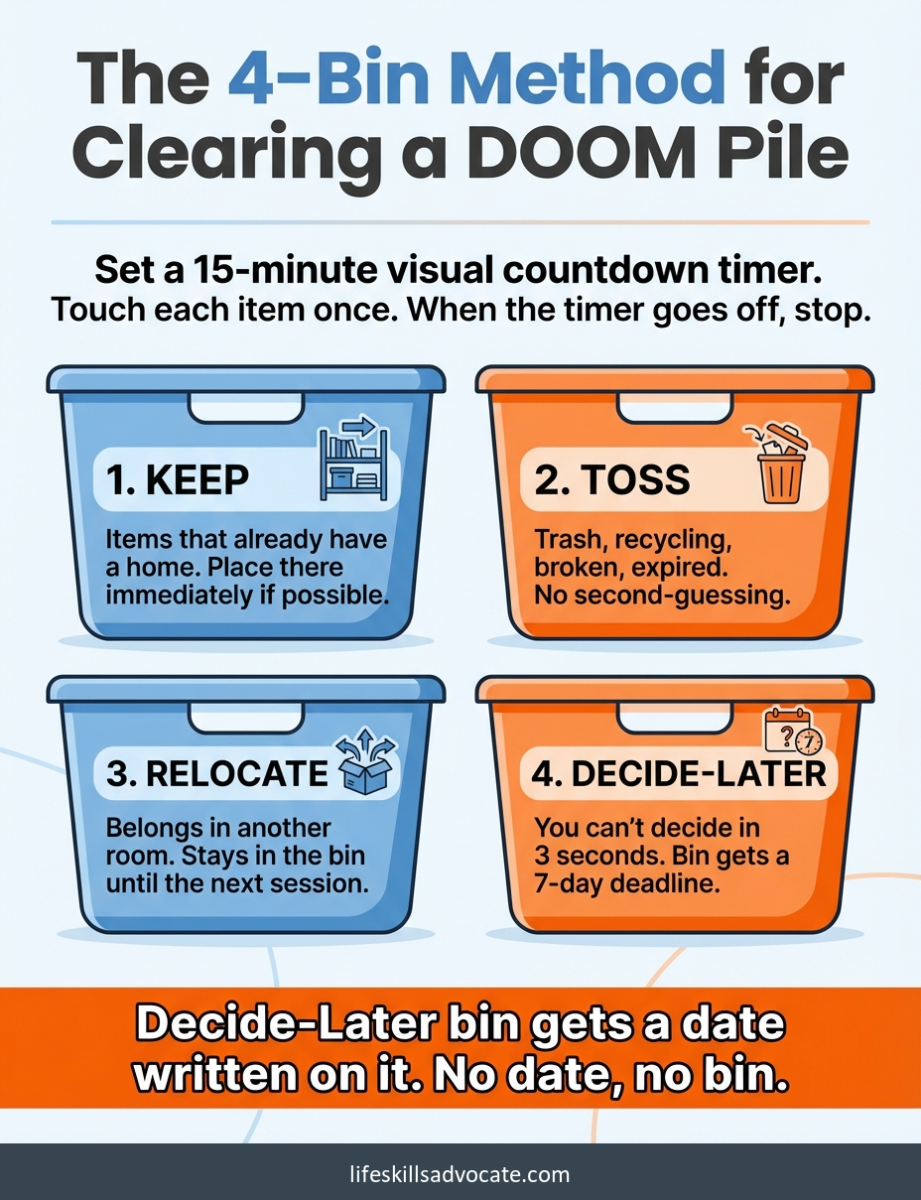
More categories means more decisions per item. Four is the limit for most people in a 15-minute window: Keep, Toss, Relocate, Decide-Later. Any storage container will work. Laundry baskets, cardboard boxes, paper grocery bags, all fine. Do not buy fancy bins for this; that becomes its own pile.
Body Double If You Can
Body doubling means having another person work alongside you, in person or on a video call, while you both do your own thing. It sounds like nothing. It is not nothing. The presence of another nervous system lowers the activation cost of starting and the loneliness of mid-task slogging. Many ND adults find this the single most effective change they make.
Touch Each Item Once
The one-touch rule is a guardrail. Pick up an item, decide its bin, place it, move on. If you cannot decide in three seconds, the item is a Decide-Later.
If You Stall, Sort by Category Instead of Destination
When the bins are not enough and the brain seizes, switch the question. Instead of “where does this go,” ask “what is this.” Group like with like: receipts together, cables together, random screws together. Categorizing is a different cognitive operation than placing, and sometimes the brain has more of one than the other left in the tank.
Stop on Time, Even If You Are Not Done
Hardest rule, most important rule. When the timer goes off, stop. Pushing past 15 minutes turns a manageable session into a marathon, and marathons rarely happen twice. A finished 15-minute session you will repeat tomorrow beats a two-hour session you will never repeat.
Set a Decide-Later Deadline Before You Walk Away
The Decide-Later bin is the most dangerous bin in the system, because it loves to become a fresh heap. Before you walk away, write a date on it: “Decide by [seven days from today].” Put it on the calendar. The deadline is what keeps the whole thing honest.
Organizing Spaces Workbook ($15)
A gamified workbook that turns organizing into small, finishable missions, so a cleared pile is easier to keep clear.
Best for: teens and young adults whose stuff piles up faster than the usual organizing advice can handle.
Habits That Prevent the Next DOOM Pile
Preventing the next DOOM pile is a system, not a willpower test. Environment design will outperform willpower every time, because environment design does not require executive function in the moment.
The “Don’t Put It Down, Put It Away” Rule (When It Works)
The “don’t put it down, put it away” rule is the most-cited prevention move in ADHD circles, and it works for some people. For others, it is one more decision their brain does not have, and it backfires. If it is genuinely available to you, use it. If not, change the environment instead.
The Daily Five-Minute Reset
A daily five-minute reset is the most accessible habit for most ND households. Set the timer, walk through one or two rooms, put away whatever your hands land on. No sorting. Just movement. Pair that with a weekly review session, the kind covered in the post on the brain dumping approach, and the prevention loop starts to hold.
Reduce Flat Surfaces
The deeper move is to reduce flat surfaces. The chair-that-collects-clothes collects clothes because it is a flat surface in the line of sight to the dresser. Move it, or replace it with a wall-mounted hook board, and the pile has nowhere to start. The same applies to entryway tables and the tops of dressers. Visible storage with labels works better than pretty closed storage, because what your brain cannot see, it cannot retrieve. Many ADHD adults describe this experience as object permanence, and the broader set of environmental workarounds is worth a look. This is the same loop that ADHD overwhelm creates in other parts of daily life.
Some weeks, the pile comes back anyway. That is not failure. It is what happens when ND brains and busy lives interact. The goal is a faster reset cycle, not a permanently empty surface.
A compact Bluetooth label maker that prints from your phone, so the “visible storage with labels” habit takes seconds instead of becoming its own project. Label the bins and drawers where things pile up, and each item finally has an obvious home your brain can see.
Best for: Anyone whose piles keep coming back because stuff has no labeled destination. It prints from a phone app on its own tape rolls, so you do need the app and refill tape, but the labels are cheap and the machine is small enough to leave out.
Frequently Asked Questions
Why are they called DOOM piles?
DOOM stands for “Didn’t Organize, Only Moved.” The name caught on in ADHD communities because it perfectly describes the act of relocating a mess instead of sorting it.
Are DOOM piles a sign of ADHD?
Not exactly. DOOM piles are common with ADHD, but they show up across many executive function profiles, including autism, AuDHD, depression, and ordinary burnout. The pattern reflects executive function load, not a specific diagnosis. A doom pile alone is not enough to diagnose anything; it is a clue worth paying attention to, especially if it shows up alongside other consistent EF struggles.
How do I stop creating new DOOM piles?
Environment design beats willpower. Reduce flat surfaces in high-traffic spots, add visible storage with labels for the items that pile up most often, and run a daily five-minute reset at the same time each day. Pair that with the “don’t put it down, put it away” rule for the first thirty days. Expect the pile to test the new system in the first two weeks; that is the system working, not failing. The most common mistake is buying matched bins before the habit exists. The bins become their own DOOM container. Build the habit first; let it tell you what storage you actually need, then buy the storage to match. Most ND folks need fewer containers and clearer destinations, not more containers and prettier ones.
What is the difference between a DOOM pile and hoarding?
DOOM piles are about avoidance and decision fatigue. The items inside usually carry no special meaning; they are just unsorted. Hoarding involves significant distress at discarding objects and is a recognized clinical condition with diagnostic criteria. The two can overlap, but they are not the same thing. If the act of discarding items causes intense emotional distress, or if clutter is starting to affect safety in the home, that is worth talking to a clinician about rather than treating as a productivity question.
What if the same DOOM pile keeps coming back?
If the same pile reforms in the same spot every week, the spot is the problem, not you. Move the storage closer, or remove the flat surface.
Where to Start This Week
If only one piece of this article is going to stick, make it the 15-minute timer. Everything else builds on that one habit.
- This week: identify the smallest DOOM pile in your home. Just identify it. Do not touch it yet.
- Next time you have 15 minutes: try the four-bin method on that one pile. Stop when the timer goes off, even if you are not done.
- This month: read more about organization as an executive function skill to understand why bins help and willpower does not.
- If clutter is affecting safety or daily life: consider working with an executive function coach with Life Skills Advocate who can help you build a system around your specific brain.
Further Reading
- My Doom Piles Screamed ‘Undiagnosed ADHD’ – ADDitude
- Making Peace With Your Clutter: A Guide for ADHD Adults – ADDitude
- Is Your ADHD Making You a DOOM Piler? – Psychology Today
- ‘Depression Rooms’ and ‘Doom Piles’: Why Clearing the Clutter Can Feel Impossible – NAMI Queens/Nassau
- Is It Clutter or Hoarding? How to Help – CHADD
- Guide to Executive Function – Harvard Center on the Developing Child
- Executive Functioning Skills 101: All About Organization – Life Skills Advocate
- Executive Functioning Skills 101: The Basics of Task Initiation – Life Skills Advocate
- Helping Your Child Overcome Decision Fatigue – Life Skills Advocate
- AuDHD and Executive Function – Life Skills Advocate
- How Brain Dumping Can Improve Executive Functioning – Life Skills Advocate
- 12 Tips to Take Control of ADHD Overwhelm – Life Skills Advocate
- Executive Function Coaching – Life Skills Advocate