
You’ve probably said it before to your child or student: “If you’re stuck, why don’t you just ask for help?” But for many neurodivergent teens, that instruction is far from simple.
Maybe your student sits frozen over an assignment, clearly struggling, but says nothing. Maybe your child insists everything’s fine, only for you to find out they’ve been falling behind for weeks. Or maybe your teen nods along in class but won’t raise a hand, even when they’re completely lost.
It’s easy to assume this silence means stubbornness or a lack of effort. In reality, it often reveals something deeper: a mix of habit, learning history, and environment that can make knowing how to ask for help genuinely hard.
What we know of as “asking for help” actually involves a whole stack of quick decisions and behaviors: Is this the right time? What if I sound dumb? What if they say no? How do I ask?
By the time many neurodivergent learners have worked through all of those decisions, the moment has often passed, and the cycle of avoidance continues.
This post looks at the hidden reasons that keep teens from asking for help, and shares five practical strategies to break that cycle and build confidence. You’ll walk away with concrete ways to support help-seeking as a skill your teen can learn and get comfortable with over time.
TL;DR
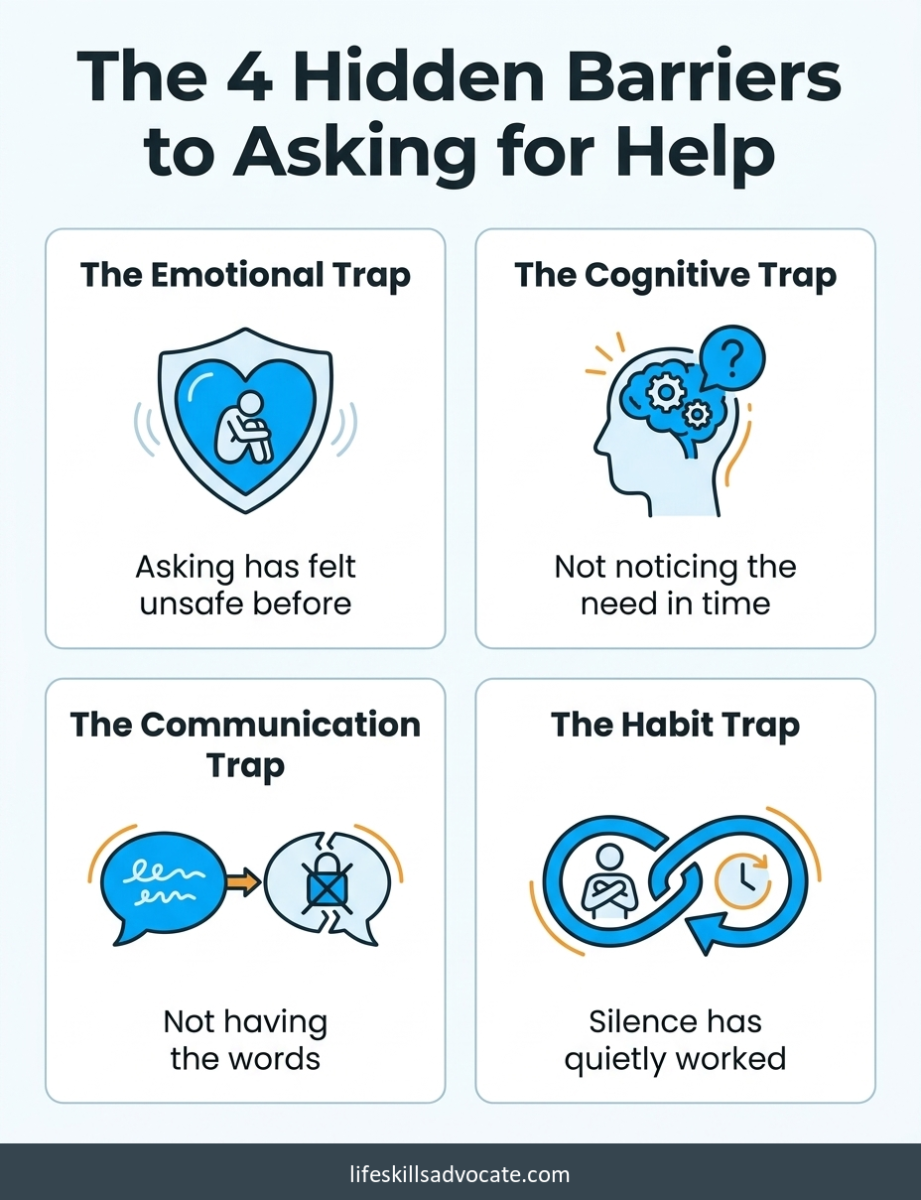
Teaching a neurodivergent teen how to ask for help starts with seeing why it’s hard. The silence usually isn’t defiance. It’s the result of four quiet barriers, and each one is something you can help with:
- A learning history where asking for help once felt unsafe or embarrassing.
- Executive function hurdles, like self-monitoring, that make it hard to notice the need for help in time.
- Not having the words, even when they know they’re stuck.
- A long habit of silence that has quietly worked, so it sticks.
- Plus five strategies to shift the pattern: name the barriers, start with small asks, use social scripts, praise the effort over the outcome, and model asking for help yourself.
This article is educational, a practical guide for the adults supporting a teen. It isn’t medical, diagnostic, or mental health advice. If your teen is already working with a provider, use these ideas alongside that support.
Asking for Help Is a Foundation Skill of Adulthood
Asking for help isn’t just a classroom skill. It’s one of the foundational communication skills of adulthood. It’s how we solve problems, build relationships, and handle everything from apartment leases to workplace expectations.
Yet for many neurodivergent learners, asking for help gets tangled up in what we might call the myth of independence: the belief that “real adults” handle everything on their own. That myth can run deep, reinforced by years of feedback like “you should know this by now” or “just figure it out.” (We dig into that tension in our guide to balancing independence and support.)
Over time, it teaches teens that competence equals silence, and that needing support means failure. The opposite is closer to the truth. Recognizing when you need help and reaching out for it is one of the strongest markers of self-awareness and growth toward adulthood. In other words, asking for help is not a weakness; it’s a skill.
That reframe matters, because asking for help is a form of self-advocacy. As Understood’s guide to self-advocacy puts it, self-advocacy is simply the ability to communicate what your needs are, and teens who build that skill tend to do better in school, at work, and in daily life.
It’s also one of the first Power Skills we cover in the free Adulting Like a Champ Workbook, which has a focused companion in the Asking for Help Workbook, because so many teens and young adults get stuck at exactly this step.
The Barriers Behind “Why Don’t You Just Ask?”
From the outside, asking for help looks simple: spot the problem, find the right person, and ask. But there are many places where that sequence can break down. Beneath the silence, the avoidance, or the late assignments, there are often powerful emotional and behavioral traps at work, patterns that make asking for help feel risky, confusing, or even impossible.
The frustrating part is that this is common and well documented. Research on academic help-seeking finds that students who could benefit from help often avoid it, even when it’s right in front of them. Four of the most common reasons show up again and again.
The Emotional Trap: A Learning History of Rejection
For many teens, the moment they consider asking for help, a flood of other thoughts arrives too: What if I sound dumb? What if they get annoyed? What if everyone finds out I don’t know what I’m doing? These thoughts don’t come from nowhere; they’re usually learned through experience.
Maybe the student once asked for help and heard, “You should already know this.” Maybe they raised their hand and got laughed at. Each of those moments becomes part of a learning history, one that quickly labels help-seeking as unsafe. The next time they’re stuck, the safer move feels like staying silent.
Over time, that pattern can harden into something researchers call rejection sensitivity. In interviews, adults with ADHD have described expecting rejection and protecting themselves by pulling back, staying quiet or withdrawing before anyone can say no. Even in a supportive classroom, a history of being dismissed or embarrassed can stop a teen from asking, long before they actually try.
The Cognitive Trap: Executive Functioning and Awareness
For other learners, it isn’t fear of rejection that gets in the way. It’s that challenges with executive function skills make it hard to even notice when help is needed. Skills like self-monitoring, planning, and task initiation all play a role in recognizing when you’re stuck and deciding what to do next.
Noticing you’ve hit a wall is its own kind of judgment, and studies of self-monitoring find it comes less easily to some learners than to others. A student might start a math problem thinking, “I’ll figure this out later,” or put off sending an email until the window has closed. The result? They end up overwhelmed, not because they didn’t want help, but because they didn’t catch the need for it early enough.
This is part of what we call the Executive Functioning Ripple Effect: one missed moment leads to procrastination, then frustration, then shame. And there’s a second cost. When teens finally do ask, it’s often late in the process, sometimes too late for the help to make a real difference.
When that happens, they start building a different kind of learning history, one where asking doesn’t seem to work or doesn’t seem worth it. That belief feeds right back into the pattern of staying silent the next time.
The Communication Trap: Trouble Finding the Right Words
Even when a teen wants to ask for help, knowing what to say can be a real barrier. Many neurodivergent learners are ready to ask but unsure how to begin, or how to put into words what would actually help.
In classrooms or workplaces that expect quick, verbal answers, that hesitation can be misread as disinterest or defiance. Really, the teen is just missing the tools to start the conversation.
This is where social scripts and sentence starters help. They lower the pressure of thinking and talking at the same time under stress. Written and visual prompts like these are a recognized classroom scaffold: with a few pre-taught phrases like “I’m confused about this part, can you explain it again?” or “Can I check that I’m doing this right?”, a teen can get to help faster and with less friction.
A script is a starting point you rehearse until the words feel like your own, not a one-and-done trick.
The Habit Trap: Reinforcement of Silence
In behavior analysis, we talk about reinforcement: behaviors tend to happen more often when they’re immediately followed by something rewarding (attention, relief, getting to a preferred activity) or by escaping something uncomfortable. As the May Institute puts it, a reinforcer is a consequence that follows a behavior and makes it more likely to happen again.
For many neurodivergent teens, staying silent has been reinforced for years. Avoidance feels safe, and staying quiet sidesteps embarrassment. Turning in something imperfect can feel better than speaking up and risking conflict. Each time silence “works,” the habit of handling things alone gets a little stronger.
The tricky part is that this pattern often looks like independence. A parent or teacher sees a quiet, compliant student and assumes everything is fine, when really that student is masking confusion or discomfort.
Breaking the habit takes new experiences: small, safe, successful moments of asking that gradually rebuild trust. It isn’t about forcing a teen to ask. It’s about giving them enough wins that asking finally feels worth it.
5 Strategies to Teach Your Teen How to Ask for Help
Once you can see the traps, the next step is helping your teen build replacement behaviors that make asking for help easier, more natural, and more rewarding. None of this requires hours of therapy or a complex behavior plan. It comes down to steady modeling, a little structure, and practice.
1. Name the Traps Out Loud
Start by helping your teen talk about why asking feels hard. Naming the fear (“I’m worried they’ll think I’m dumb”) or the habit (“I always wait too long to ask”) gives them language for what’s happening, and it makes the challenge feel solvable instead of mysterious.
2. Start With Small Asks
Work with your teen to build a list of short, low-stakes chances to ask for help: asking a teacher to repeat directions, checking with a friend about a due date, or asking a parent for a quick reminder. Practice these first, or even role-play them, before building up to the bigger asks.
Each successful attempt helps build a better learning history around asking for help.
3. Use Social Scripts
Give your teen short, concrete sentence starters so they don’t have to invent the words on the spot. Drop these into their phone, or keep a list in a backpack or planner. Aim for phrases that are short and clear:
- “Can you show me that step again?”
- “I think I’m missing something. Can you explain it another way?”
- “Could we go over this together?”
Scripts work best when they’re practiced ahead of time and when your teen gets a warm response for using them (“I love that you asked me for help”). For a ready-made set sorted by situation, our library of social scripts for asking for help is a good place to start, and you can practice them together straight from the free Adulting Like a Champ Workbook or the focused Asking for Help Workbook.
4. Reinforce the Effort, Not the Outcome
Positive feedback matters a lot as your teen starts to practice. Praise the act of asking, even when the situation doesn’t go perfectly. Lines like “I appreciate that you spoke up” or “That took some courage” point out what went well and build confidence over time.
5. Model Help-Seeking Yourself
Teens and young adults learn a lot from watching the adults around them. So model help-seeking out loud, and point out when it works (or doesn’t). Say things like, “I wasn’t sure how to fix this, so I asked for help,” or “I checked with a coworker to make sure I got it right.”
Modeling shows that asking for help is a normal, respected part of being an adult. You can also share the times you had to be persistent, when the first ask didn’t get you what you needed and you tried again.
These approaches work best together: modeling, practicing small wins, and reinforcing practice over perfection. The goal isn’t to make asking for help automatic overnight. It’s to build a new learning history where reaching out feels safe and worth it.
Build the Habit of Asking for Help With Support
If your teen or student struggles with asking for help, you don’t have to figure it out alone, and they don’t have to keep learning it the hard way. The Asking for Help Workbook walks through this one skill step by step, so the practice has a structure to lean on.
Inside, you’ll find:
- Ready-to-use social scripts for school, home, and community settings
- Teaching strategies that turn the ideas here into real-world practice
- Reflection prompts that help teens notice what went well and what to try next
- A clear structure for building the habit of asking for help without shame or anxiety
If you’ve ever thought, “I know they need help, but I don’t know how to teach it,” this is the bridge between understanding the problem and practicing the skill. For a broader toolkit, the free Adulting Like a Champ Workbook covers asking for help alongside the other Power Skills teens and young adults need.
A step-by-step workbook that turns the five moves above into guided practice, with ready-to-use scripts, teaching plans, and reflection prompts you can work through with your teen.
Best for: A parent, teacher, or coach who wants a structured, low-pressure way to practice asking for help alongside their teen or young adult. (This is a paid LSA workbook, not a free download.)
What the Research Says About Asking for Help
A few findings help explain why learning how to ask for help is genuinely hard, and why these approaches work. Much of this research studied students in general classrooms, not neurodivergent teens specifically, and every kid is different, so use it as a lens on the pattern, not a precise map of your teen.
| Finding | What it means | Source |
|---|---|---|
| Help-seeking is a self-regulation skill learners can build, and struggling students often avoid the help that would benefit them. | Learning how to ask for help is a skill you teach and practice, not a fixed personality trait. The teens who need it most are often the least likely to reach for it. | Dong, Jong & King, 2020 (Frontiers in Psychology) |
| Noticing you’re stuck is a metacognitive self-monitoring judgment, and it’s harder for some learners than others. | A teen may not ask because they didn’t catch that they were stuck in time, not because they didn’t care. | Oudman, van de Pol & van Gog, 2021 (Metacognition and Learning) |
| Written and visual prompts (scripts) are a recognized classroom tool that supports interaction. | Pre-planned sentence starters lower the in-the-moment pressure of finding the right words. They’re a support, not a substitute for practice. | ASHA Autism Practice Portal, 2024 |
| A reinforcer is a consequence that follows a behavior and makes it more likely to happen again. | Each time staying silent removes discomfort, the habit of not asking gets a little stronger. New, safer experiences with asking are what shift it. | May Institute |
| Adults with ADHD describe expecting rejection and protecting themselves by withdrawing. | A history of being dismissed or embarrassed can teach a teen that asking is unsafe, long before the next time they’re stuck. | PLOS ONE, 2024 (rejection sensitivity in ADHD) |
| Self-advocacy is the ability to communicate your needs, and it’s linked to doing well in school, work, and life. | Asking for help is self-advocacy. It’s a marker of growth toward adulthood, not a failure of independence. | Understood.org |
Frequently Asked Questions
Why won’t my neurodivergent teen ask for help even when they’re clearly struggling?
Usually it isn’t defiance or laziness. Asking for help is really a chain of small decisions, and any link can break: noticing you’re stuck, deciding it’s worth it, finding the right person, and finding the words, all while managing the worry that you’ll be judged for it.
For a neurodivergent teen, several of those links can be fragile at the same time. A learning history where asking once felt unsafe, executive function hurdles around self-monitoring, and a habit of silence that has quietly worked for years can stack up until saying nothing feels like the safest option.
So the silence you see is the surface of a pattern, not a verdict on how much your teen cares or tries. That reframe matters, because a pattern is something you can help change, one small, successful ask at a time.
How do I help a teenager who doesn’t want help or insists they’re fine?
Start smaller than feels necessary, and lower the stakes. Instead of pushing them toward the thing they’re most avoiding, practice a tiny, low-pressure ask first and respond warmly every time they try. Naming the barrier out loud together, like “it makes sense that asking feels risky after last year,” often does more than encouragement. Educators building this into a plan can start from our bank of asking-for-help IEP goals.
Isn’t needing help a sign my teen isn’t ready for independence?
It’s closer to the opposite. Knowing when you need help and being able to reach out for it is one of the clearest signs of self-awareness, and it’s a skill adults use constantly. Real independence isn’t doing everything alone. It’s knowing which door to knock on.
What are some low-pressure ways to teach a teen how to ask for help?
Keep the first tries small and scripted. Make a short list of easy asks (a teacher for a repeat, a friend for a due date, a parent for a reminder), pair each with a ready-made sentence starter, and role-play them before the real moment. Put the scripts somewhere your teen will actually see them, like their phone or planner.
What matters most is what happens after. Praise the effort, not whether it went perfectly, so their brain files the attempt under “that went okay.” How quickly it sticks varies a lot from teen to teen, and that’s normal.
Next Steps
You don’t need to overhaul anything this week. Pick one small move and start there.
- Name one barrier together. Ask your teen what makes asking hard, and just listen. Putting the fear or the habit into words is often the first real step.
- Choose two or three scripts and put them somewhere your teen will see them. Our social scripts for asking for help are sorted by situation if you want a head start.
- Catch and praise the next ask, however small. A quick “I’m glad you checked with me” tells their brain that asking was worth it.
- Work through it with a structured guide. The Asking for Help Workbook lays out the practice step by step, and the free Adulting Like a Champ Workbook puts it alongside the other skills teens and young adults are building.
- Give it time. A new learning history is built one successful ask at a time, not overnight.
Further Reading
- How Does Prior Knowledge Influence Learning Engagement – Dong, Jong & King, Frontiers in Psychology
- Effects of Self-Scoring on Monitoring and Regulation Accuracy – Oudman, van de Pol & van Gog, Metacognition and Learning
- Autism: Treatment Strategies and Accommodations – American Speech-Language-Hearing Association
- Positive and Negative Reinforcement – May Institute
- The Lived Experience of Rejection Sensitivity in ADHD – PLOS ONE
- The Importance of Self-Advocacy – Understood.org
- Asking for Help Is Not a Weakness – Life Skills Advocate
- 50 Social Scripts for Asking for Help – Life Skills Advocate
- The Executive Functioning Ripple Effect – Life Skills Advocate
- Executive Functioning 101: Self-Monitoring – Life Skills Advocate
- What Are Executive Functioning Skills? – Life Skills Advocate
- Balancing Independence and Support – Life Skills Advocate
- Asking-for-Help IEP Goals – Life Skills Advocate
- Asking for Help Workbook – Life Skills Advocate
- Adulting Like a Champ Workbook – Life Skills Advocate