
It’s 7 p.m. after a long day. The fridge door is open, the takeout app is one tap away, and nothing in there adds up to an obvious dinner.
That moment is where dinner gets decided. The question that helps most at the fridge is “how much energy do I have left?” A recipe that’s easy on paper can still take 40 minutes, three pans and a dozen small decisions.
So the 20 ADHD meals below are sorted by energy, from open-and-eat plates with no cooking at all to cook-once batches for days when there’s energy to spare. Pick the tier that matches tonight, eat, and keep a short default menu so tomorrow takes less deciding.
TL;DR
These 20 ADHD meals are grouped by how much energy you have left, so you can pick from the tier you’re in tonight:
- Open and eat: a grazing plate, canned tuna or chickpeas with crackers, a yogurt bowl, a peanut butter banana roll-up.
- About ten minutes with one appliance: a microwave baked potato, a black bean quesadilla, ramen with frozen vegetables and an egg, peanut butter toast toppers.
- One pan or pot: frozen stir-fry with a rice pouch, scrambled eggs with whatever’s in the fridge, pasta with jarred sauce and spinach, black beans and rice.
- Set it and walk away: sheet-pan sausage and vegetables, slow cooker salsa chicken, slow cooker chili, overnight oats.
- Cook once, eat for three days: freezer breakfast burritos, one rotisserie chicken turned into three meals, rice and beans in single portions, slow cooker pulled pork.
This is practical, everyday guidance, not nutrition or medical advice. If food, appetite or weight is something you’re working on with a professional, their advice comes first.
ADHD Meals and the Four Jobs Behind Every Dinner
Dinner looks like one task.
It’s closer to four: deciding what to eat, planning so the ingredients are in the house, starting, and cooking. When dinner does stall, it tends to stall at whichever of those four jobs is hardest that day.
The cooking part alone asks a lot. A 2015 paper that used cooking as an executive function task describes making a meal as calling for planning, multitasking, prospective memory (remembering to do something later) and finishing each step within a time limit. That’s a lot of moving parts for something people call “just making dinner.”
Starting is a separate job again, which is why task initiation gets so much attention in executive function work. And when dinner hasn’t happened for a few nights running, the next attempt can start carrying more weight than a sandwich should. That’s the idea behind the Wall of Awful.
The four jobs don’t line up the same way for everyone.
Plenty of adults with ADHD like cooking, and some work in busy kitchens where the pace suits them. When a cook like that does get stuck, the sticking point is often the deciding or the planning, and the cooking is the easy part. This split comes up a lot in executive function coaching around food: someone can be fine at one job and stuck on the next.
A note on scope: this article sticks to getting food made. Appetite, medication and eating disorders are bigger topics than a meal list can cover, and ADHD and eating disorders is a better place to start on those.
Which Tier Are You in Right Now?
How much is left in the tank tonight? Three yes-or-no questions sort ADHD meals into a tier in under a minute:
- Can you stand at the counter for about 10 minutes right now? If not, go to Tier 1.
- Is there a clean pan or pot, and enough energy for about 20 minutes of on-and-off attention? If not, Tier 2 uses only a microwave, a toaster or a single pan for a few minutes. If yes, Tier 3.
- Is this for later rather than right now? Tier 4 suits a day with low energy but some time ahead, like loading a slow cooker in the morning. Tier 5 suits a day with extra energy to spend.
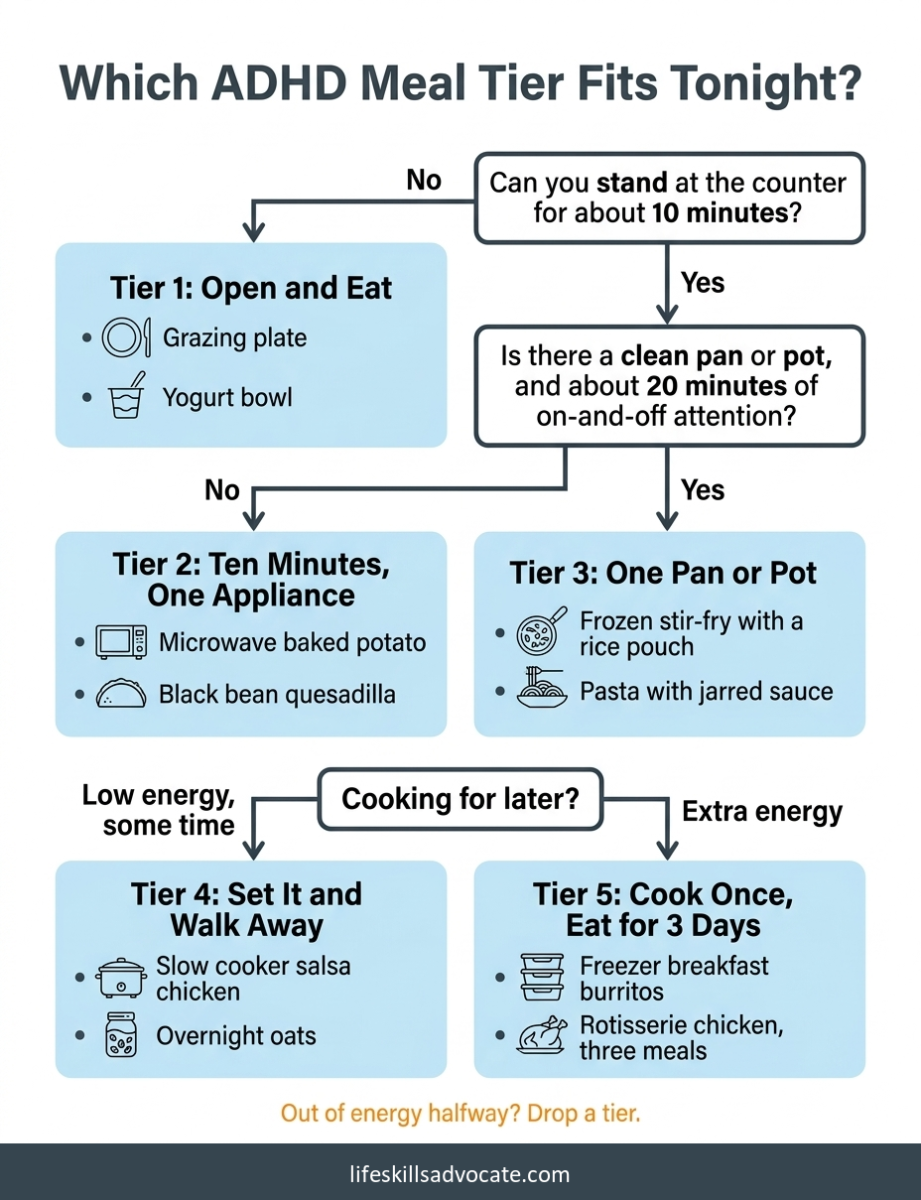
Energy also shifts partway through. The pasta water is on, and suddenly there’s nothing left. The tortilla and cheese for a quesadilla are still in the fridge, so starting in Tier 3 and finishing in Tier 2 still ends with dinner. Dropping a tier halfway is part of the plan.
The Neurodivergent-Friendly Cookbook by Chris Hanson and Amy Sippl (BCBA) rates recipes the same way. Every recipe carries a Brain Power Meter, a battery icon with four levels, from nearly empty to full, for how much executive function it takes.
20 ADHD Meals, Grouped by How Much Energy They Take
These 20 ADHD meals run from no cooking at all to one big batch that covers three days.
Tier 1: Open and Eat (No Cooking)
No stove, no pan, under five minutes, and nothing to wash but a plate or a bowl.
- Grazing plate. Cheese, crackers, a piece of fruit, and lunch meat or a handful of nuts on one plate. Any mix of something salty, something filling and something fresh works.
- Tuna or chickpeas, straight from the can. Drain, squeeze on some lemon or stir in a spoon of mayo, and scoop it up with crackers. A pull-tab can skips the can opener.
- Yogurt bowl. Yogurt topped with granola and a handful of frozen berries, which soften while you find a spoon.
- Peanut butter and banana roll-up. Peanut butter spread on a tortilla, a banana laid on top, rolled up. It holds together better than a sandwich when it’s eaten standing up.
The Neurodivergent-Friendly Cookbook has a no-cook chapter, “Beyond the Basics,” with meals built the same way, including Extra Easy Charcuterie and Tuna Salad with Crackers.
A plate like this is dinner.
Tier 2: Ten Minutes and One Appliance
One appliance does most of the work here: a microwave, a toaster or one pan, for about ten minutes.
- Microwave baked potato. Poke a potato a few times with a fork and microwave it until soft, usually 4 to 5 minutes for one potato, turned over halfway. A big potato or a weaker microwave takes longer. Top it with butter and cheese, canned chili, or beans and salsa.
- Black bean quesadilla. A tortilla, shredded cheese and a scoop of rinsed canned black beans, folded and heated in a dry pan for a few minutes per side. The microwave makes a softer version.
- Ramen with frozen vegetables and an egg. Add a handful of frozen vegetables to the pot with the noodles, then crack in an egg and let it cook until the white is set.
- Peanut butter toast toppers. Toast with peanut butter and sliced banana, a drizzle of honey or a few raisins.
The cookbook’s “I Just Need to Eat” chapter is built for this tier, and its “3 Ingredients or Less” chapter has a 7 Minute Baked Potato.
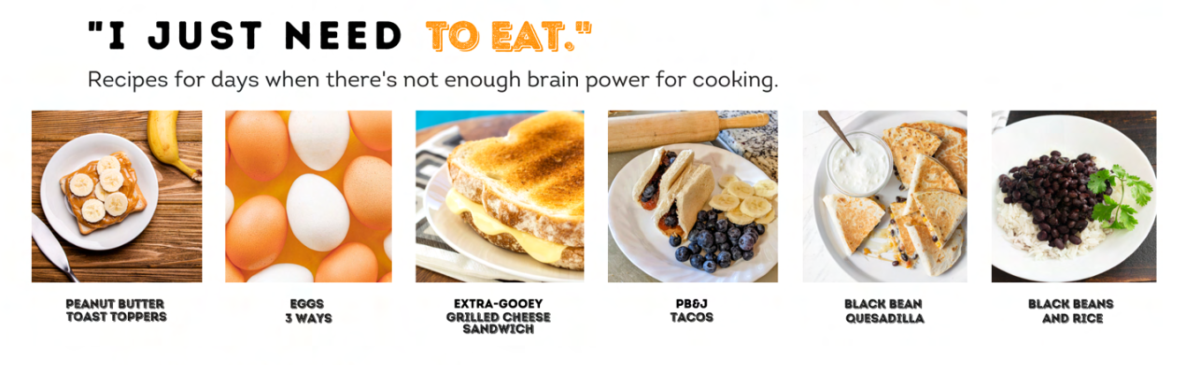
From the cookbook’s “I Just Need to Eat” chapter: six recipes, each with a photo for every step.
Tier 3: One Pan or Pot, 20 Minutes or Less
Frozen vegetables carry a lot of this tier, and they’re a fair stand-in for fresh. A 2017 study comparing fresh, frozen and fridge-stored produce found no significant difference in the vitamins it measured in most comparisons, and frozen came out ahead of produce kept five days in the fridge more often than the reverse. (The study had a frozen food industry partner.)
Getting everything out on the counter before the heat goes on is one of the simplest ways to make cooking executive function friendly. Start the rice or the pasta water first, so the pieces finish together.
- Frozen stir-fry with a rice pouch. A bag of frozen stir-fry vegetables, a protein if there is one (leftover chicken, a scrambled egg, a drained can of chickpeas), bottled stir-fry sauce and a microwave rice pouch or leftover rice.
- Heat a little oil in a pan.
- Add the vegetables and the protein, and stir now and then until hot, following the time on the bag.
- Heat the rice while the pan works.
- Stir in the sauce at the end and serve it over the rice.
- Scrambled eggs with whatever’s in the fridge. Eggs plus the last of the cheese, spinach, ham or salsa, with toast.
- Put the bread in the toaster.
- Beat two or three eggs with a fork.
- Cook them in a buttered pan over medium-low heat, stirring, for about five minutes, until just set.
- Stir in the extras for the last minute.
- Pasta with jarred sauce and frozen spinach. One pot, one colander.
- Boil the pasta for the time on the box.
- Drain it and put it back in the pot.
- Stir in jarred sauce and a handful of frozen spinach over low heat until everything’s hot.
- Black beans and rice. A can of seasoned black beans over rice, with cheese, salsa or a fried egg on top.
- Microwave a rice pouch, or use leftover rice.
- Warm the beans in a small pot or the microwave.
- Spoon them over the rice and add a topping.
The cookbook’s “One Pot Wonders” chapter fits this tier too.
Tier 4: Set It and Walk Away
The work here takes five or ten minutes up front. Then an oven, a slow cooker or the fridge does the rest.
- Sheet-pan sausage and vegetables. Sliced precooked sausage and a bag of frozen vegetables. An air fryer does the same job in smaller batches, but the oven works fine.
- Heat the oven to 425°F and line a sheet pan.
- Spread out the sausage and the frozen vegetables, then add oil and salt.
- Roast until the vegetables brown, usually 20 to 35 minutes, with a stir halfway.
- Slow cooker salsa chicken. Chicken breasts and a jar of salsa. Serve it in tortillas, over rice or on a baked potato.
- Put thawed chicken breasts in the slow cooker.
- Pour the salsa over them.
- Cook on low until the chicken shreds with a fork, then shred it into the sauce.
- Slow cooker chili. Canned beans, canned diced tomatoes, a jar of salsa or a chili seasoning packet, and browned ground meat or one more can of beans.
- Brown the meat in a pan, or skip it and add another can of beans.
- Put everything in the slow cooker and stir.
- Lid on, cook on low, and leave it.
- Overnight oats. By morning the fridge has done the work.
- Stir equal amounts of oats and milk together in a jar.
- Add a spoon of peanut butter or yogurt.
- Put the lid on and leave it in the fridge overnight.
One safety step matters for the slow cooker meals. The USDA’s slow cooker guidance says to always thaw meat or poultry before it goes in, so move the chicken from the freezer to the fridge the night before. Chili and salsa chicken also work in a pot on the stove for anyone without a slow cooker.
The cookbook’s “Slow-Cooker Superstar” chapter has its own Slow-Cooker Salsa Chicken and Apple Cinnamon Overnight Oats.
Tier 5: Cook Once, Eat for 3 Days
This is the tier for a day with extra energy, or for anyone who likes cooking and would rather do it in one go. An hour or so in the kitchen on a big batch can feed the next three days.
- Freezer breakfast burritos. A dozen eggs, cooked sausage or beans, cheese and tortillas. It’s also a good way to use up sausage or eggs that need eating.
- Scramble the eggs with the sausage or beans and the cheese.
- Let the mix cool a little, then roll it into tortillas.
- Wrap each one and freeze it.
- To eat one, take off any foil and microwave it until hot.
- One rotisserie chicken, three meals. No cooking on night one, and 10 to 20 minutes on the next two.
- Night one: pull the meat off the bones and make tacos. Put the rest in the fridge.
- Night two: rice bowls with frozen stir-fry vegetables.
- Night three: the rest goes into a pot with broth and frozen vegetables for soup.
- A big pot of rice and beans, in portions. Each container becomes a Tier 2 meal later: microwave, top, eat.
- Cook a large batch of rice and beans.
- Split it into single containers and get them in the fridge within 2 hours.
- Keep a few in the fridge and freeze the rest.
- Slow cooker pulled pork. A pork shoulder and barbecue sauce, for sandwiches, bowls and quesadillas over the next few days.
- Put the pork and sauce in the slow cooker on low for most of the day.
- Shred it with two forks and stir it into the sauce.
- Freeze whatever won’t get eaten in the next few days.
Timing keeps a batch useful. Leftovers keep 3 to 4 days in the fridge or 3 to 4 months in the freezer, according to the USDA’s guide to leftovers, and cooked food should go in the fridge within 2 hours. Freezing some portions on day one means the batch is still good on day five.
Most of these scale up for a partner or kids with no extra steps. Double the cans.
All 20 ADHD Meals at a Glance
All 20 ADHD meals in one place, with the equipment each one needs. A slow cooker and an air fryer are handy, not required.
| Meal | Energy tier | About how long | What you need |
|---|---|---|---|
| 1. Grazing plate | 1: Open and eat | Under 5 min | A plate |
| 2. Tuna or chickpeas from the can | 1: Open and eat | Under 5 min | Crackers, a can opener or pull-tab can |
| 3. Yogurt bowl | 1: Open and eat | Under 5 min | A bowl |
| 4. Peanut butter and banana roll-up | 1: Open and eat | Under 5 min | A knife |
| 5. Microwave baked potato | 2: Ten minutes | About 5 min | Microwave |
| 6. Black bean quesadilla | 2: Ten minutes | About 10 min | One pan or microwave |
| 7. Ramen with vegetables and an egg | 2: Ten minutes | About 10 min | One pot |
| 8. Peanut butter toast toppers | 2: Ten minutes | About 5 min | Toaster |
| 9. Frozen stir-fry with a rice pouch | 3: One pan or pot | About 15 min | One pan, microwave |
| 10. Scrambled eggs with fridge leftovers | 3: One pan or pot | About 10 min | One pan, toaster |
| 11. Pasta with jarred sauce and spinach | 3: One pan or pot | About 20 min | One pot, colander |
| 12. Black beans and rice | 3: One pan or pot | About 15 min | Small pot or microwave |
| 13. Sheet-pan sausage and vegetables | 4: Walk away | 5 min, then 20 to 35 in the oven | Oven, sheet pan |
| 14. Slow cooker salsa chicken | 4: Walk away | 5 min, then hours unattended | Slow cooker or a pot |
| 15. Slow cooker chili | 4: Walk away | 10 min, then hours unattended | Slow cooker or a pot |
| 16. Overnight oats | 4: Walk away | 5 min the night before | A jar, the fridge |
| 17. Freezer breakfast burritos | 5: Cook once | An hour or so, once | One pan, freezer |
| 18. Rotisserie chicken, three meals | 5: Cook once | 10 to 20 min a night | A pot, a pan |
| 19. Rice and beans in portions | 5: Cook once | An hour or so, once | A big pot, containers |
| 20. Slow cooker pulled pork | 5: Cook once | 15 min, then most of a day | Slow cooker |
Want a vegetable on the side? Baby carrots, snap peas, a bag of salad or microwaved frozen vegetables all skip the chopping.
Build a Default ADHD Meal Menu
Deciding what to eat takes energy too, and evening is often when there’s least of it. A default ADHD meal menu does that deciding ahead of time: one go-to meal per tier, written down once.
It’s a menu, not a schedule. Nothing is assigned to Tuesday, so a skipped night doesn’t break anything. The same five meals can stay on repeat for as long as they keep working.
Copy this into a phone note and fill in the blanks:
Ten minutes: ________
One pan: ________
Walk away: ________
Cook once: ________
For a paper version, the free Weekly Menu Planner fits a week of meals on one sheet and can live on the fridge door. Anyone who wants the full planning routine, with grocery lists and a weekly rhythm, will find it in these meal planning tips for neurodivergent eaters.
Keep the note where the decision happens: the phone’s home screen, or taped inside a cabinet door.
When the Steps Themselves Are the Hard Part
Some nights the meal is picked, the ingredients are in the kitchen, and the recipe is what stops dinner. Eight steps written as one paragraph, with “while that simmers” tucked into the middle, ask for a lot of holding things in your head at once.
The Neurodivergent-Friendly Cookbook
Every recipe shows its total time and a Brain Power Meter rating, lists ingredients and supplies as photos with checkboxes in the order you use them, and gives each step its own photo. Step 1 is always “read it through,” so nothing surprising turns up halfway.
Best for: Adults who want recipes broken into short steps, with a picture for each. It is a digital PDF ($19.99 at the time of writing; prices can change) with a paperback option, and it teaches recipes rather than planning your week.
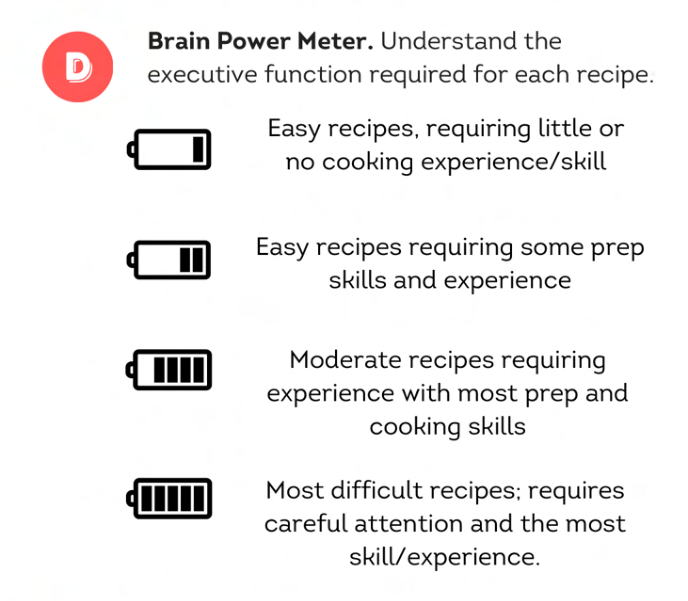
The Brain Power Meter: every recipe in the cookbook is rated on this four-level scale.
Other Cookbooks Worth a Look
Two newer cookbooks take on ADHD meals and low-energy cooking from different angles. The ADHD Recipe Book by Jacqueline Galanty, a dietitian, sorts its recipes by need (no-cook, 30 minutes or less, one-pot and batch cooks) and lists the equipment before each recipe starts. It also covers hunger cues and meal planning, with more nutrition guidance than this article gives.
Spoons: A Neurodivergent-Friendly Cookbook by Phoebe Jordan, an autistic adult and researcher, sorts recipes by “spoons,” a way of counting the energy you have, and by texture: chewy, crunchy, soft, hot and cold. It suits anyone for whom texture matters as much as energy.
For a free option, Goblin Tools has two tools that fit here. The Chef suggests a dish from the ingredients you type in, and you can add details like the equipment you have or the time you’ve got. Magic ToDo breaks a task into smaller steps, so a recipe step that feels too big can be pasted in and split into several small ones.
Neither one shops or cleans up, sadly.
Quick Facts Behind These ADHD Meals
| Quick facts behind these ADHD meals | What it means at home | Source |
|---|---|---|
| Cooking a meal draws on planning, multitasking, remembering to do things later, and finishing steps on time. | A recipe with many steps uses more executive function than its cook time suggests. | Doherty et al., 2015 |
| In a 2017 lab comparison, frozen produce showed no significant vitamin difference from fresh in most comparisons. | Frozen vegetables are a fair swap for fresh. | Li et al., 2017 |
| Leftovers keep 3 to 4 days in the fridge or 3 to 4 months in the freezer. | Cook once on a good day and eat it within that window. | USDA FSIS, Leftovers and Food Safety |
| Cooked food should be refrigerated within 2 hours. | Put leftovers away before the next thing pulls you out of the kitchen. | USDA FSIS, Leftovers and Food Safety |
| Meat or poultry should be thawed before it goes in a slow cooker. | Frozen-meat “dump” meals need a thaw step the night before. | USDA FSIS, Slow Cookers and Food Safety |
FAQ
What are easy ADHD meals for days with no energy at all?
The no-cook meals in Tier 1 are built for these days: a grazing plate, tuna or chickpeas from the can with crackers, a yogurt bowl with granola and frozen berries, or a peanut butter and banana roll-up. None of them needs a stove or a pan, and the only cleanup is a plate or a bowl. Cheese, nuts, lunch meat or a hard-boiled egg are the parts that make these plates filling.
Do people with ADHD eat the same thing every day?
Plenty do. Eating the same breakfast or the same lunch on repeat takes a decision out of the day, and a meal that’s always the same is easy to shop for, easy to start and hard to get wrong.
For some people that keeps working for years. For others, a food that was easy for weeks or even months stops appealing one day with no warning at all, and there’s no reliable way to know ahead of time which way it will go. Keeping one swap in mind for each repeat meal helps, though the swap can wear out too.
Does a snack plate count as a meal?
Yes, it’s dinner. A plate with a protein, something filling like crackers or bread, and a fruit or vegetable covers the same ground as a cooked dinner.
Are some ADHD meals better than others?
Not in a way a meal list can rank. How specific foods or diets relate to ADHD is a separate question from what to make tonight, and it’s outside what a meal list can answer well. For how food and executive function connect, nutrition and executive function covers that ground.
What if you like cooking but planning is the problem?
Keep the cooking and hand off the deciding. A default menu with one meal per tier means the choice is already made when the evening arrives, and the shopping list is the same list most weeks.
Then use the days with energy for the part you enjoy. A Tier 5 batch on a Sunday, or a new recipe tried on a slow Saturday, gives the cooking somewhere to go without needing a weekly plan behind it. If a plan falls apart after a week, the menu is still there.
Some people also find it easier to plan out loud than alone on paper, with someone they choose: a partner, a friend or a coach. Talking it through gets the plan made, the person cooking still decides what goes on it, and the cooking stays the fun part.
Next Steps
Tonight’s meal matters more than the system that gets built this weekend.
- Tonight, answer the three tier questions and pick one meal from that tier. Nothing to buy or print.
- Write your five-line default menu in a phone note, or print the free Weekly Menu Planner and put it on the fridge.
- If step-by-step photos would help, The Neurodivergent-Friendly Cookbook lays out every recipe in short steps, each with a photo.
- Deciding and planning still taking over most evenings? Executive function coaching works on that part directly, building a food routine around your actual week. Coaching is skill-building, not therapy.
Further Reading
- The Cooking Task: Making a Meal of Executive Functions – Doherty et al., Frontiers in Behavioral Neuroscience
- Selected Nutrient Analyses of Fresh, Fresh-Stored, and Frozen Fruits and Vegetables – Li et al., Journal of Food Composition and Analysis
- Leftovers and Food Safety – USDA Food Safety and Inspection Service
- Slow Cookers and Food Safety – USDA Food Safety and Inspection Service
- The ADHD Recipe Book – Jacqueline Galanty
- Spoons: A Neurodivergent-Friendly Cookbook – Phoebe Jordan
- Goblin Tools – Goblin Tools
- The Chef – Goblin Tools
- Executive Functioning Skills 101: The Basics of Task Initiation – Life Skills Advocate
- Why Does the Wall of Awful Make Easy ADHD Tasks Feel Impossible? – Life Skills Advocate
- 6 Executive Function Patterns Behind ADHD and Eating Disorders – Life Skills Advocate
- 10 Ways to Make Cooking Executive Functioning Friendly – Life Skills Advocate
- 16 Meal Planning Tips for Neurodivergent Eaters – Life Skills Advocate
- Nutrition and Executive Function: What to Eat for Better Focus – Life Skills Advocate
- Weekly Menu Planner (free printable) – Life Skills Advocate
- The Neurodivergent-Friendly Cookbook – Chris Hanson and Amy Sippl
- Executive Function Coaching for Adults – Life Skills Advocate