
By the time I have figured out what I want to say, the conversation has already moved on. Two topics on, usually. It is not that I did not understand what was said. I understood fine. My brain just takes the room in slower than the room moves, so by the time my response is ready, it is too late to be worth saying out loud.
That lag has a name. Slow processing speed is how long it takes you to take in information, make sense of it, and respond, and for some of us that whole loop runs slower than the pace everyone else seems to keep. It shows up worst in fast, live moments: meetings, group chats, the quick back-and-forth where you are supposed to have an answer ready before the question is even finished.
What follows is what this actually feels like from the inside, why neurodivergent brains often run this way, and the moves that help when you are in the thick of it. Not a definition written for somebody’s parents. The lived version, and what to do about it.
TL;DR
Slow processing speed means your brain takes longer to take in, make sense of, and respond to information, even when you understand it fine. The short version:
- It is common in ADHD and autism, and separate from how smart you are.
- It shows up worst in fast, real-time moments like meetings and group conversations.
- What helps is not pushing your brain to go faster. It is lowering the load and giving yourself more time.
- The 8 strategies below start with live conversations, then move to work and meetings.
This is lived experience and coaching perspective, not medical advice. If processing speed is something you are working through with a professional, treat this as a supplement to that conversation, not a replacement for it.
What Slow Processing Speed Actually Feels Like
Slow processing speed feels like being a half-step behind in a room that does not wait for you.
Someone asks a question. Your brain starts working on it. And while you are still assembling the answer, the discussion has rolled forward without you.
You land on the perfect thing to say right as everyone stands up to leave. The thought was good. The timing was useless.
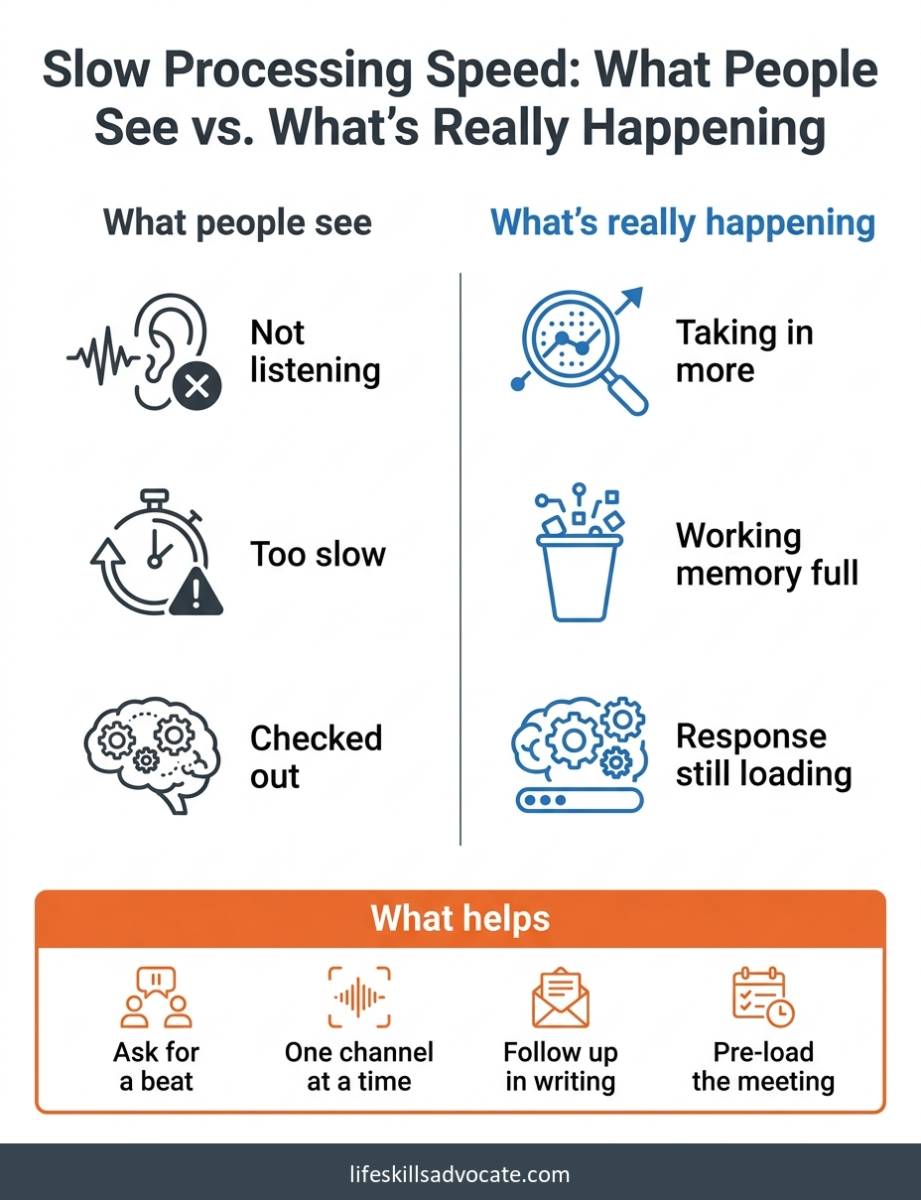
It is not a comprehension problem. Processing speed describes how long it takes to take in information and act on it, not how well you understand it. You can follow every word and still need an extra beat to use them.
In daily life it shows up in a few familiar ways. You ask people to repeat themselves, not because you missed the words but because you needed a second pass to use them. Multi-step instructions arrive as one blur and you only catch the first step. You go quiet in fast group conversations, because the gap between one person finishing and the next jumping in is shorter than your turnaround.
And it is tiring. Matching a pace your wiring does not match means running a background process all day just to keep up.
The hardest part is not the lag itself. It is getting read as not listening, not interested, or not that bright, when the truth is you are doing more work than the people who answered first.
Why Neurodivergent Brains Process Slower
This is not one thing with one cause. It is what happens when there is more to take in per moment than there is time to take it in, and neurodivergent brains tend to hit that wall sooner. A few mechanisms stack up.
The Working Memory Squeeze
Processing speed and working memory are tightly linked. Working memory is the mental sticky-note that holds information while you use it, and it has a limited surface. When new input arrives faster than you can process what is already up there, the note overflows and you lose the thread. Slowing down is partly your brain protecting what it already has. Here is how working memory works if you want the deeper version.
ADHD: Fast Brain, Slow Output
People are surprised that ADHD can mean slow anything, given the reputation for speed.
But ADHD involves variation across several thinking domains, and processing speed is one of the areas that commonly varies. The pattern a lot of ADHDers know is a fast inner world paired with slow output. Ideas everywhere, but packaging one and getting it out of your mouth on demand takes longer than the room allows. For folks who are both autistic and ADHD, the two can compound, which is part of how this plays out for AuDHD adults.
Autism: More Detail Per Moment
For a lot of autistic people, the brain is not slow. It is taking in more. More detail, more sensory information, more of everything per second.
When you register more, you have more to sort through before you respond, and from the outside that extra sorting can read as a delay. It is not a delay in understanding. It is a fuller plate.
| Term | What it means |
|---|---|
| Processing speed | How quickly you take in information, make sense of it, and respond. |
| Slow processing speed | When that take-in, understand, respond loop runs slower than the pace around you, even though your comprehension is intact. |
| Working memory | The mental sticky-note that holds information while you use it. It can overflow when input arrives faster than you can process it. |
| Real-time processing | Making sense of information as it arrives live, with no chance to pause, like a fast conversation or a meeting. |
Slow Processing Speed Isn’t Low Intelligence
This is the part worth saying plainly, because it does the most quiet damage when nobody says it.
Slow processing speed is not low intelligence. How fast you process and how well you reason are measured separately, and you can have plenty of one while the other runs slow. One description from the community that stuck with me calls it a Mercedes running at Pinto speed. The engine is fine. The road just goes by slower.
The Davidson Institute makes the same distinction: how fast you process and how deeply you reason are different abilities, and one tells you little about the other. People who think carefully and land on genuinely good answers are sometimes the slowest to get there in real time, precisely because they are doing more with the information.
There is a limit to this, though. Knowing the distinction does not make the misreads stop. People will still mistake your pause for a blank.
What the reframe gives you is the accurate read. Your brain takes a different amount of time, and the rest of this is about working with that instead of fighting it.
8 Strategies for Real-Time Conversations
You cannot make your brain process faster on command, and the moves that help do not try to. They lower the load and buy you time, which is a far more reachable goal. These are the ones I lean on most.
1. Buy Yourself a Beat
The most useful thing is having a few honest phrases ready, so a pause does not turn into panic. You say them on autopilot, which protects the processing time you actually need. A few that work:
- “Give me a second to think about that.”
- “Good question. Let me sit with it for a beat.”
- “I want to answer that well, so let me catch up.”
None of these are stalling. They reframe a delay as a deliberate choice, out loud, which most people respect more than a rushed half-answer.
2. Cut the Simultaneous Load
The fewer things firing at once, the more bandwidth is left for processing.
A noisy room, a buzzing phone, and three side conversations are not background. They are all competing for the same limited resource. Cutting even one frees up real capacity, which is partly a matter of attentional control and partly just managing your environment. A pair of noise-cancelling headphones in a loud open office is not a luxury here. It removes a whole channel of competition for your attention.
3. Follow Up in Writing
Real-time is the worst format for a slow-processing brain, so move the important stuff off real-time when you can. After a fast conversation, a short follow-up message lets you say the thing you only fully formed twenty minutes later. “Thinking about what we discussed, here is what I would add” is a complete and completely legitimate move. Your best contribution does not have to happen at conversation speed to count.
4. Pre-Load the Recurring Conversation
A lot of real-time moments are not surprises. The weekly check-in, the standing meeting, the talk you know is coming all let you do the work in advance, when you have time, instead of live, when you do not. Before one, it helps to get it out of your head first so you walk in with your points already half-built. Our free Brain Dump worksheet is made for this kind of offloading.
Handling Work and Meetings
Work is where slow processing speed gets expensive, because so much of it runs on fast verbal response. The meeting where the quickest answer wins. The question fired at you with the whole table watching. Most of the fix is structural: you design the conditions instead of white-knuckling the moment.
5. Get the Agenda First
Ask for an agenda before any meeting where you will be expected to contribute. It takes the organizer a couple of minutes, and it changes everything for you, because it moves the thinking from live to beforehand. You walk in having already chewed on the topics instead of meeting them cold while the clock runs.
6. Ask for Async
Not everything needs to be a meeting, and the things that do not are the things slow processing handles worst.
Where you can, push a decision to a shared doc or a message thread, where you get to read, think, and respond on your own clock. Async is not a workaround to feel sheepish about. It often produces better answers from everyone, not only the people who process slowly.
7. Design Your Inputs
Pay attention to how information reaches you, and shape it on purpose. Ask for instructions in writing so you can reread them instead of holding a verbal blur in working memory. Block focus time so input is not constant. Some of this overlaps with managing time blindness, since both take something your brain handles poorly in the moment and build external structure around it.
8. Pick Roles That Fit Slow-and-Deliberate
Where you have a choice, lean toward work that rewards depth and accuracy over instant reaction. Roles that let you prepare, that value the careful answer over the fast one, that run on documents instead of rapid-fire meetings, all play to a slow-deliberate brain rather than against it. The same trait that is a real cost on a trading floor is barely a factor in work built around considered output.
How to Explain Slow Processing Speed to People
Private coping only goes so far.
At some point it helps to say the thing out loud to a partner, a manager, or a friend, because an unexplained pause gets filled in with the worst guess, and people cannot meet a need they do not know about.
You do not owe anyone a diagnosis or a lecture. A plain sentence does the work: “I process things a little slower than I talk, so I might go quiet for a second before I answer. That is me thinking, not me checking out.” Said once, calmly, it reframes every future pause for that person. At work it can be even simpler: “Send me the agenda ahead of time and I will come in with much better input.”
If asking for what you need in the moment is its own struggle, that is a normal place to get support. Working with an executive function coach for adults is one way to practice the scripts and build the systems until they feel like yours instead of something you brace for.
Frequently Asked Questions
Is slow processing speed part of ADHD?
Often, yes. Many people with ADHD process more slowly, particularly with the inattentive presentation, and the fast-brain, slow-output pattern is common enough to feel like a signature. That said, it is not unique to ADHD. Plenty of people have it without ADHD, and plenty of people with ADHD do not experience it strongly. It is one ingredient in the picture, not proof of a diagnosis.
Can you have a high IQ and slow processing speed?
Yes. Reasoning ability and processing speed are measured separately, so you can grasp something deeply and still take longer to produce a response.
Is slow processing speed a disability?
It depends on how much it affects daily life, and that is a genuinely unsettled question rather than one with a clean answer.
For some people it reaches the point where formal workplace or school accommodations apply and genuinely help, things like extra time, written instructions, or advance agendas. In that case the label can be what gets you the support.
For other people it sits more in the range of a trait to design around, no paperwork required, handled with the kind of environment changes in this article.
The same person can even land in different places at different stages of life, depending on the demands they are under. Where your own experience falls is worth taking seriously, on its own terms, rather than forcing into a yes or no.
What jobs are a good fit if you process slowly?
Roles that reward depth and accuracy over instant reaction, and that allow some prep or async time, tend to fit better than high-speed, high-interruption ones. What matters is less the specific industry than whether the work lets you think before you answer.
Can you improve slow processing speed?
You can get more done and feel less behind, but it is worth being clear about how. The lever that works is reducing the load and building supports, not training your brain to run at someone else’s clock speed. Brain-training products that promise to speed up your processing have weak evidence behind them and are mostly a sales angle. The durable gains come from working with how your brain takes in information: shaping your inputs, protecting your timing, and lowering what you have to handle live.
Where to Start
You do not have to overhaul anything to feel a difference. A few small, specific moves go a long way.
- Pick one recurring conversation this week and try the buy-a-beat line in it. One situation, one phrase, and notice what changes.
- Cut a single source of simultaneous load. Mute notifications during your next meeting, or put on headphones in a loud room, and see how much more bandwidth you have.
- Map where it costs you most with the free Executive Functioning Assessment, which helps you see which skills are carrying the load.
- If you want a partner in building these systems, executive function coaching for adults is a practical, skill-focused option, and a different thing from therapy. It is about structure and tools, not mental health treatment.
Further Reading
- Processing Speed: What You Need to Know – Understood
- Understanding, Diagnosing, and Coping With Slow Processing Speed – Davidson Institute
- Attention-Deficit/Hyperactivity Disorder (primer) – Faraone et al., Nature Reviews Disease Primers
- Executive Functioning Skills 101: Working Memory – Life Skills Advocate
- AuDHD and Executive Function in Daily Life – Life Skills Advocate
- Executive Functioning 101: Attentional Control – Life Skills Advocate
- Time Blindness and ADHD – Life Skills Advocate
- 8 Best Noise Cancelling Headphones for Neurodivergent Teens – Life Skills Advocate
- How Brain Dumping Can Improve Executive Functioning – Life Skills Advocate
- Brain Dump Worksheet (free) – Life Skills Advocate
- Free Executive Functioning Assessment – Life Skills Advocate
- Executive Function Coaching for Adults – Life Skills Advocate