
Making Coaching More Affordable
Cost is a real factor when you are deciding on support. Executive function coaching with Life Skills Advocate is a private-pay, non-clinical service, so it's not covered by health insurance.
Many clients are still able to lower their out-of-pocket cost through. Click any option to jump to that section:
- Flexible Spending Accounts (FSA) or Health Savings Accounts (HSA)
- Employer or Employee Assistance Programs (EAP)
- Our partnership with the Canopy Neurodiversity Foundation for qualifying Washington State adults
This page walks you through each option step-by-step.
Option 1: Using an FSA or HSA for coaching
What This Option Is
Executive function coaching may be considered a reimbursable expense under a Flexible Spending Account (FSA), Health Savings Account (HSA), or Health Reimbursement Arrangement (HRA) when it is prescribed as part of treatment for a medical condition such as ADHD or autism. In many plans, coaching is treated as “lessons” or “learning disability treatment” that require a Letter of Medical Necessity from a medical practitioner.
Limited-purpose FSAs (LPFSA) and Dependent Care FSAs (DCFSA) usually do not cover this category.
We do not bill your FSA or HSA directly. Instead, clients typically pay for sessions and then submit documentation to their plan for reimbursement.
Who this may help
You may want to explore this option if:
- You (or your child) have a formal diagnosis related to executive functioning, such as ADHD, autism, or a related condition.
- The person paying for coaching participates in an FSA, HSA, or HRA through an employer.
- Your plan allows reimbursement for lessons or skill-building supports when they are medically necessary.
How To Get It
- Confirm your account. Log in to your benefits portal or contact HR to confirm that you have an FSA, HSA, or HRA and whether “lessons” or similar services can be covered with a Letter of Medical Necessity.
- Talk with your medical provider. Schedule a visit with the clinician who manages your ADHD, autism, or related diagnosis. Share that you are considering executive function coaching as part of your support plan.
- Provide information to your clinician. In case your provider is unfamiliar with executive function coaching, bring our Information Sheet for Practitioners to your appointment.
- Request a Letter of Medical Necessity (LMN). If your provider agrees that coaching is appropriate, ask them to complete a Letter of Medical Necessity that:
- States the diagnosis
- Explains why coaching is medically necessary
- Describes how coaching will help
- Specifies the expected duration of coaching
- Submit your LMN and receipts. Send the LMN to your plan administrator following their instructions. After each session, you can submit your Life Skills Advocate receipts for reimbursement, as long as your plan approves the expense.
We cannot guarantee reimbursement, and final decisions always rest with your benefit plan.
Option 2: Employer or Employee Assistance Program (EAP) reimbursement
What This Option Is
Many employers offer an Employee Assistance Program as part of their benefits package. EAPs are designed to support employees with personal or work-related challenges and often include limited-session counseling, wellness support, and sometimes coaching or related services.
Some of our clients have successfully received reimbursement for executive function coaching through:
- An EAP that covers coaching or skill-building services
- A professional development or wellness benefit that reimburses coaching
Coverage, number of sessions, and rules vary widely between employers.
Who this may help
You may want to explore this option if:
- You are currently employed (full-time or part-time)
- Your employer offers an EAP, wellness benefit, or professional development fund
- You are comfortable talking with HR or an EAP representative about coaching
How To Get It
- Review your benefits. Check your employee handbook or benefits portal for EAP, wellness, or professional development benefits.
- Ask clear, concrete questions. When you contact HR or your EAP provider, questions like these can help:
- Does my plan cover coaching with an external provider for ADHD or executive function support?
- How many sessions are covered, and at what rate?
- Do I need pre-approval or a referral?
- What documentation do you require from the coach?
- Get any approvals in writing. If your employer or EAP says coaching can be reimbursed, ask for the approval details by email or through your benefits portal.
- Schedule coaching and save your documentation. You will pay Life Skills Advocate directly. We can provide itemized receipts and session dates for you to submit to your employer or EAP.
We cannot guarantee that an employer or EAP will reimburse coaching, even if other clients have had success with similar plans.
Option 3: Canopy Neurodiversity Foundation grant funding

What This Option Is
Life Skills Advocate proudly partners with the Canopy Neurodiversity Foundation to reduce financial barriers for qualifying Washington State adults who want career-focused executive function and employment coaching.
Canopy’s Career Coaching Support Program (CCSP) provides funding so neurodivergent adults can work with neuroaffirming coaches to build skills, self-advocacy, and confidence in the workplace.
Grant funds can pay a portion of coaching.
Who this may help
In line with current CCSP information, applicants need to:
- Live in Washington State
- Be 18 years of age or older
- Identify as autistic, ADHD, or have a closely related neurotype
- Be seeking coaching that supports work or career goals, such as job search, workplace communication, time management at work, or maintaining employment
- Have a level of financial need that makes paying full fee difficult (see “How we determine grant amounts” below for a bit more detail)
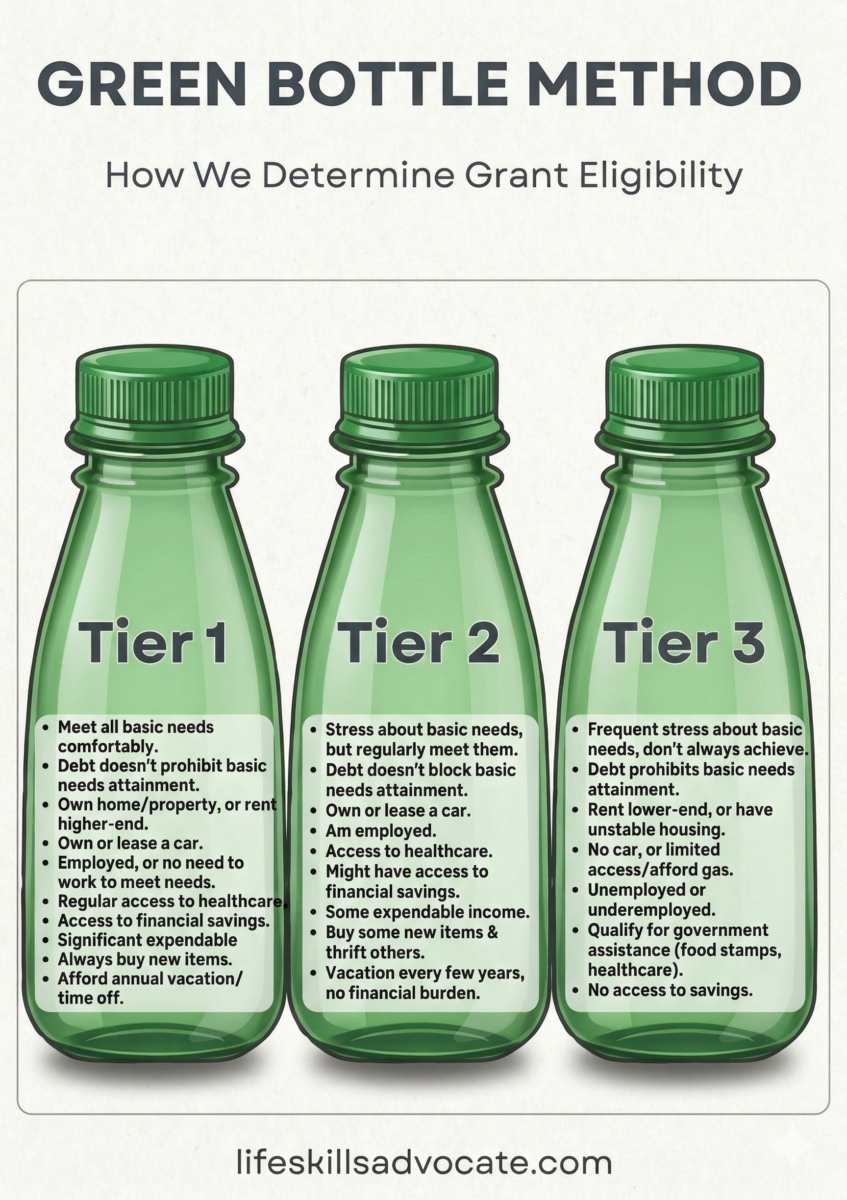
How We Determine Grant Amounts
To keep the process respectful and straightforward, we use the green bottle pricing method (more info) during intake:
- You review a short description of different price “bottles” that represent different levels of financial stretch.
- You choose the bottle that feels most honest for your current situation.
- We combine your selection with a few basic questions about your financial picture to decide what portion of coaching costs can be covered by grant funds and what portion, if any, you contribute.
This helps match support to need without requiring a lot of detailed financial paperwork.
How To Get It
- Check the basic criteria. Confirm that you:
- Live in Washington State
- Are 18 or older
- Are autistic, ADHD, or similarly neurodivergent
- Need coaching that is clearly connected to work or career goals
- Schedule a discovery meeting. Book a complimentary discovery meeting and let us know you are interested in financial aid through the Canopy Neurodiversity Foundation.
- Complete a brief financial aid form. After the discovery meeting, our Client Support Specialist will send you a simple form that includes a short green bottle pricing exercise and a few clarifying questions.
- Review and decision. We review your information and let you know:
- Whether you are eligible for grant funding
- What the grant can cover
- What your out-of-pocket cost, if any, would be
Grant funding is limited and cannot be guaranteed, even if you meet the general criteria, but we will always be clear about your options before you decide to move forward.
Important notes
- Life Skills Advocate provides executive function coaching, not healthcare, therapy, or medical services.
- Information on this page is based on current resources about FSAs, HSAs, EAPs, and the Canopy Neurodiversity Foundation, but individual plans and programs vary.
- Nothing here is tax, legal, medical, or financial advice. Always confirm details with your benefits provider, medical practitioner, or financial professional before making decisions.
- You are welcome to combine options. For example, some clients use FSA funds for part of their cost and a grant or employer benefit for the rest.