
You have had a long, loud day. Your skin feels like it is buzzing, your thoughts will not sit still, and the idea of one more thing touching you sounds awful, except for the specific, heavy pressure of something pressing you back down into yourself.
That is the feeling a lot of autistic and ADHD people are chasing when they look for a weighted blanket for autism or ADHD: not better sleep numbers, but the sense of being held still enough to settle.
Here is the version most product pages skip. The research on weighted blankets and sleep is mixed. What people consistently report is calmer, safer, and less wound-up, and that is a real and worthwhile reason to own one. The catch is that almost every guide online is written for children, so an adult-sized body gets pictures of kids and a blanket that tops out too light to do anything.
This is the guide for the rest of us. We cover how much weight a teen or adult actually needs, how to keep from overheating, what the evidence does and does not support, and 12 blankets we would point real people toward, all sized for adults.
TL;DR
A weighted blanket for autism or ADHD will not solve your sleep on its own, but a lot of autistic and ADHD people find the deep pressure genuinely grounding. Here is what actually matters when you pick one: If a full blanket ever feels too pinning, a weighted stuffed animal offers the same deep-pressure comfort in a smaller, portable form.
- What the research really shows: calmer and less anxious, yes; guaranteed better sleep, not so much.
- How heavy and how large to go for a teen or adult body, using the roughly 10 percent starting point.
- How to match fabric and temperature so you do not wake up sweating.
- Our 12 picks, from budget breathable to premium cooling, every one of them sized for adults.
- How to start using one safely, and cheaper ways to test the feeling before you spend a cent.
This article is educational, not medical advice. A weighted blanket is sensory support, not medical care, and it is deeply individual. Some people love the weight and some cannot stand it, and both are fine.
Does a Weighted Blanket for Autism or ADHD Actually Help Adults?
Short answer: it depends on what you want from one. If you are hoping a weighted blanket for autism or ADHD will knock you out cold every night, the evidence is shaky. If you want something that helps your body downshift when it is overloaded, the case is much stronger, and it lines up with what autistic and ADHD adults say over and over.
The mechanism people point to is deep pressure, the same steady, hug-like input that calms a lot of nervous systems. Temple Grandin built her well-known “hug machine” on exactly this idea. The feeling is easy to recognize even when the science is still catching up to it.
On sleep specifically, the best study is worth knowing about. A 2014 randomized trial in Pediatrics put weighted blankets to the test with autistic children and found no measurable improvement in how long or how well they slept. And yet the children and their parents preferred the weighted blanket anyway, and it was well tolerated. That gap, between what a sleep monitor records and what a person actually prefers, is the whole story of weighted blankets in one finding.
For adults, a 2020 randomized study in the Journal of Clinical Sleep Medicine tested weighted blankets with adults who had insomnia alongside conditions including ADHD, and the weighted-blanket group reported better sleep and less daytime tiredness. It measured how people felt and rated their sleep, which is useful, but it is a subjective outcome, so read it as promising rather than proof.
ADHD gets treated as an afterthought almost everywhere, which is a shame, because the wind-down problem is real. A lot of ADHD adults describe a body that will not stop moving and a brain that will not stop narrating at bedtime, and steady weight gives the restlessness something to push against.
Some people also keep a lighter blanket on the couch or across their lap at a desk, using the pressure during the day to take the edge off. The direct ADHD research is thin and mostly done with children, so we will say plainly that the daytime, wind-down, and lap-pad uses come more from lived experience than from trials.
The most useful way to hold all of this: a weighted blanket is a comfort and regulation tool. Autistic adults describe using one during meltdowns and shutdowns, not only for sleep, because the weight makes a hard moment feel survivable and lets emotion move through without tipping into panic. That is the payoff worth buying for. Better sleep, if it comes, is a bonus.
How to Size a Weighted Blanket for a Teen or Adult Body
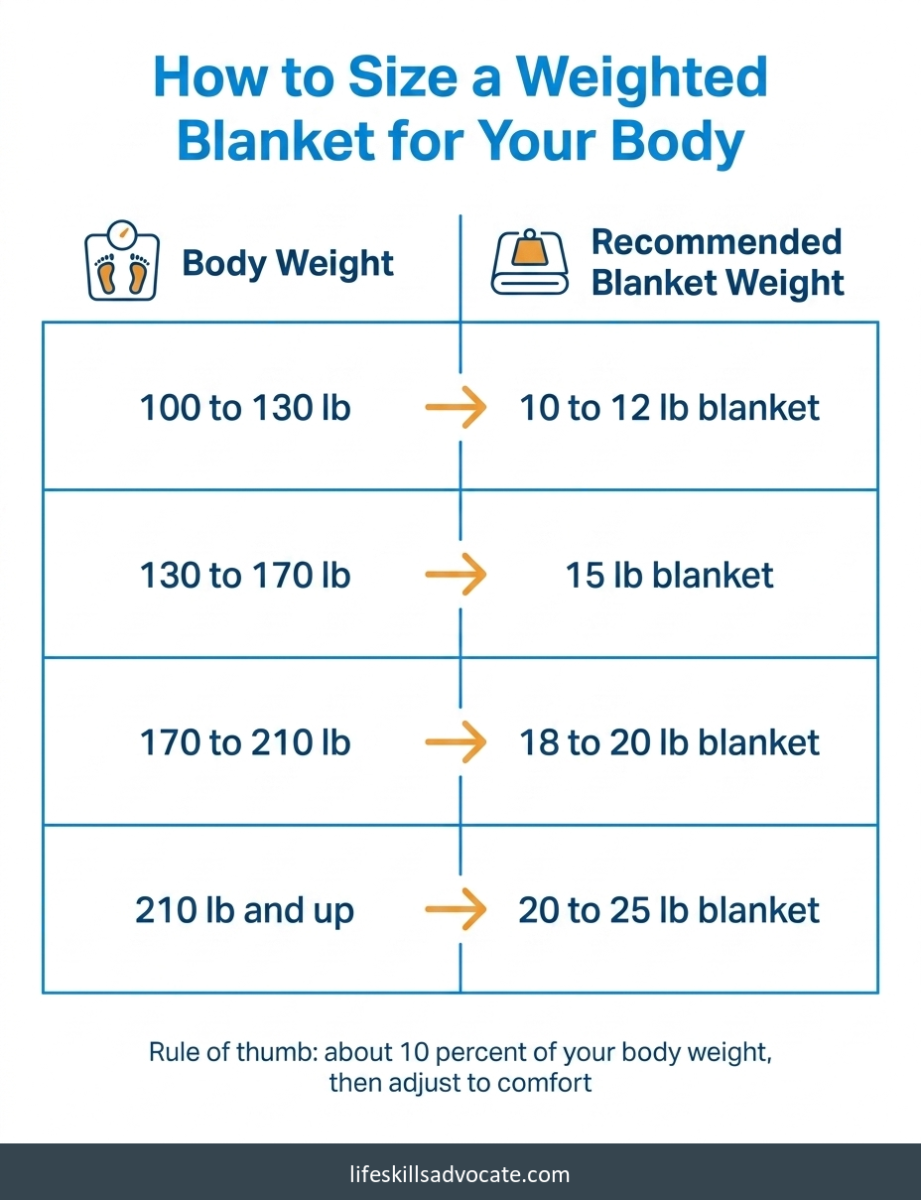
This is where the kid-focused guides fall apart. The common guideline is to pick a weighted blanket that is roughly 10 percent of your body weight, then adjust to what feels good. It is a starting point borrowed from occupational therapy, not a law, so treat the number as a first guess and trust your body over the chart.
The problem is that most popular blankets top out around 15 pounds, which is sized for a 150-pound frame. A 180 to 220-pound adult needs something closer to 20 to 25 pounds to feel that reassuring, pinned-in pressure instead of a slightly heavy sheet. If you have ever tried a weighted blanket and shrugged, an underweight blanket for your body is often why.
Here is the rough map we use, rounding to what is actually sold:
- 100 to 130 pounds: a 10 to 12-pound blanket.
- 130 to 170 pounds: a 15-pound blanket, the most common size.
- 170 to 210 pounds: an 18 to 20-pound blanket.
- 210 pounds and up: a 20 to 25-pound blanket.
Size matters as much as weight. A weighted blanket is meant to sit on your body, not drape off the sides of the bed like a regular comforter, because the weight needs to stay on you rather than sliding to the floor.
For one person, a throw or twin (around 48 by 72 inches) is usually right even on a bigger bed. Only size up to a full or queen blanket if you are sharing it, and know that a shared weighted blanket rarely works well, since it pulls toward whoever moves.
One more note. If you fall between weights, size down rather than up. A blanket that is slightly too light still feels nice, while one that is too heavy feels trapping and gets shoved onto the floor at 2 a.m.
Match the Fabric and Temperature to Your Sensory Needs
For autistic and ADHD folks, the outside of the blanket matters as much as the weight, and this is the part no other guide seems to cover. The single most common complaint we hear about weighted blankets is that they run hot. So before you fall for a photo of a cozy fur throw, think about how your body actually handles temperature and texture.
Run through your own sensory profile first. Do you run warm and kick blankets off, or are you always cold? Does soft fuzzy fabric feel comforting or does it make your skin crawl? Sensory-seeking and sensory-avoidant bodies want opposite things here, and there is no universally “best” fabric, only the one that fits you.
If you are not sure where you land, our free How My Body Pays Attention exercise walks you through mapping your own sensory responses, which is useful before you spend money on a texture you might hate.
Three broad fabric families cover most of what is sold:
- Cooling and breathable (bamboo-style viscose, smooth microfiber, 100 percent cotton). The right call if you run hot or live somewhere warm. These trade a little coziness for staying comfortable all night.
- Smooth and neutral (plain microfiber, cotton). Middle of the road, easy to wash, and the safest bet if bumpy or fuzzy textures bother you.
- Warm and plush (minky, faux fur, sherpa, fleece). Cozy and enveloping for cold sleepers and cold rooms, but they hold heat, so skip them if you overheat.
A few autistic and ADHD adults tell us they own two: a warm one for winter and a cooling one for summer, or a heavy one for bed and a lighter one for the couch. That is a reasonable setup if the budget allows, though it is a want, not a need. If overheating has killed a weighted blanket for you before, a genuinely cooling one changes the whole experience.
12 Best Weighted Blankets for ADHD and Autism
These are the 12 we would recommend to autistic and ADHD teens and adults, every one available in a real adult weight. We lead with the breathable and cooling picks, since overheating is the number-one thing that makes people give up on their blanket, and finish with the warm, plush options for cold sleepers. The comparison table sums up the specs, and each write-up gives our take. Prices shift, so we use tiers: $ is under about $40, $$ is roughly $40 to $90, and $$$ is $90 and up.
| Blanket | Weight / Size | Sensory feel | Temperature | Best for | Price |
|---|---|---|---|---|---|
| ZonLi | 5-25 lb, throw-king | Breathable microfiber weight | Breathable | First-timers who want a well-reviewed budget starter at a true adult weight | $ |
| BETU | 12-25 lb, throw-king | Breathable microfiber weight | Breathable | Bigger adults who need to size up to 20-25 lb | $$ |
| Topblan Cooling | 10-20 lb, twin-queen | Cooling, lightweight weight | Cooling | Warm sleepers who want the coolest option at a low price | $ |
| yescool Cooling | 15-25 lb, twin-queen | Cooling, washable weight | Cooling | Hot sleepers who want cooling plus easy machine washing | $ |
| LiAgraty | 5-20 lb, twin-queen | Breathable microfiber weight | Breathable | Anyone who wants a plain, washable, everyday blanket | $ |
| Bare Home Cotton | 15-25 lb, twin-queen | Natural 100% cotton weight | Breathable | People who prefer natural cotton over synthetic minky | $$ |
| LUXOME | 8-25 lb, twin-king | Premium, removable cooling cover | Cooling | Hot sleepers who will pay more for the easiest-to-clean cover | $$$ |
| Huloo Sleep | 15/20 lb, twin-queen | Soft minky, moderate warmth | Warm | People who want a soft, cozy top without a lot of heat | $ |
| Wemore Minky Dot | 15/20 lb, twin-king | Plush dot-textured weight | Warm | People who find raised-dot texture soothing to touch | $$ |
| Cottonblue Faux Fur | 12/15/20 lb, twin-queen | Warm faux-fur plush | Warm | Cold rooms and anyone who loves a fuzzy, sink-in feel | $$ |
| Uttermara Shaggy | 12/15/20 lb, twin-queen | Warm shaggy faux fur | Warm | A couch blanket that doubles as a decorative throw | $$ |
| YnM Sherpa | 10/15/20 lb, throw-queen | Warm sherpa weight | Warm | The coldest sleepers and winter use | $$ |
1. ZonLi Weighted Blanket (20 lb)
ZonLi Weighted Blanket is the one we point most first-time buyers toward. It comes in nearly every weight from 5 to 25 pounds, so you can hit your actual body-weight target instead of settling for whatever is in stock, and the breathable microfiber does not trap much heat. With more than 23,000 ratings it is about as road-tested as a weighted blanket gets. It is a plain, no-frills blanket rather than a plush one, which is exactly why it works for so many people.
Best for: first-timers who want a well-reviewed, budget-friendly starter at a real adult weight.
2. BETU Weighted Blanket
The BETU Weighted Blanket is the pick for bigger adults, because it runs all the way to 25 pounds when most blankets quit at 15. The glass-bead fill sits in individually sewn pockets, so the weight stays evenly spread instead of sliding into one heavy clump, and the microfiber shell breathes reasonably well. It starts at 12 pounds, so lighter folks are covered too.
Best for: heavier adults who need to size up past the usual 15-pound ceiling.
3. Topblan Cooling Weighted Blanket (12 lb)
The Topblan Cooling Weighted Blanket is the budget answer to the overheating problem. The breathable build is designed to sleep cooler than a standard minky blanket, and the whole thing goes in the wash. It is on the lighter side at 12 pounds, so most adults will want to move up to the 15 or 20-pound version for full pressure. If very hot, humid summers are your reality, no fabric is truly magic, but this one holds up better than most.
Best for: warm sleepers who want the coolest option without spending much.
4. yescool Cooling Weighted Blanket (20 lb)
The yescool Cooling Weighted Blanket pairs a genuine adult weight with a cooler-sleeping shell and, unlike a lot of heavy blankets, it is fully machine washable. The 20-pound version is sized for a roughly 190 to 210-pound frame, so heavier adults finally get real pressure and a fabric that will not cook them.
Best for: hot sleepers who want cooling and the convenience of tossing the whole thing in the washer.
5. LiAgraty Weighted Blanket (15 lb)
The LiAgraty Weighted Blanket is the quiet, sensible everyday option. Smooth breathable microfiber, small evenly-filled pockets, machine washable, and a weight range from 5 to 20 pounds so most bodies are covered. There is nothing flashy here, and for a lot of sensory-sensitive people that is the point: no loud texture, no strong smell, nothing to react to.
Best for: anyone who wants a plain, washable, breathable blanket and none of the extras.
6. Bare Home Cotton Weighted Blanket (20 lb)
The Bare Home Cotton Weighted Blanket is for people whose skin says no to synthetic minky. It is all-natural 100 percent cotton, which breathes better and feels less “plasticky” than fleece-style shells, and it comes in adult weights up to 25 pounds. Cotton wrinkles and is a touch heavier to handle wet, but if natural fibers are what your body trusts, that is a fair trade.
Best for: people who prefer natural cotton over a plush synthetic feel.
7. LUXOME Weighted Blanket With Removable Cover (18 lb)
The LUXOME Weighted Blanket is the splurge, and we will be straight that it costs several times what the budget picks do. What you get for it is the easiest cleaning of the group, because the cool-to-the-touch cover zips off and machine washes on its own while the weighted core stays put. For hot sleepers who also hate wrestling a soggy 20-pound blanket into a washer, that convenience is the whole pitch.
Best for: adults who run hot and will pay a premium for the simplest-to-clean setup.
8. Huloo Sleep Weighted Blanket (15 lb)
The Huloo Sleep Weighted Blanket gives you a soft minky top without going full furnace. The plush side feels cozy against skin, the glass-bead fill sits in a gridded anti-leak layer so it stays put, and it comes in 15 and 20-pound adult sizes. It leans a little warm, as minky does, so it suits a cool bedroom better than a hot one.
Best for: people who want a soft, comforting surface without a lot of extra heat.
9. Wemore Minky Dot Weighted Blanket (15 lb)
The Wemore Minky Dot Weighted Blanket earns its spot on texture. The raised velvet dots give your hands something to fidget with, which some autistic and ADHD folks find quietly regulating on its own. It comes in 15 and 20-pound adult weights and sizes up to a king. Like other minky blankets it holds heat, so it is a cool-room pick.
Best for: people who find raised, dotted texture soothing to run their hands over.
10. Cottonblue Faux Fur Weighted Blanket (15 lb)
The Cottonblue Faux Fur Weighted Blanket is unapologetically cozy, with a fuzzy fur top and a sherpa reverse that begs to be buried under. It comes in 12, 15, and 20-pound weights. Two caveats worth flagging: it runs warm, so it is a winter and cold-room blanket, and it is a one-piece design that is a pain to wash, with some buyers reporting beads working loose over time. If sink-in fuzziness is your love language, it delivers.
Best for: cold rooms and anyone who loves a plush, fuzzy, disappear-into-it feel.
11. Uttermara Shaggy Faux Fur Weighted Blanket (15 lb)
The Uttermara Shaggy Faux Fur Weighted Blanket looks like a throw you would leave out on the couch, which is part of the appeal, since it does double duty as decor and sensory tool. Shaggy faux fur on top, sherpa underneath, adult weights from 12 to 20 pounds. As with any faux fur, it is warm and not really an all-season blanket.
Best for: a living-room blanket that fits your space and still delivers real weight.
12. YnM Sherpa Weighted Blanket (20 lb)
The YnM Sherpa Weighted Blanket is the warmest pick on the list and comes from one of the more established names in weighted blankets. The sherpa shell is built for people who feel calmest under heavy warmth in a cold room, and it comes in 10, 15, and 20-pound weights. It is genuinely toasty, so pass on it if you overheat, but for a cold sleeper in winter it is hard to beat.
Best for: the coldest sleepers and deep-winter use.
How to Start Using a Weighted Blanket (and Who It Won’t Suit)
Getting a weighted blanket to help is partly about how you introduce it. Piling 20 pounds on all night the first time is how a lot of people decide they hate the whole idea. Ease into it instead.
Start with the blanket across your lap or over your legs while you read or watch something, for 15 or 20 minutes, and see how your body reacts. Work up to draping it over more of yourself, and only then to sleeping under it. Some people take to it in a night, others need a week, and a few never warm up to it. All of those outcomes are normal.
The one firm safety rule: you have to be able to get out from under it on your own. A weighted blanket should never pin you in place or be something you cannot lift off yourself. That is why weighted products are not safe for infants and are not recommended for young children unsupervised, and why you should skip a weighted blanket, or check with a professional first, if you have a breathing, circulation, or mobility condition that could make heavy weight risky.
Be straight with yourself about fit, too. If you are a restless sleeper who needs to flip and shift all night, the weight can feel like a cage rather than a hug, and some people find it genuinely hard to climb out of bed under one in the morning.
A weighted blanket is not going to help everyone, and there is no prize for forcing it. If it is not for you, the next section has lighter options that might be.
Try It Cheaply First, and Alternatives if a Blanket Isn’t for You
Before you spend $40 to $200, you can test the sensation for free. This is a trick autistic adults pass around: pile a stack of regular blankets, a couple of heavy jackets, or a folded comforter on top of yourself and lie there for a while. If that pressure feels good, you will probably like a weighted blanket. If it feels smothering, you just saved yourself some money and a return.
You can also start small on purpose. A throw-size or lighter blanket costs less and tells you whether the weight is your thing before you commit to a heavy queen-size one.
And if full-body weight is not your thing, you are not out of luck. Plenty of people who dislike being covered still love targeted pressure:
- Weighted lap pads rest on your thighs at a desk or in the car, giving you pressure while your arms and legs stay free.
- Weighted stuffed animals or plush sit on your chest or in your arms, which many autistic and ADHD folks find grounding without the trapped feeling.
- Weighted hoodies and vests spread a little pressure across your shoulders and torso so you can move around and still get the input.
A weighted blanket is one tool in a much bigger kit. If you are piecing together what settles your system, our guide to sensory regulation strategies for ADHD and autistic adults covers the whole-body picture, and if noise is a bigger trigger than touch, the same thinking applies to our roundup of noise-cancelling headphones for sensory overload. And because a wound-up body and a racing brain often show up worst at bedtime, our look at the connection between trouble sleeping and ADHD pairs well with anything you try here.
What the Research Says About a Weighted Blanket for Autism and ADHD
Here is the evidence in a form you can quote or screenshot. The through-line: the strongest, most consistent signal is for calm and comfort, and objective sleep gains are mixed. A weighted blanket for autism or ADHD is best understood as sensory support, not a guaranteed sleep solution.
| Finding | What it means | Source |
|---|---|---|
| In a randomized trial with autistic children, weighted blankets did not improve measured sleep, but the children and their families preferred them and they were well tolerated. | Do not buy one expecting better sleep metrics. People often like it anyway, which is a real reason to own one. | Gringras et al., 2014, Pediatrics |
| In a randomized study of adults with insomnia and co-occurring conditions including ADHD, a weighted blanket was linked to better self-reported sleep and less daytime fatigue. | Promising for adults, but based on how people rated their own sleep, so treat it as encouraging rather than settled. | Ekholm et al., 2020, J. Clinical Sleep Medicine |
| A 2021 review of sleep in adults with ADHD found only preliminary evidence for weighted blankets, with stronger support for approaches like morning light therapy. | For ADHD specifically, the weighted-blanket evidence is early, so treat it as worth trying rather than proven. | Surman and Walsh, 2021, Brain Sciences |
| U.S. safety regulators warn that weighted products are not safe for infants. | Never use a weighted blanket with a baby, and use caution with young children. | U.S. CPSC, 2025 |
Frequently Asked Questions
What if a weighted blanket doesn’t help, or I hate the weight?
Then it is not the right tool for you, and that is genuinely common. A fair number of people try a weighted blanket and find the pressure trapping rather than calming, or discover it makes them too hot to sleep. Neither means you did it wrong.
Before you give up on the idea entirely, it is worth checking two things: whether the blanket was heavy enough for your body, and whether the fabric was the problem rather than the weight. A blanket that is too light for a bigger frame just feels like a warm sheet, and an overheating minky blanket can ruin an otherwise good fit.
If you have ruled both out and still dislike it, a lap pad, weighted plush, or weighted hoodie gives you targeted pressure without covering your whole body. Some people never land on a version they like, and there are plenty of other ways to settle an overloaded system.
Is a weighted blanket for autism actually helpful?
For many autistic people, yes, though not in the way the marketing suggests. The reliable benefit is regulation: the deep pressure helps a lot of autistic teens and adults feel calmer, safer, and more grounded, which is why so many reach for one during a meltdown or shutdown, not only at bedtime.
What a weighted blanket for autism does not reliably do is improve measured sleep, and the best study in autistic children found no sleep improvement even though the kids preferred the blanket. So it is fair to expect comfort and a sense of being settled, and unfair to expect it to solve a sleep problem on its own. It is one supportive tool, not a total solution, and it works best alongside other things that help you regulate.
How heavy should a weighted blanket be for an adult?
A common starting point is roughly 10 percent of your body weight. That puts most adults somewhere between 15 and 20 pounds, and heavier adults around 20 to 25. Adjust from there based on what feels reassuring rather than trapping, and if you are between sizes, size down.
Why do people with ADHD like weighted blankets?
Because steady pressure gives a restless body and a racing brain something to settle against. Many ADHD adults describe a hard time winding down at night, with legs that keep moving and thoughts that will not switch off, and the weight of a blanket can take the edge off that keyed-up feeling.
Some also use a weighted blanket for ADHD during the day, across the lap at a desk, to stay a bit more anchored while they work. The direct ADHD research is limited and mostly done with children, so this rests more on what adults consistently report than on large trials, but the pattern is common enough to be worth trying.
Do weighted blankets make you hot?
They can, and overheating is the top reason people stop using one. Plush minky, faux fur, and sherpa hold the most heat. If you sleep warm, go for a breathable cotton or a blanket marketed as cooling, like the yescool or Topblan picks above.
Next Steps
The fastest way to know whether this is for you is to test the feeling tonight with blankets you already own, before you buy anything.
- Do the free pile-on test: stack a few blankets or a heavy comforter on yourself for 20 minutes and notice whether the pressure feels calming or smothering.
- Weigh yourself and do the math: aim for about 10 percent of your body weight, then pick from the list above at that weight, sizing down if you are between options.
- If you run hot, start with a cooling or cotton pick rather than a plush one, since heat is the most common reason people quit.
- Map your sensory profile with our How My Body Pays Attention exercise so you choose a texture your body actually likes.
If the harder part is not the blanket but building routines that help your nervous system settle day to day, that is the kind of thing executive function coaching for adults works on. Coaching is educational and skills-focused, not therapy or medical care, and it fits people who want practical support putting tools like this into an actual routine.
Further Reading
- Weighted Blankets and Sleep in Autistic Children – Gringras et al., Pediatrics (2014)
- A Randomized Controlled Study of Weighted Chain Blankets for Insomnia – Ekholm et al., Journal of Clinical Sleep Medicine (2020)
- Managing Sleep in Adults with ADHD: From Science to Pragmatic Approaches – Surman and Walsh, Brain Sciences (2021)
- Warning on Weighted Infant Sleep Products – U.S. Consumer Product Safety Commission (2025)
- 9 Sensory Regulation Strategies for ADHD and Autistic Adults – Life Skills Advocate
- 8 Best Noise Cancelling Headphones for ADHD and Sensory Overload – Life Skills Advocate
- The Connection Between Trouble Sleeping and ADHD – Life Skills Advocate
- How My Body Pays Attention Exercise – Life Skills Advocate
- Executive Function Coaching for Adults – Life Skills Advocate