
Most college students I’ve coached don’t walk in saying “I have executive function problems.” They say something closer to “I know what I need to do and I still can’t make myself do it.”
That gap between knowing and doing has a name, and it is not laziness. Executive function is the set of mental skills your brain uses to plan, start, focus, shift gears, and finish. College asks you to run all of those skills at once, with less structure than you had in high school, and usually with more on the line.
This guide is built for students (and the people who support them) who are dealing with that gap right now. Nothing here is medical, mental health, or legal advice, so if any of these topics hit close to home, bring this to your next conversation with a professional or your campus disability services office.
TL;DR
College executive function problems usually aren’t about effort. They’re about structure, start lines, and follow-through. These are the seven approaches that make the biggest difference.
- One calendar. Pull every due date from every syllabus into a single place you actually check.
- Mini-deadlines. Break big assignments into 2 to 4 checkpoints so “due in three weeks” becomes something startable today.
- A 20-minute weekly review. Check deadlines, pick 3 priorities, schedule 2 work blocks, and move anything that slipped.
- A daily start-line routine. Choose one first task, set a short timer, and write a handoff note when you stop.
- The 2-minute start. When starting feels impossible, shrink the first action until it takes 2 minutes. Then use a timer sprint to keep going.
- Body doubling. Study near another person, use a coworking space, or schedule a campus support session. Borrowed momentum is real.
- A finish-and-submit checklist. Finished work only counts when it’s uploaded, confirmed, and screenshotted.
The article also covers what to do when you’re already behind and how campus accommodations work under the ADA and Section 504.
If You’re Already Behind: A 20-Minute Reset
You log into your LMS and see three missing assignments, a quiz you forgot about, and a paper due soon. Your brain wants to either tackle all of it at once or avoid all of it at once.
Here’s a third option.
This reset is not about catching up on everything today. It’s about stopping the slide with a short plan you can act on before the day is over. I use a version of this with almost every student I coach mid-semester, because by the time someone reaches out, “just get organized” is about as helpful as “just be taller.”
- Pick the next 1 or 2 deadlines within 48 hours. Circle what affects your grade soonest (quiz window, lab, discussion post).
- Make a “not pretty” list. Write down what is missing and what is next. Use the assignment titles from the LMS so nothing gets renamed in your head.
- Triage into three buckets: “Do now,” “Ask for an adjustment,” and “Probably drop.” If you work a lot of hours or commute, assume you have less time than you want and plan smaller.
- Send one short email today. Choose the class where points are bleeding fastest or where the instructor is strict about late work.
- Schedule one support move. Office hours, tutoring center, writing center, or a study buddy session. Put it on your calendar like an appointment.
- Do a 10-minute starter sprint. Open the assignment, copy the prompt into a doc, and write three messy bullets. Momentum matters more than quality at this step.
Quick email script (edit to fit your situation):
“Hi Professor [Name], I’m behind on [assignment]. My plan is to submit [specific item] by [date]. Is that workable in your course, or should I prioritize a different piece first?”
If you’re not sure which skill is creating the biggest bottleneck (planning, starting, working memory, or something else), the free executive functioning assessment can help you name it. Naming the pattern makes choosing the right approach much easier than trying random tips.
Why Does Executive Function Feel Harder in College?
If you did fine in high school and suddenly can’t keep up, you’re probably not broken.
You’re probably dealing with a structure change your brain wasn’t ready for.
Each class in college is a mini-universe with its own rules, dates, and hidden expectations. Your LMS shows a quiz window, two readings, a lab write-up, and a paper that is “due in three weeks.” Nothing is happening today, but everything is happening. When the plan is fuzzy, your brain usually defaults to urgency, avoidance, or both. (Working memory load, by the way, is the thing that kills most “just try harder” plans.)
What counts as executive function in college?
Executive function is the set of skills that helps you manage yourself over time. In college, that looks like:
- Remembering what’s due (working memory)
- Choosing what matters first (prioritizing)
- Getting started (task initiation)
- Staying with it (attention control)
- Noticing when you’re off track (self-monitoring)
- Shifting plans when something changes (cognitive flexibility)
- Handling the stress that comes with all of it (emotional regulation)
For a plain-language breakdown of each of these skills, the Executive Functioning 101 Resource Hub covers them in detail.
High school vs college: the independence gap
High school often provides frequent reminders, shorter deadlines, and adults who notice missing work quickly. College runs on syllabi, long-range projects, and “come to office hours if you need help.” That shift is big, even for students who were strong academically before. I’ve watched many students go from “I did fine” to “Why can’t I keep up?” simply because the system changed, not their ability.
When you name the problem as a skills-and-structure mismatch instead of a character flaw, the next steps get clearer. You stop trying to power through with willpower and start building supports that make college tasks startable and finishable.
Turn Every Syllabus Into One Plan You Trust
Missed deadlines in college are rarely about forgetting that school exists. They happen because due dates live in five different places (syllabi PDFs, your LMS, random screenshots, your memory) and disappear at the worst moment.
One reliable calendar fixes most of this.
Sweep Your Syllabi in 45 Minutes
Pick one time this week and do a quick deadline sweep for each class. It doesn’t need to be a perfect time. My own brain will delay this kind of task indefinitely if I wait for the “right moment,” so I tell students what I tell myself: pick a time that’s available and start before your brain has a chance to negotiate.
- Open the syllabus and the LMS calendar (if your course uses one). You’re looking for due dates, quiz windows, exams, labs, and big projects.
- Write down every due date in plain language. Use the assignment names you’ll see in the LMS, like “Discussion 3” or “Lab 2 Write-Up.”
- Put every due date into one main calendar. Google Calendar, iCal, Outlook, or any calendar you actually check.
- Add reminders that match your life. If you commute or work long shifts, set reminders earlier than you think you need.
- Choose one task list. Keep tasks in one place, and let the calendar hold dates.
Mini-Deadlines for Big Assignments
Big assignments are where executive function challenges show up loudest, because “due in three weeks” does not tell your brain what to do today. Mini-deadlines create a start line.
| Assignment | Final Due Date | Mini-deadlines To Add |
|---|---|---|
| Research paper | Sun, Oct 20 | Topic picked (Oct 6), sources found (Oct 9), outline done (Oct 11), rough draft (Oct 16) |
| Lab report | Thu, Sep 19 | Data organized (Sep 16), methods written (Sep 17), results drafted (Sep 18) |
| Group project | Mon, Nov 4 | First meeting scheduled (Oct 14), roles assigned (Oct 16), shared doc created (Oct 16), first draft slides (Oct 28) |
The goal is not perfection. The goal is one calendar and one task list that keep you out of “surprise deadline” mode. If you miss a mini-deadline, that is useful information, not a moral failing. Adjust it in your weekly review and keep going.
Weekly and Daily Routines That Cut Decision Load
It’s Sunday night (or Monday morning, or “whenever you finally remember”), and you are trying to hold five classes in your head at once. Your brain starts bargaining: “I’ll just wing it this week.” That usually ends with surprise deadlines and late-night panic.
A short routine is a kinder option.
Not because routines are magic, but because they reduce the number of decisions you have to make when you are already tired.
Your 20-Minute Weekly Review
Do this once a week at a time you can actually repeat. If you work long shifts, do it right after you get your schedule. If you commute, do it in a quiet spot on campus before your first class. The specific day matters less than the consistency.
- Look at the next 7 days in your calendar. Spot deadlines, exams, quiz windows, and meetings.
- Pick 3 priorities for the week. Not 12. Three.
- Schedule 2 to 4 work blocks. Put them on your calendar like appointments, even if they are only 30 to 60 minutes.
- Add one buffer block. This is where slipped tasks go, so your whole week does not collapse when something unexpected happens.
- Update your task list. Move tasks that slipped, delete tasks that no longer matter, and write the next action for anything big.
I’ll be honest: I still skip my own weekly review sometimes and regret it by Wednesday. The weeks I do it, I feel noticeably less frantic. That’s not a personality difference. It’s a working-memory difference.
A daily “start line” routine
The daily goal is not to plan your whole life. The daily goal is to create a start line so your brain does not have to invent one from scratch.
- Open your calendar and choose one “first task.” Make it concrete, like “open the lab doc and write the first two headings.”
- Set a short timer. Ten minutes is enough to get moving and short enough to feel safe.
- Make the environment match the task. If focus is hard, choose a quieter location, use headphones, or put your phone in another room for the first sprint.
- End with a clean handoff. Write one sentence: “Next time, I will ___.” This helps future-you restart without having to re-figure out where you left off.
Starting and Staying Focused When Your Brain Says No
What if you’ve got the calendar, you’ve got the routine, and your brain still will not cooperate?
That’s not a planning failure.
That’s task initiation, and it’s one of the most common executive function bottlenecks, especially for students with ADHD or autism. “Start the assignment” is too vague for a brain that needs a concrete first move. You have a 20-page reading and a discussion post due tonight, you know you should begin, and your brain keeps sliding to anything else.
Shrink the First Step to 2 Minutes
The goal is not to finish in two minutes. The goal is to cross the start line.
- Open the document or LMS page. Do not decide anything yet.
- Copy the prompt into a doc. Create space for a messy first pass.
- Write three ugly bullets. Any three. You are proving to your brain that motion is possible.
- Name the next step in one sentence. “Next I will find one quote,” or “Next I will answer question one.”
My own brain reacts to big, fuzzy tasks with a flat “nope.” In coaching, I see the fastest progress when students stop waiting to feel ready and instead make the first step so small it’s hard to argue with. Two minutes of ugly writing beats two hours of sophisticated avoidance.
Once you cross the start line, a short timer can keep you going. Some students hate timers because they feel like pressure, so think of it as a starter sprint, not a prison sentence.
- Set a 10-minute timer. Your only job is to stay with the first tiny step until the timer ends.
- When the timer ends, choose: stop, take a 5-minute break, or do one more 10-minute sprint.
- Keep a “restart note.” Before you stop, write one line: “Next time I will ___.”
Body doubling: borrowing someone else’s momentum
If starting alone keeps failing, add another person to the environment. You do not need them to help you do the work. You need them to make it easier to begin and stay in the lane.
- Study buddy: sit near each other, agree on a start time, then work quietly.
- Coworking: library table, campus study room, or a virtual coworking call.
- Campus supports: tutoring center, writing center, or structured study sessions.
If you are a commuter or you work long hours, treat accountability like transportation. Schedule it when you are already on campus, so it does not require extra effort later.
Bonus for reading-heavy classes: Stop treating reading like an all-or-nothing event. Preview headings first (3 minutes), pick a target (“the author’s main claim and two supporting points”), read in short 5 to 10 page chunks, and write a 2 to 3 sentence summary after each one. Turn reading into output right away by drafting one discussion-post bullet while the text is still open.
If you want a student-friendly list of study and executive function skills, the University of Minnesota’s ADHD academic success skills guide is a helpful reference.
Finish, Submit, and Recover
There’s a particular kind of frustration that comes from doing 90% of the work and still getting a zero. I’ve seen it more times than I can count: a student writes most of the paper but never turns it in, because “submit” has hidden steps (formatting, citations, file uploads, confirmation screens) that get missed when your brain is fried.
Finishing is its own executive function skill.
College often grades the last 10 percent the hardest, and a “finish and submit” routine protects your points when a week goes sideways.
Before You Click Submit
- Re-read the prompt and rubric. Confirm you answered the right question.
- Do a 10-minute cleanup pass. Fix the title, headings, and obvious typos. Stop there.
- Check citations and format. Make sure the basics match what the class expects.
- Save the file with a clear name. Example: “HIST201_Paper2_YourName.docx.”
- Upload and click the final submit button. Many LMS platforms require more than one click.
- Confirm submission. Look for a confirmation message, timestamp, or submitted status.
- Capture proof. Take a screenshot or save the confirmation page.
Backlog triage in 15 minutes
When you are behind, the goal is to stop guessing. Triage creates a short plan based on points and deadlines, not guilt.
- List what is missing. Use the exact assignment titles from your LMS.
- Mark what still earns credit. If the syllabus says “no late work,” highlight that item for a conversation with the instructor.
- Choose one class to stabilize first. Pick the class with the closest deadlines or the biggest grade impact.
- Pick the smallest high-impact task. A discussion post or short quiz often stops the bleeding faster than a perfect paper.
Asking for an adjustment
Keep communication short and specific. Offer a plan instead of a long explanation.
Script: “Hi Professor [Name], I’m behind on [assignment]. I can submit [specific item] by [date]. Is that workable, or should I prioritize a different piece first?”
If you’re still unsure what is doable this week, office hours or a quick meeting with an academic advisor can help you pick a plan that matches your actual time and energy.
Campus Support and Accommodations: What’s Protected and How to Ask
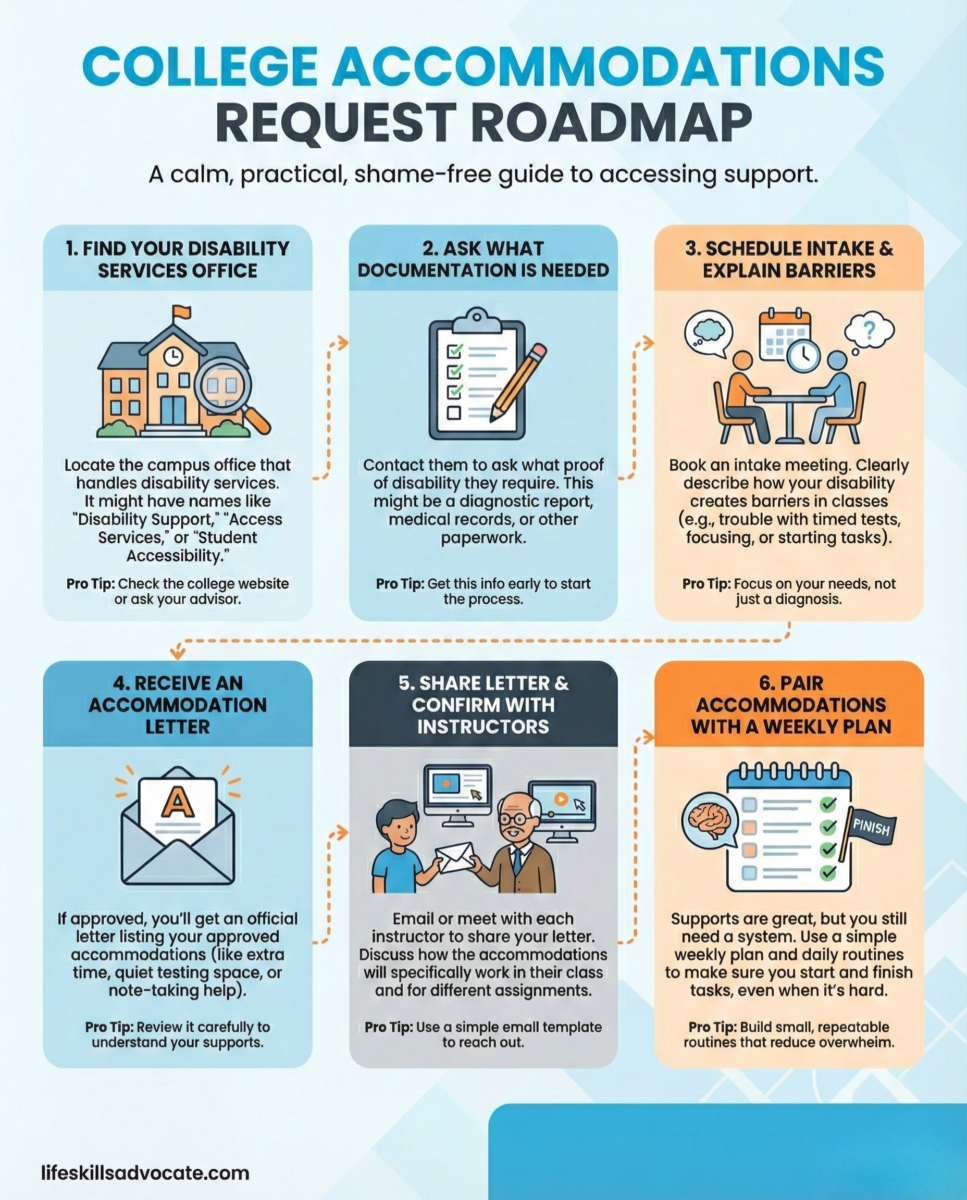
If timed quizzes leave you frozen, you keep missing submission windows, or you cannot track shifting deadlines across five classes, that is not a motivation problem. That is an access barrier, and there are processes designed to address it.
ADA and Section 504 in plain language
In the U.S., most colleges are covered by Section 504 and/or the ADA, which means they must provide equal access for qualified students with disabilities. A helpful starting point is the U.S. Department of Education’s guide Students with Disabilities Preparing for Postsecondary Education: Know Your Rights and Responsibilities and the overview of Section 504 protections. For a plain-language overview focused specifically on college, the ADA National Network’s Postsecondary Institutions and Students With Disabilities fact sheet is a clearer match than employment-focused ADA resources.
Quick expectations check: College accommodations are meant to provide equal access, not to lower academic standards. Schools can offer academic adjustments and auxiliary aids, but they generally are not required to make changes that would fundamentally alter a program or create an undue burden, as described in the ADA National Network guidance on college responsibilities.
One shift that catches a lot of students off guard: IEPs don’t carry over into college, and colleges don’t write IEPs.
The student initiates the process through the disability services office and decides when and how to share accommodation letters with instructors. If you’re used to adults catching problems early, this can feel like falling off a cliff.
What disability services typically needs from you
Every school has its own process, but the general pattern is: you contact disability services, ask what documentation they require, complete an intake, and discuss accommodations for your classes. AHEAD’s documentation guidance offers a practical reference for what to expect.
- Start early if you can. Setting up supports is harder when grades are already sliding.
- Be specific about barriers. “I have ADHD” is less useful than “I miss quiz windows because I lose track of time” or “I cannot finish timed exams even when I know the material.”
- Ask about timelines. Some offices need time to review paperwork and schedule intakes.
Common accommodations for EF-related barriers
Accommodations vary by school and course, but students commonly ask about supports like extended time or reduced-distraction testing, note-taking supports, assistive technology, or registration supports that reduce schedule chaos. I’d add one thing that often gets overlooked: ask about structure that supports follow-through, like clarifying interim deadlines or confirming submission expectations. Without that, “more time” can quietly turn into more avoidance.
Email templates: disability services and professors
To disability services: “Hi, I’m a student in [program]. I’m looking for support related to [barrier, like timed exams or task initiation]. What documentation do you need, and how do I schedule an intake?”
To a professor (after you have a letter): “Hi Professor [Name], I have an accommodation letter from disability services. What’s the best way to apply these accommodations in your course, especially for [exams, quizzes, labs]?”
When structured skill-building helps
Some students benefit from skills programs that teach planning, time management, and follow-through in a consistent way. For college students with ADHD, a multisite randomized trial of a CBT-based skills program reported improvements compared with usual services (Anastopoulos et al., 2021). A DBT-based skills group has also been studied, but the published evidence includes a small pilot trial, so it is best described as promising rather than settled (Fleming et al., 2015). I don’t have good long-term data on which approach works best for which students, but anecdotally, the students who stick with a program and pair it with a simple weekly routine tend to do better than those chasing isolated tips.
Frequently Asked Questions
What are executive functioning skills in college, in plain language?
Executive functioning skills are the “manage myself over time” skills: planning, starting, focusing, shifting gears, and finishing. In college, that means remembering deadlines, deciding what to do first, beginning assignments without panic, and turning finished work into a submitted assignment. A reliable external system (calendar, weekly review, routines) picks up where working memory leaves off.
Why can’t I start assignments even when I care about the class?
Task initiation is a common executive function bottleneck, and it is separate from motivation. Executive function is often described as the set of mental skills that support goal-directed behavior over time, including working memory, inhibitory control, and cognitive flexibility (Cleveland Clinic overview of executive function). When a task is big, vague, or high-stakes, your brain may stall even though you care deeply about the outcome. ADHD and autism can make this worse because the “start” signal gets stuck behind competing demands. A practical fix is to shrink the first step until it takes about 2 minutes (open the doc, copy the prompt, write three messy bullets), then use a short timer to build momentum. If starting still stalls, studying near another person or using a campus support space can reduce friction without requiring willpower.
Can executive function actually get worse in college even if high school was fine?
It can look that way, and in a sense it’s real. High school typically provides more external structure (frequent reminders, shorter deadlines, adults who chase missing work). When college removes that scaffolding, the demand on your own executive function spikes. Whether your EF skills themselves changed or the environment just outpaced them is genuinely hard to untangle without a professional evaluation, and the honest answer is that it can be both.
How do I get through readings when my brain checks out?
Stop aiming for “perfect reading” and aim for “useful reading” instead. Preview the headings first, pick a target (the author’s main claim plus two supporting points), then read in short chunks and write a 2 to 3 sentence summary after each one. Drafting one discussion-post bullet while the text is still open turns passive reading into active output and reduces working memory load.
Are deadline extensions actually helpful for executive dysfunction?
They can help, but only with structure around them. Ask for an extension plus a short plan: a new due date, one checkpoint like a partial draft, and a check-in. Without interim steps, more time tends to become more time to avoid.
Next Steps: Pick 2 Changes, Not 10
The students I’ve coached who actually build lasting habits almost never do it by overhauling everything at once. They pick one planning change and one starting change and repeat both for two weeks before adding anything else.
- Planning pick: Do one 20-minute weekly review and schedule two work blocks for your highest-priority class.
- Starting pick: Use the 2-minute start plus a 10-minute timer for one assignment today, even if the result is messy.
- If you are behind right now: Do the 20-minute reset from earlier in this article and send one short email today. A small plan you act on beats a thorough plan you never start.
- Find your bottleneck: Write down the one executive function skill that creates the most friction in your week. That’s where to focus first.
If you want structured practice (not just tips), the Real-Life Executive Functioning Workbook walks you through skill-by-skill exercises. If you want live support and accountability, executive function coaching for college students is an option. Coaching is educational support, not therapy or medical treatment.
If you’re a parent or supporter: Ask the student which two changes they chose, then offer one “body double” study session or one weekly check-in. Keep it short. Keep it practical.
About This Post
This post was written by Chris Hanson, founder of Life Skills Advocate. Chris is a former special education teacher and executive function coach who has worked with neurodivergent teens and adults for over a decade. The research cited here draws on peer-reviewed clinical trials, U.S. Department of Education guidance, and professional resources from organizations like AHEAD and the ADA National Network. Nothing in this article is medical, diagnostic, or legal advice. If you have concerns about ADHD, executive function, or college accommodations, please talk with your campus disability services office and, when relevant, a qualified clinician. Last updated June 2025.
Further Reading
- Executive Functioning 101 Hub (Life Skills Advocate overview of executive function skills)
- Free executive functioning assessment (Life Skills Advocate tool to identify skill bottlenecks)
- Real-Life Executive Functioning Workbook (Life Skills Advocate skill-by-skill practice resource)
- Executive function coaching for college students (Life Skills Advocate educational coaching support)
- Cleveland Clinic overview of executive function
- Students with Disabilities Preparing for Postsecondary Education (U.S. Department of Education)
- Section 504 protections (U.S. Department of Education)
- Postsecondary Institutions and Students With Disabilities (ADA National Network)
- ADA National Network guidance on college responsibilities
- Documentation guidance from AHEAD
- ADHD academic success skills guide (University of Minnesota)
- Anastopoulos et al., 2021 (multisite randomized controlled trial of CBT-based skills program for college ADHD)
- Fleming et al., 2015 (pilot randomized controlled trial of DBT skills training for college students with ADHD)