
Your teen can build an entire Minecraft world in one sitting but somehow cannot start a 10-minute reading assignment. They know the project is due tomorrow. You know they know. And yet, nothing happens. If you are raising a teen with ADHD, this pattern probably feels painfully familiar.
You are not imagining the disconnect, and your teen is probably not doing this on purpose. What looks like laziness from the outside is almost always something else: a brain-based gap between wanting to do something and being able to get started. In my coaching work with ADHD teens and their families, this is one of the most common conversations I have.
This article covers the science behind why ADHD affects motivation, how executive function skills play a central role, and what you can do to help without turning every evening into a battle. When parents understand what is driving the behavior, they can shift from pushing harder to supporting smarter, which reduces conflict and builds their teen’s confidence over time.
TL;DR
If you only have a few minutes, here is what this article covers.
- When an ADHD teen seems unmotivated, the issue is usually brain-based, not an attitude problem. ADHD affects the brain’s dopamine reward system, making it harder to start and sustain effort on tasks that are not immediately interesting or rewarding.
- Executive function skills like task initiation, planning, and time management are often delayed in ADHD teens, which widens the motivation gap.
- The “lazy” label does real harm. Look for signs of frustration, guilt, or shutdown rather than indifference.
- Parents can help by leading with connection, working with the ADHD brain (not against it), breaking tasks into smaller steps, and gradually building independence.
- If motivation problems are paired with withdrawal, persistent sadness, or sharp grade drops, it may be time to bring in professional support.
Why ADHD Teens Seem Unmotivated (Not Lazy)
The most important thing to understand is that your teen’s motivation challenges are rooted in brain wiring, not character. ADHD is not just about attention. It also shapes how the brain processes reward, effort, and the drive to act. Once you see the pattern clearly, it becomes much easier to respond in ways that help rather than ways that accidentally make things worse.
It Starts in the Brain’s Reward System
The brain relies on dopamine to signal that something is worth doing. PET imaging research has shown that adults with ADHD have lower availability of dopamine receptors and transporters in the brain’s reward centers, and that this difference correlates directly with reduced motivation. While that study focused on adults, the underlying neurobiology applies across the lifespan.
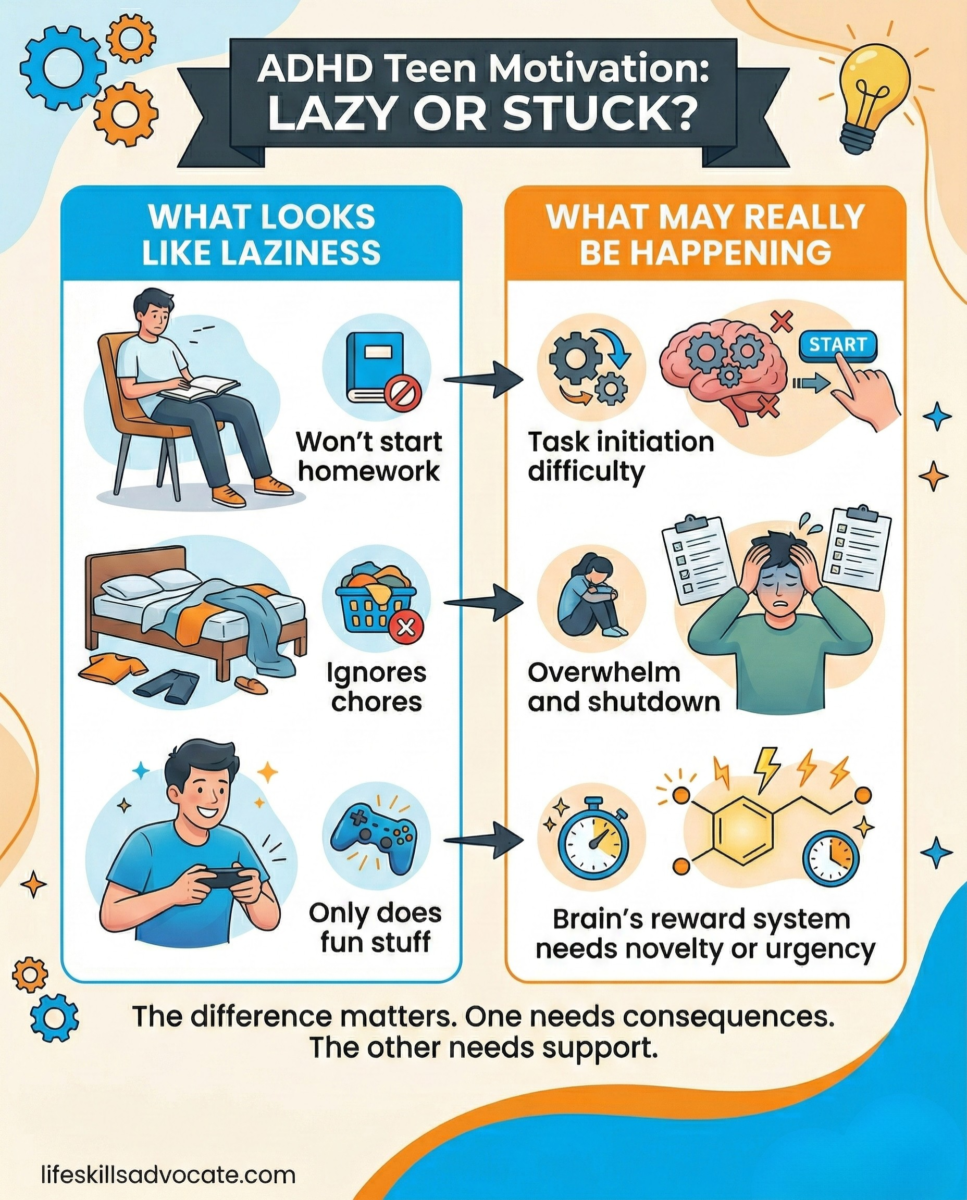
In practical terms, teens with ADHD often need a task to be novel, interesting, urgent, or personally meaningful before their motivation system activates. This explains the pattern parents know well: your teen can hyperfocus on a video game (constant novelty, immediate feedback, built-in rewards) but seems unable to open a textbook (delayed payoff, low stimulation, no urgency until the night before).
This is not a character flaw. It is a difference in how intrinsic and extrinsic motivation operate in the ADHD brain.
The Developing Prefrontal Cortex
The prefrontal cortex handles planning, prioritization, impulse control, and the ability to keep working toward a goal even when it is boring. According to the National Institute of Mental Health, this region is one of the last parts of the brain to fully mature, continuing to develop into the mid-20s.
ADHD adds another layer. Research summaries suggest that executive function development in teens with ADHD may lag roughly 2 to 3 years behind same-age peers. That means a 15-year-old with ADHD might have the executive function capacity of a 12- or 13-year-old in some areas, while being fully capable of advanced academic material. That mismatch is confusing for everyone involved.
When I explain this to families in coaching, I sometimes see visible relief cross a parent’s face. It is not that their teen does not care. The wiring is just different, and the timeline is longer than they expected.
ADHD and Teen Motivation: Key Facts
| Fact | Context | Source |
|---|---|---|
| ADHD is associated with reduced dopamine receptor and transporter availability in the brain's reward pathway | PET imaging study of 53 unmedicated adults with ADHD vs. 44 controls | Volkow et al., 2009 (JAMA) |
| Executive function skills in teens with ADHD may lag roughly 2 to 3 years behind same-age peers | Applies broadly to planning, organization, and self-regulation skills | ADDitude / Barkley research summaries |
| The prefrontal cortex continues developing into the mid-20s | Relevant to all teens; especially impactful when EF development is already delayed | NIMH Teen Brain Development |
| Reinforcement can normalize inhibitory control in children and adolescents with ADHD to the level of controls | Meta-analysis of reinforcement effects on executive function tasks | Ma et al., 2016 (meta-analysis, cited in van Dessel et al., 2022) |
| Co-occurring anxiety or depression is common alongside ADHD in teens and independently affects motivation | Clinical and epidemiological consensus across multiple sources | CHADD / CDC-supported overview |
The Executive Function Connection
If ADHD were only about attention, motivation challenges would be simpler. But ADHD also affects executive function, the set of mental skills that help someone plan, start, organize, and follow through on tasks. When those skills are strained, even a teen who wants to do their homework may not be able to figure out where to begin.
Which EF Skills Affect Motivation Most?
Not every executive function skill ties directly to what parents see as “motivation,” but several do. The ones that show up most often in coaching conversations are:
- Task initiation: The ability to get started, even when a task feels boring or overwhelming. For many ADHD teens, starting is the single hardest part.
- Planning and prioritization: Knowing what to do first when there are five assignments, a practice, and a social event competing for attention.
- Time management: Sensing how long something will take and feeling urgency before it becomes a crisis.
- Working memory: Holding the steps in mind long enough to carry them out without getting lost.
- Metacognition: Self-awareness about what is working, what is not, and what to try differently.
When one of these skills is weak, it often sets off what we call the executive functioning ripple effect. A teen who struggles with task initiation puts off homework, falls behind, feels guilty, avoids even more, loses sleep, and eventually seems to stop caring. The “not caring” is usually the last stage of a long cascade, not the starting point.
What This Looks Like at Home and School
A teen sits down after dinner, opens their laptop, stares at the assignment list, and then… nothing. Or they start writing a sentence, get stuck, pick up their phone “for just a second,” and 45 minutes disappear. From the outside, this looks like a teen who does not care. From the inside, it feels like being frozen in place while the clock keeps ticking. If this pattern sounds familiar, it is worth exploring whether signs of executive dysfunction are playing a bigger role than motivation alone.
“Lazy” or Stuck? How to Tell the Difference
The word “lazy” is one of the most damaging labels a teen with ADHD can carry. Life Skills Advocate has written about the difference between laziness and learning differences in depth, and the core question is this: Does your teen seem genuinely unbothered, or do you see signs of frustration, guilt, shame, or shutting down?
A teen who truly does not care tends to be relaxed about outcomes. That is relatively rare. Far more common is the teen who does care, feels stuck, and has stopped trying because trying and failing repeatedly hurts worse than not trying at all.
As a former special education teacher, I watched this play out with so many students. The label “lazy” never once helped. What did help was naming the real barrier, usually an executive function skill gap, and building support around it. If your teen has heard “you’re not trying hard enough” for years, that message compounds into what researchers describe as an “I can’t” mindset. At that point, the shame is often a bigger barrier than the ADHD itself.
What Parents Can Do Differently
No single strategy works for every ADHD teen. Brains are different, families are different, and what clicked last month might stop working next month. That is normal. The goal is not to find the one perfect system. It is to run small experiments, keep what helps, and let go of what does not. Here are six places to start.
1. Lead With Connection, Not Correction
When motivation is low and tension is high, the most effective thing you can do has nothing to do with homework. It is maintaining a warm, trusting relationship with your teen. Without a positive parent-teen connection, no motivation strategy will land.
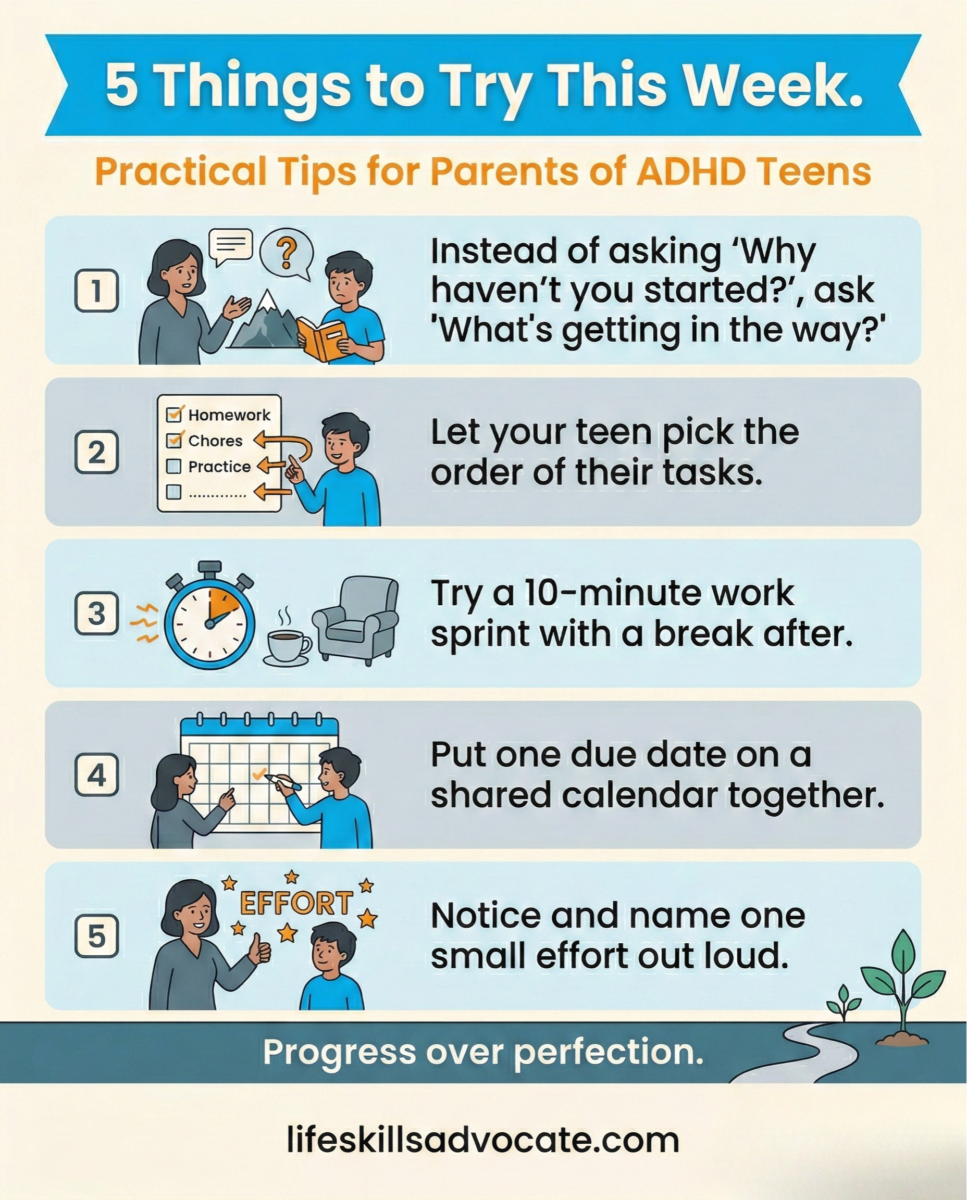
This does not mean avoiding hard conversations. It means approaching them with curiosity instead of frustration. Try replacing “Why haven’t you started your homework?” with “What’s getting in the way tonight?” One sounds like an accusation; the other opens a door. Nemours KidsHealth notes that teens with ADHD are often especially sensitive to criticism, and criticism rarely changes behavior for the better.
2. Work With the ADHD Brain, Not Against It
The ADHD brain responds to novelty, personal interest, choice, and urgency. You can use those levers without lowering expectations.
Let your teen pick the order they tackle their assignments. Change the study environment (kitchen table one night, library the next). Add a timer to create a sense of urgency on a low-stakes task. If your teen is stuck on something boring, help them find even a small connection to something they actually care about.
The dopamine menu concept is a structured version of this idea: a short list of quick, enjoyable activities your teen can choose from to get their brain “unstuck” before starting a harder task.
3. Break It Down and Make Starting Easier
For many ADHD teens, task initiation is the steepest hill. Once they are moving, momentum can carry them. The problem is getting started in the first place.
Try the “just the first step” approach. Instead of “Do your homework,” try “Open the document and write one sentence.” Instead of “Clean your room,” try “Pick up the five things closest to your feet.” Making the entry point tiny lowers the emotional cost of getting started. External structures help too: a visual checklist on the wall, a body-doubling session where you sit nearby doing your own work, or short “work sprints” (15 minutes on, 5 minutes off).
4. Scaffold, Then Step Back Gradually
Scaffolding means supporting the skill your teen is almost able to do independently, then slowly removing that support as they build capacity. It is very different from over-parenting, where you take over the skill entirely.
In practice: You put upcoming due dates on a shared calendar, but your teen checks it each evening. You help brainstorm the first three steps of a project, but they choose the order and do the work. You set a “homework window” together, but you do not stand over them during it. The psychologist Adam Price uses the phrase “less is more.” If you take on less responsibility for your teen’s tasks, they eventually pick up the slack. For more on finding that balance, our article on setting realistic expectations for neurodivergent teens may help.
5. Watch for the Shame Spiral
Years of “you’re not trying” messages build up. When a teen has been told they are lazy often enough, they start to believe it. That belief becomes a self-fulfilling cycle: they avoid tasks to protect themselves from another failure, which leads to worse outcomes, which reinforces the belief.
My own brain tends to react to vague advice with “nope, too much,” so I keep steps small and specific when working with teens. If your teen has stopped trying entirely, shame may be the bigger barrier to address before any productivity strategy will stick. Use neutral language about what their brain is doing (“Your task initiation is getting stuck tonight”) rather than language about who they are (“You’re being lazy”).
6. Celebrate Effort and Progress, Not Just Results
Small wins matter disproportionately for ADHD teens who are used to hearing what went wrong. A meta-analysis on reinforcement and ADHD found that reinforcement improves performance in youth with ADHD even more than in controls. But the reinforcement has to be timely, specific, and connected to effort.
“You got started 10 minutes earlier tonight” is more useful than a generic “good job.” Noticing progress, even tiny progress, tells your teen that movement in the right direction counts.
When to Bring In Professional Support
Not every motivation challenge needs outside help, but some do. Consider reaching out to a professional if you are seeing:
- Grades dropping sharply over a semester or more
- Withdrawal from friends, hobbies, or activities they used to enjoy
- Persistent sadness, irritability, or talk of hopelessness
- Significant changes in sleep patterns
- Motivation problems worsening despite your best efforts at home
These can be signs that something beyond ADHD is at play. CHADD’s resources on teen motivation note that co-occurring conditions like anxiety, depression, and oppositional defiant disorder are common alongside ADHD and each can independently reduce motivation. A psychologist, neuropsychologist, or your teen’s prescribing physician can help sort out what is happening.
Executive function coaching is another option that works alongside clinical care (not instead of it). Coaching focuses on building practical skills like planning, task initiation, and follow-through. If your teen could use structured, skills-focused support, you can learn more about executive function coaching for high school students at Life Skills Advocate.
If you are a teen reading this and something resonated, that awareness matters. Talking to a parent, school counselor, or another trusted adult about what you are experiencing is a reasonable next step.
Frequently Asked Questions
Is lack of motivation a symptom of ADHD?
Yes, difficulty with motivation is a well-documented part of ADHD. ADHD involves differences in the brain’s dopamine reward pathway, which directly affects the drive to begin and sustain effort on tasks. This is especially noticeable with schoolwork and activities that are not personally interesting. Motivation challenges in ADHD reflect how the brain processes reward signals, not willpower or attitude. A teen with ADHD may be highly motivated for activities they find engaging while struggling significantly with tasks that feel boring or overwhelming.
How do I know if my teen is lazy or has ADHD-related motivation issues?
The clearest signal is the pattern of frustration and inconsistency. A teen with ADHD-related motivation challenges can typically focus intensely on things they enjoy but seems unable to start things they find boring or overwhelming. They often express guilt, shame, or frustration about not following through. A teen who is simply choosing not to act tends to be more relaxed about the outcome. If your teen wants to do well but cannot seem to make it happen, that gap between intention and action is a hallmark of executive dysfunction, not laziness.
Why can my ADHD teen play video games for hours but not do 10 minutes of homework?
Video games deliver exactly what the ADHD brain responds to: constant novelty, immediate feedback, clear goals, and built-in rewards. Homework typically offers none of those things. The payoff is delayed, stimulation is low, and urgency is absent until the deadline looms. This contrast reflects how the brain’s reward system prioritizes different tasks, not a character flaw. Adding timers, breaking assignments into smaller steps, and letting teens choose their task order can help bridge the gap.
What is the best way to motivate a teenager with ADHD?
The most effective approaches work with the ADHD brain rather than against it. Start with maintaining a warm, low-conflict relationship. From there, focus on connection, choice, and small steps: let your teen have some control over how and when they do tasks, break work into manageable pieces, and use external structure like visual checklists or short work sprints. Celebrate effort and small progress rather than waiting for perfect results. No single technique works for every teen, so treat these as experiments and adjust as you go.
Should I punish my ADHD teen for not being motivated?
Punishment rarely improves motivation when the underlying issue is executive dysfunction. Taking away privileges may create short-term compliance, but it often increases shame and avoidance, which makes the motivation problem worse over time. A more effective approach is to identify the specific skill gap (for example, task initiation or planning) and build support around it. That might look like co-creating a homework routine, using visual reminders, or working with an executive function coach. Holding your teen accountable is still important, but accountability paired with support works better than consequences alone.
Putting It Into Practice
You do not need to overhaul your family’s entire approach tonight. Pick one idea from this article, just one, and try it this week. Maybe it is swapping “Why haven’t you started?” for “What’s getting in the way?” Maybe it is putting one due date on a shared calendar together. Maybe it is simply noticing a small effort out loud.
If you want to understand your teen’s specific executive function strengths and challenge areas, our free executive functioning assessment is a practical starting point. And if you are looking for structured, ongoing support, our executive function coaching for high school students pairs your teen with a coach who gets it, someone who builds skills collaboratively and keeps your teen in the driver’s seat.
Progress does not have to be dramatic to be real. A little less friction tonight. One fewer argument this week. Your teen getting started five minutes earlier than yesterday. That is the kind of forward movement that adds up.
About This Post
Written by: Chris Hanson, founder of Life Skills Advocate, former special education teacher, and neurodivergent adult (ADHD).
Last updated: March 2, 2026
How this was sourced: This article draws on peer-reviewed neuroimaging research (Volkow et al., JAMA), meta-analyses on reinforcement and ADHD (Ma et al.), clinical resources from CHADD and the National Institute of Mental Health, and practical insights from executive function coaching with ADHD teens and families.
Scope and limits: This article is for educational purposes only and does not provide medical, mental health, or legal advice. Life Skills Advocate provides executive function coaching, not healthcare. If your teen is struggling, please consult a qualified healthcare or mental health professional for individualized support.
Further Reading
- Volkow et al., 2009 (JAMA) – PET imaging study showing reduced dopamine markers in the reward centers of adults with ADHD.
- NIMH: The Teen Brain, 7 Things to Know – Overview of adolescent brain development, including prefrontal cortex maturation timelines.
- ADDitude: Executive Functioning Deficits That Deflate Motivation – Which EF skills affect teen motivation most, with expert strategies.
- van Dessel et al., 2022 (PMC) – Review of motivation research in ADHD through Self-Determination Theory, including meta-analytic findings on reinforcement.
- CHADD: Motivating an Unmotivated Child or Teen with ADHD – CDC-supported resource on reasons for low motivation and positive parenting strategies.
- Nemours KidsHealth: Parenting a Teen with ADHD – Communication strategies and relationship-building for ADHD families.
- Psychology Today: ADHD Kills Motivation (Dr. Adam Price) – The Three Cs framework and the role of scaffolding.
- Is My Teen Lazy? – Distinguishing executive dysfunction from willful avoidance.
- The Basics of Task Initiation – Why getting started is often the hardest part and how to support it.
- Extrinsic and Intrinsic Motivation – How motivation types work differently in ADHD brains.
- The Executive Functioning Ripple Effect – How one weak EF skill cascades across learning, relationships, and emotional health.
- Dopamine Menu for ADHD – Guide to creating structured activities for getting unstuck.
- Parent’s Guide to Low Academic Motivation – Additional strategies for supporting academic engagement.
- Signs of Executive Dysfunction and Practical Strategies – Recognizing executive dysfunction patterns and choosing supports.
- Setting Realistic Expectations for Neurodivergent Teens – Calibrating expectations to skill level without lowering the bar.
- Executive Function Coaching for High School Students – LSA’s coaching approach for teens.
- Free Executive Functioning Assessment – Tool for identifying which EF skills need the most support.