
If you have spent any time reading about ADHD, autism, or learning differences, you have probably run into the word “neurodivergence” and wondered what exactly it means. You are not the only one. The term shows up in school meetings, workplace trainings, blog posts, TikTok comments, and doctor’s offices, often without much explanation attached.
Here is the short version: neurodivergence describes people whose brains develop or work differently from what society treats as typical. That includes people with ADHD, autism, dyslexia, and a growing list of other conditions. But the word carries more weight than a simple definition suggests, and the details matter if you are trying to understand yourself, your kid, or someone you work with.
This guide breaks down what neurodivergence means in plain language, which conditions it includes (and where the lines get blurry), and how it connects to the executive function challenges that shape daily life for so many neurodivergent people. I have spent years coaching neurodivergent teens and adults on exactly those challenges, and the vocabulary confusion comes up in a lot of first conversations.
This article is educational, not medical or diagnostic advice. If you are working through any of this with a clinician, treat what follows as a supplement to that relationship, not a substitute.
TL;DR
The word neurodivergence gets used loosely, but it has a specific origin and a practical meaning worth understanding.
- Neurodivergence is a non-medical umbrella term for people whose brains develop or function differently from dominant societal norms, including ADHD, autism, dyslexia, and other conditions.
- The concept grew from Judy Singer’s 1998 coining of “neurodiversity” and Kassiane Asasumasu’s subsequent creation of “neurodivergent” around 2000.
- An estimated 15 to 20 percent of the global population is neurodivergent, though exact figures depend on which conditions you count.
- Executive function differences, including planning, time management, task initiation, and emotional regulation, are among the most common daily-life impacts shared across neurodivergent conditions.
- Neurodivergence is not a diagnosis, not a mental illness on its own, and not something that needs to be “fixed.” It is a framework for understanding how brains vary and what support actually helps.
What Does Neurodivergence Actually Mean?
Neurodivergence is not a medical diagnosis. It is a non-clinical term that describes people whose brains develop or function in ways that differ significantly from what a given society treats as standard. That is an important distinction, because it means no doctor will ever hand you a piece of paper that says “neurodivergent” on it. The word lives outside the diagnostic manual. It exists to describe a pattern of difference without automatically framing that difference as disease.
The term grew out of two related ideas.
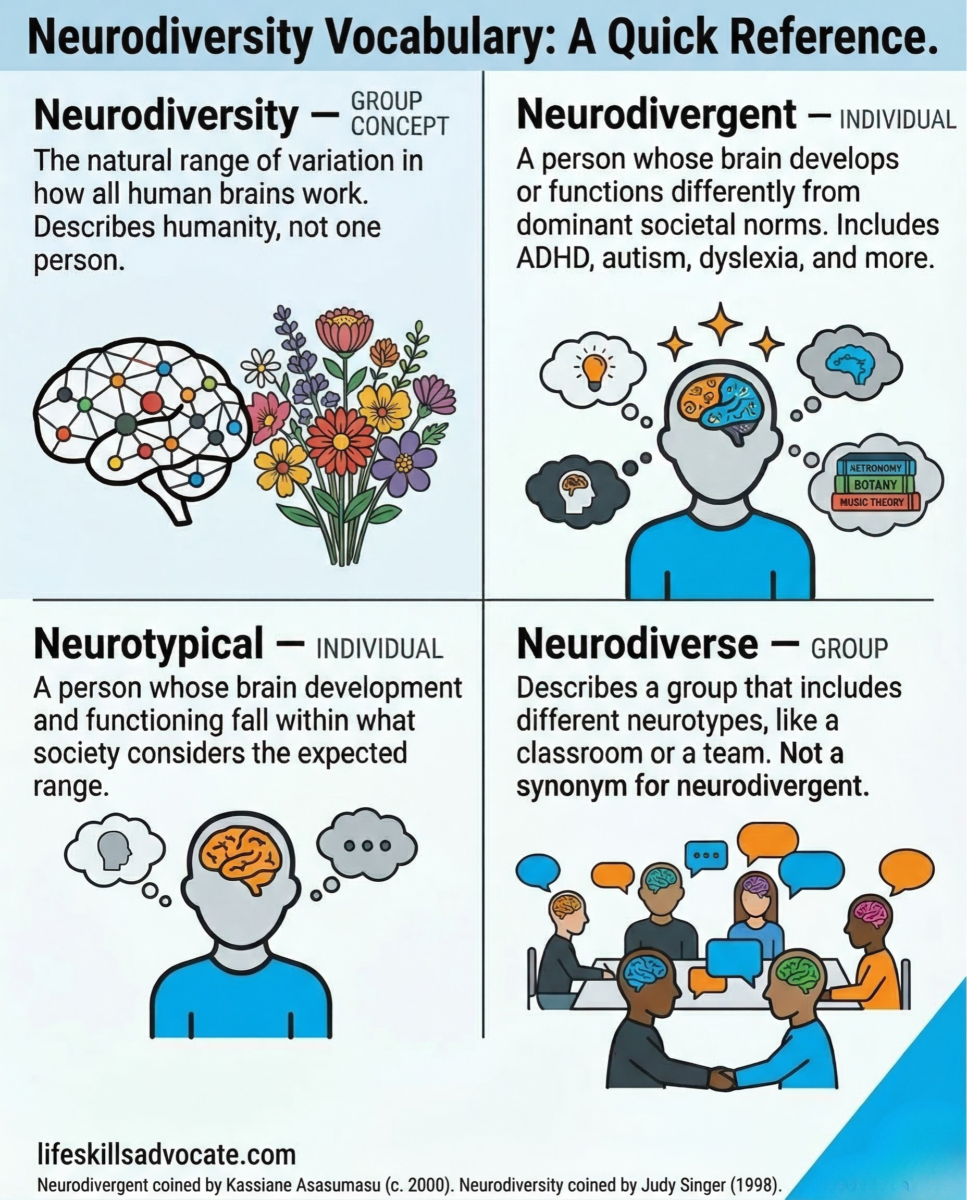
- In 1998, Australian sociologist Judy Singer introduced the word “neurodiversity” to describe the natural range of variation in human brains, the same way “biodiversity” describes variation in ecosystems.
- A few years later, around 2000, activist Kassiane Asasumasu coined “neurodivergent” to describe individuals whose neurocognitive functioning diverges from dominant norms.
Singer gave us the concept. Asasumasu gave us the word for a person.
This vocabulary distinction trips people up constantly. In coaching conversations and school meetings, I hear “neurodiverse” used to describe one person quite often. Technically, “neurodiverse” describes a group (a classroom can be neurodiverse; a single student is neurodivergent). “Neurotypical” describes people whose brain development and functioning fall within what society considers the expected range.
If you want a more thorough breakdown of how to use these terms precisely, the LSA guide to neurodiversity-affirming language walks through the distinctions with examples you can use in IEPs, emails, and everyday conversation.
None of this means the words are universally agreed upon. Nick Walker, a neurodivergent scholar, defines neurodivergent as “having a mind that functions in ways which diverge significantly from the dominant societal standards of ‘normal.'” The Cleveland Clinic’s overview frames it similarly but emphasizes that it is a way to describe people using words other than “normal” and “abnormal.”
The common thread across definitions: divergence from a societal norm, not from a biological one. There is no universally agreed-upon “correct” brain.
Which Conditions Count as Neurodivergent?
This is the question that starts the most arguments in neurodivergent communities, and honestly, the arguments are not finished yet. Most people agree on a core set of conditions. Beyond that core, the boundaries get genuinely contested.
The conditions most commonly included under the neurodivergence umbrella are:
- ADHD (attention-deficit/hyperactivity disorder), which affects attention regulation, impulse control, and often emotional regulation. Global estimates place ADHD prevalence at roughly 7 to 8 percent of children and 3 to 4 percent of adults, with U.S. figures trending higher.
- Autism (autism spectrum disorder), which involves differences in social communication, sensory processing, and patterns of interest or behavior. The CDC’s most recent estimate, from the 2025 ADDM Network report, places autism prevalence at about 1 in 31 children in the U.S. For many autistic people, sensory differences are among the most immediate daily challenges, and tools as simple as noise-filtering earplugs can make environments like grocery stores or open offices significantly more manageable.
- Dyslexia, dyscalculia, and dysgraphia, which are learning differences affecting reading, math, and writing respectively. Dyslexia alone is estimated to affect roughly 5 to 10 percent of the population, depending on the identification criteria used.
- Dyspraxia (developmental coordination disorder), which affects motor coordination and planning.
- Tourette syndrome, which involves involuntary tics.
- Down syndrome and other genetic conditions affecting cognitive development.
Where it gets complicated: many people also include conditions like OCD, bipolar disorder, sensory processing differences, and intellectual disabilities. Some include acquired conditions like PTSD or traumatic brain injury. Asasumasu, who coined the term, explicitly intended it to be broad. She wrote that she created it because people were using “neurodiverse” to mean only autistic, and she wanted a word that included “way more ways a person can have a different yet perfect brain.”
The practical reality I see in coaching is that most people who use the word are talking about ADHD, autism, or learning differences. But the boundaries are genuinely unsettled, and pretending otherwise would be dishonest. If you are trying to figure out whether the term applies to you or someone you know, the more useful question is usually not “does this count?” but “does thinking about my brain this way help me get the support I need?”
One more thing worth knowing: co-occurrence is extremely common. Many people are multiply neurodivergent. ADHD and autism frequently co-occur (the DSM did not even allow dual diagnosis until 2013). ADHD and dyslexia overlap frequently. In my experience, the clients who show up for executive function coaching rarely have just one thing going on. The overlaps are the norm, not the exception.
How Neurodivergence Connects to Executive Function
A parent once told me her teenager could write a 10-page essay on marine biology in one sitting but could not remember to put his lunch in his backpack three days in a row. That gap, between what someone clearly can do and what they consistently struggle to do, is where executive function lives. And it is one of the things that most neurodivergent conditions have in common.
Executive function is a set of cognitive skills that help you plan, organize, manage time, start tasks, regulate emotions, and hold information in working memory while you use it. Think of it as the brain’s project management system. When it works smoothly, you barely notice it. When it does not, the friction shows up everywhere: missed deadlines, lost belongings, difficulty switching between tasks, emotional reactions that feel out of proportion, meals that never get planned, and mornings that fall apart before 8 AM.
Research consistently shows that executive function differences appear across neurodivergent conditions, not just ADHD. A 2024 study in the journal Cortex used machine learning to map executive function profiles in 566 neurodivergent children and found that the profiles did not map neatly onto diagnostic categories. In other words, executive function challenges cut across diagnoses. An autistic person and a person with ADHD may struggle with different specific EF skills, but both are working with an executive function system that operates differently from what schools and workplaces expect.
This matters because most of the daily-life friction neurodivergent people describe, from “I know what I need to do but I cannot make myself start” to “I always underestimate how long things take,” is executive function friction. Not laziness. Not lack of caring. Not a character flaw. A real difference in how the brain handles planning, initiation, and self-regulation. If you have ever wondered why a clearly intelligent person cannot seem to “just” keep a schedule or tidy a room, executive function is almost always part of the answer. (Working memory load, by the way, is the thing that kills most “just try harder” advice.)
This is also why tools like a visual timer can do more than a phone alarm ever will: they make elapsed time something you can physically see shrinking, which sidesteps the internal estimation problem entirely.
For a more detailed look at individual executive function skills and how to build them, the Executive Functioning 101 Resource Hub breaks each skill down with practical explanations.
Neurodivergence Quick Facts
| Fact | Detail | Source |
|---|---|---|
| What neurodivergence means | A non-clinical umbrella term for people whose brains develop or function differently from dominant societal norms | Cleveland Clinic, 2025 |
| Estimated prevalence | 15 to 20 percent of the global population | AEI, 2024; DCEG/NCI |
| Term origins | "Neurodiversity" coined by Judy Singer (1998); "neurodivergent" coined by Kassiane Asasumasu (c. 2000) | Walker; Singer |
| Common conditions | ADHD, autism, dyslexia, dyscalculia, dyspraxia, Tourette syndrome (list is not exhaustive or universally agreed upon) | Cleveland Clinic, 2025 |
| Shared daily-life impact | Executive function differences in planning, time management, task initiation, emotional regulation, and working memory are common across neurodivergent conditions | Mareva et al., Cortex, 2024 |
Neurodivergent vs. Neurotypical: What the Distinction Actually Means
Neurotypical describes people whose brain development and functioning fall within what society considers the expected range. They tend to meet standard developmental milestones on schedule, process sensory input without significant distress, and pick up unwritten social rules without needing them spelled out. “Neurotypical” is not a compliment or an insult. It is a description of fit: their brain fits the systems that society has built.
Neurodivergent describes people whose brains diverge from those norms in significant ways. The distinction is not a clean binary. As the University of Washington’s DO-IT Center notes, “neurodiversity” ultimately refers to all of humankind, since every person processes information somewhat uniquely. The neurodivergent/neurotypical line marks a functional difference: people on one side of it generally need different environmental support, accommodations, or approaches to do the same things that the systems around them were designed for.
This is worth saying plainly because it gets lost in abstract discussions: the distinction exists because it is useful, not because brains sort neatly into two bins.
Three Things Neurodivergence Is Not
When people first encounter the concept of neurodivergence, the initial reaction I see most often is not confusion about the definition. It is confusion about where the boundaries are. So it helps to say clearly what the term does not mean.
- It is not a medical diagnosis. No clinician will diagnose you with “neurodivergence.” Specific conditions like ADHD, autism, or dyslexia have clinical diagnostic criteria. Neurodivergence is a descriptive framework that groups those conditions together based on a shared idea: that these brains work differently from what society expects, and that difference is not inherently a problem.
- It is also not a claim that everyone is “a little neurodivergent.” This one comes up constantly, usually from a well-meaning place. The problem is that it flattens the experience of people who genuinely cannot start tasks, hold jobs, manage daily routines, or maintain relationships because of how their brains work. Occasionally losing your keys is not the same thing as executive dysfunction that threatens your employment. The term has boundaries. They matter.
- And it is not the same as mental illness, though the two can absolutely co-occur. Neurodivergence typically refers to differences in how the brain develops and processes information, often from birth or early childhood. Mental health conditions like depression and anxiety may show up alongside neurodivergence (and frequently do, often as a result of years spent trying to function in systems that were not designed for neurodivergent brains). But they are not the same category of experience. A person can be neurodivergent and mentally healthy, or neurotypical and struggling with mental illness, or both at once. The neurodiversity-affirming framework treats these as distinct but potentially overlapping.
Finding Support: Coaching, Therapy, and Knowing What Fits
One of the first questions people ask after recognizing that neurodivergence applies to them or their family is “what kind of help should I look for?” The answer depends on what is actually creating the most friction.
There are three broad categories of support, and they serve different purposes:
Medical evaluation and medication. If you suspect you or your child has ADHD, autism, or another neurodevelopmental condition and do not yet have a formal assessment, a qualified clinician (psychiatrist, neuropsychologist, or developmental pediatrician) is the right starting point. Medication is an option for some conditions, particularly ADHD, and can meaningfully reduce certain symptoms. This is the lane where clinical professionals operate, and nothing else substitutes for it when a diagnosis or medication question is on the table.
Therapy. A neurodiversity-affirming therapist can help with the emotional and psychological layers: anxiety, depression, burnout, shame, relationship difficulties, and the accumulated stress of living in systems that were not built for your brain. Look for therapists who explicitly describe their practice as neurodiversity-affirming or who have experience working with ADHD and autistic clients. Therapy addresses how you feel. It is particularly important when masking, burnout, or co-occurring mental health conditions are part of the picture. LSA has a detailed guide on how to find a neurodiversity-affirming therapist if you want help with that search.
Executive function coaching. Coaching focuses on the practical, daily-life skill layer: how you plan, organize, manage time, start and finish tasks, build routines, and create systems that work with your brain instead of against it. It is not therapy and it is not medical treatment. It is skill-building and accountability, structured around your specific neurotype and the specific areas where executive function gaps are creating the most friction.
Executive function coaching at Life Skills Advocate works this way: you work one-on-one with a coach to identify the EF skills causing the most trouble, then build and test systems together. The approach is neurodivergent-affirming from the ground up, meaning it respects how your brain actually works rather than asking you to force yourself into neurotypical productivity frameworks. LSA offers coaching for adults, young adults, college students, and high school students.
These three types of support are not mutually exclusive. Many people benefit from more than one at the same time or at different points. A common pattern I see: someone starts with a clinical evaluation, adds medication, then realizes the executive function gaps are still there because medication helps with focus and regulation but does not automatically teach you how to plan a week or break down a project. That is when coaching becomes useful.
In the meantime, even something as simple as an ADHD-friendly planner with an undated format and built-in goal breakdowns can reduce the gap between knowing what to do and actually starting it. Other people start with coaching and later decide they want therapy to work on the emotional patterns underneath. There is no single correct order.
FAQ
What does neurodivergence mean in simple terms?
Neurodivergence means your brain develops or works differently from what society treats as typical. It is not a diagnosis. It is an umbrella term that covers conditions like ADHD, autism, and dyslexia.
Is anxiety considered a form of neurodivergence?
This depends on who you ask, and the honest answer is that the community has not settled the question. The original coiner of “neurodivergent,” Kassiane Asasumasu, intended the term to be broad and inclusive of any significant divergence from neurotypical functioning. Under that definition, chronic anxiety conditions could qualify.
Other voices in the neurodivergent community draw a line between innate, developmental conditions (like ADHD and autism) and conditions that may arise from life circumstances or are more episodic in nature. Anxiety also frequently co-occurs with ADHD and autism, making the categories harder to separate in practice. If anxiety significantly affects how your brain processes and responds to the world on a daily basis, the framework may be useful to you regardless of where the definitional debate lands.
Can you develop neurodivergence later in life?
Some forms of neurodivergence are acquired, like those resulting from traumatic brain injury, and can emerge at any age. But more often, what looks like “developing” neurodivergence in adulthood is actually discovering something that was always there. Many adults, particularly women and people of color, were never assessed as children because their presentations did not match the stereotypical profiles clinicians were trained to look for. A 38-year-old who just got an ADHD diagnosis did not become neurodivergent at 38. They were neurodivergent at 8, too. Nobody caught it.
Does neurodivergence affect executive function?
Yes, and this connection is one of the most practically important things to understand about neurodivergence. Executive function includes the cognitive skills you use to plan, organize, manage time, start tasks, regulate emotions, and hold information in working memory. Research shows these skills are affected across most neurodivergent conditions, not only ADHD. Autistic people may struggle with cognitive flexibility and transitions. People with dyslexia may have working memory differences that affect reading and multi-step tasks. The specific profile varies by condition and by individual, but the shared thread of executive function differences is one reason the umbrella term “neurodivergent” is useful in the first place. Our Executive Functioning 101 Resource Hub covers each skill in detail.
For parents trying to understand their child’s specific executive function profile, Smart but Scattered by Peg Dawson and Richard Guare includes quizzes and practical strategies organized by executive skill.
Is everyone a little neurodivergent?
No. Everybody has moments of forgetfulness, distraction, or social awkwardness. That is not neurodivergence. The term describes people whose brain differences are significant and persistent enough to create real friction with the systems around them. Diluting it to include everyone eliminates the very thing that makes it useful.
Next Steps
Understanding what neurodivergence means is a starting point, not a destination. What comes next depends on where you are and what kind of friction you are dealing with right now.
- If you are wondering whether executive function challenges are part of your picture, the free executive functioning assessment from Life Skills Advocate can help you notice which specific skills feel hardest.
- Pick one EF skill that creates the most daily friction, whether that is task initiation, time management, planning, or something else, and read the corresponding guide in the EF 101 Resource Hub. Start small and specific.
- Write down the one daily task that consistently falls apart. Name the executive function skill involved. That single observation is more useful than reading five more articles.
- If you do want one more book, Jessica McCabe’s How to ADHD is written by a neurodivergent creator for newly identified adults and is one of the most accessible starting points available.
- If the friction is affecting work, school, or relationships and self-directed reading is not enough, executive function coaching provides structured, neurodivergent-affirming support for building the specific systems your brain needs.
About This Post
This post was written by Chris Hanson, founder of Life Skills Advocate. Chris is a neurodivergent former special education teacher and executive function coach. The research cited here draws on clinical overviews from the Cleveland Clinic and the American Academy of Neurology, peer-reviewed studies on executive function profiles across neurodivergent populations, term definitions from the scholars who coined them, and prevalence estimates from the American Enterprise Institute and the Division of Cancer Epidemiology and Genetics. Nothing in this article is medical, diagnostic, or therapeutic advice. If you have questions about whether you or someone you know is neurodivergent, a qualified clinician is the right person to talk to.
Further Reading
- An Exploration of Neurodiversity-Affirming Language (Life Skills Advocate)
- Executive Functioning 101 Resource Hub (Life Skills Advocate)
- Neurodivergent Burnout: Signs and Recovery (Life Skills Advocate)
- Understanding Neurodiversity-Affirming Practices (Life Skills Advocate)
- How to Find a Neurodiversity-Affirming Therapist (Life Skills Advocate)
- Free Executive Functioning Assessment (Life Skills Advocate)
- Executive Function Coaching (Life Skills Advocate)
- Neurodivergent: What It Is, Symptoms and Types (Cleveland Clinic)
- Neurodiversity: Some Basic Terms and Definitions (Nick Walker)
- Mapping Neurodevelopmental Diversity in Executive Function (Mareva et al., Cortex, 2024)
- Embracing Neurodiversity at Work (American Enterprise Institute, 2024)
- What Do Neurodiverse and Neurodivergent Mean? (DO-IT Center, University of Washington)
- Neurodiversity (Wikipedia)
- CDC Community Report on Autism, 2025 (CDC ADDM Network)
- Global Prevalence of ADHD in Children and Adolescents: An Umbrella Review (Ayano et al., 2023)
- The Prevalence of Dyslexia: A New Approach to Its Estimation (Wagner et al., 2020)