
If you’ve ever searched “ADHD vs ADD,” you’ve seen that half the internet uses one term and half uses the other. Some say ADD is outdated. Others still use it because that’s what they were told they had.
The confusion makes sense. The name has changed more than once. The reasons aren’t always explained well. Here’s the thing: the distinction isn’t a medical debate anymore. It’s a naming question. But naming questions still affect how people understand themselves and whether they recognize what’s going on.
This article walks through what changed, why, and what it means in practical terms.
TL;DR: The ADHD vs ADD Basics
Here’s what you need to know about ADHD vs ADD:
- ADD and ADHD refer to the same condition. ADD was the official name from 1980 to 1987. ADHD replaced it and has been the correct term ever since.
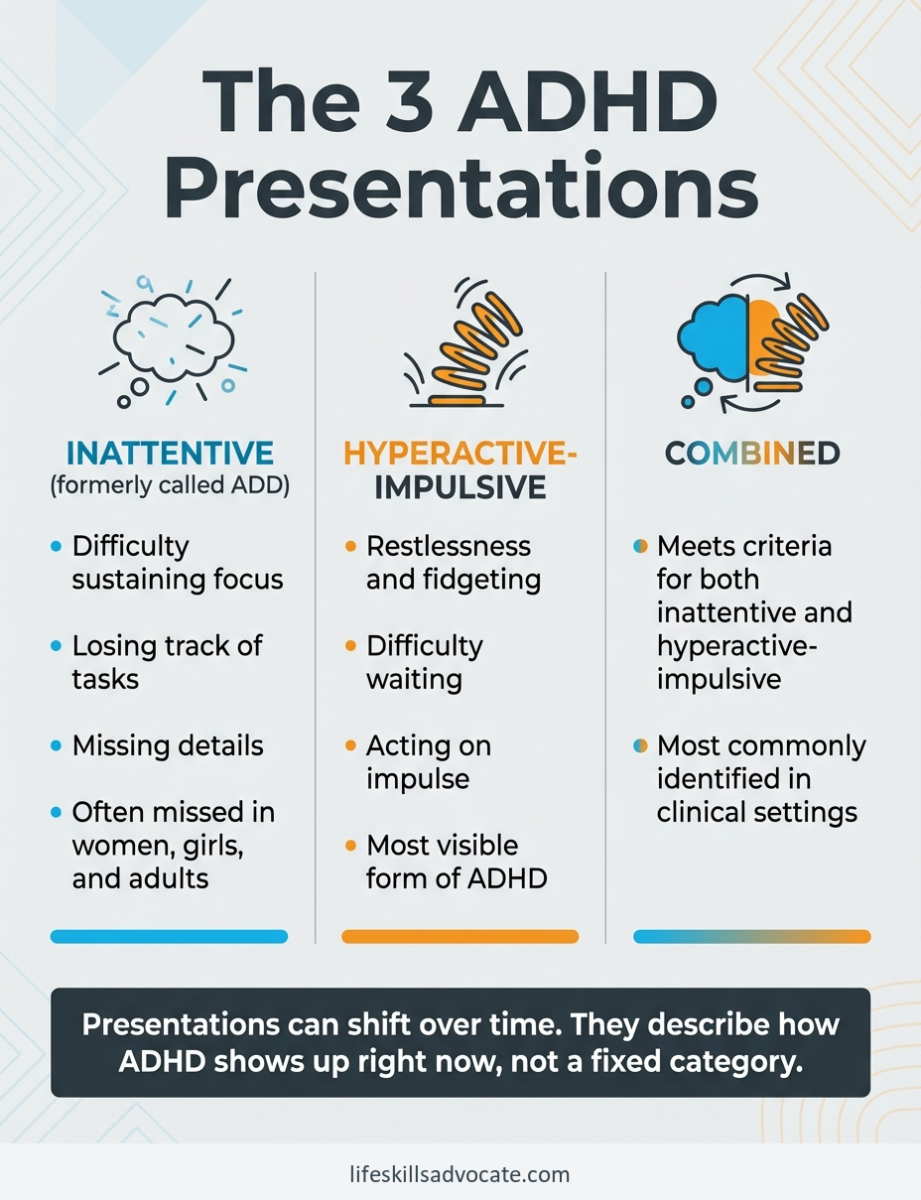
- There are three ADHD presentations: inattentive, hyperactive-impulsive, and combined. What people used to call “ADD” is now ADHD, predominantly inattentive presentation.
- The inattentive presentation is frequently missed, especially in women, girls, and adults. Without visible hyperactivity, it flies under the radar.
- Executive function is the common thread across all three presentations. It just shows up differently depending on the person.
- Using “ADD” isn’t wrong in casual conversation, but it’s no longer used in professional evaluations or research.
This article is for informational purposes only and is not a substitute for professional evaluation. If you think ADHD might be part of your picture, talk to a qualified provider who understands current criteria.
The ADHD vs ADD Question: Are They the Same Thing?
The ADHD vs ADD difference comes down to a name change, not a different condition. They describe the same brain. The APA retired ADD in 1987 and replaced it with ADHD.
“I have ADD, not ADHD” is something people say with real conviction. Usually because a professional told them that years ago. They’re not wrong about their experience. They’re just using an older map.
The term “ADD” persists partly because many adults were evaluated under that name and it became part of how they understand themselves. Some use it to distance from the word “hyperactivity,” which doesn’t match their experience at all. That makes sense. But clinically, ADD hasn’t appeared in a diagnostic manual since 1987.
If someone told you that you have ADD, what they meant is that you have ADHD, predominantly inattentive presentation. Same brain. Updated language.
How ADD Became ADHD: A Brief History
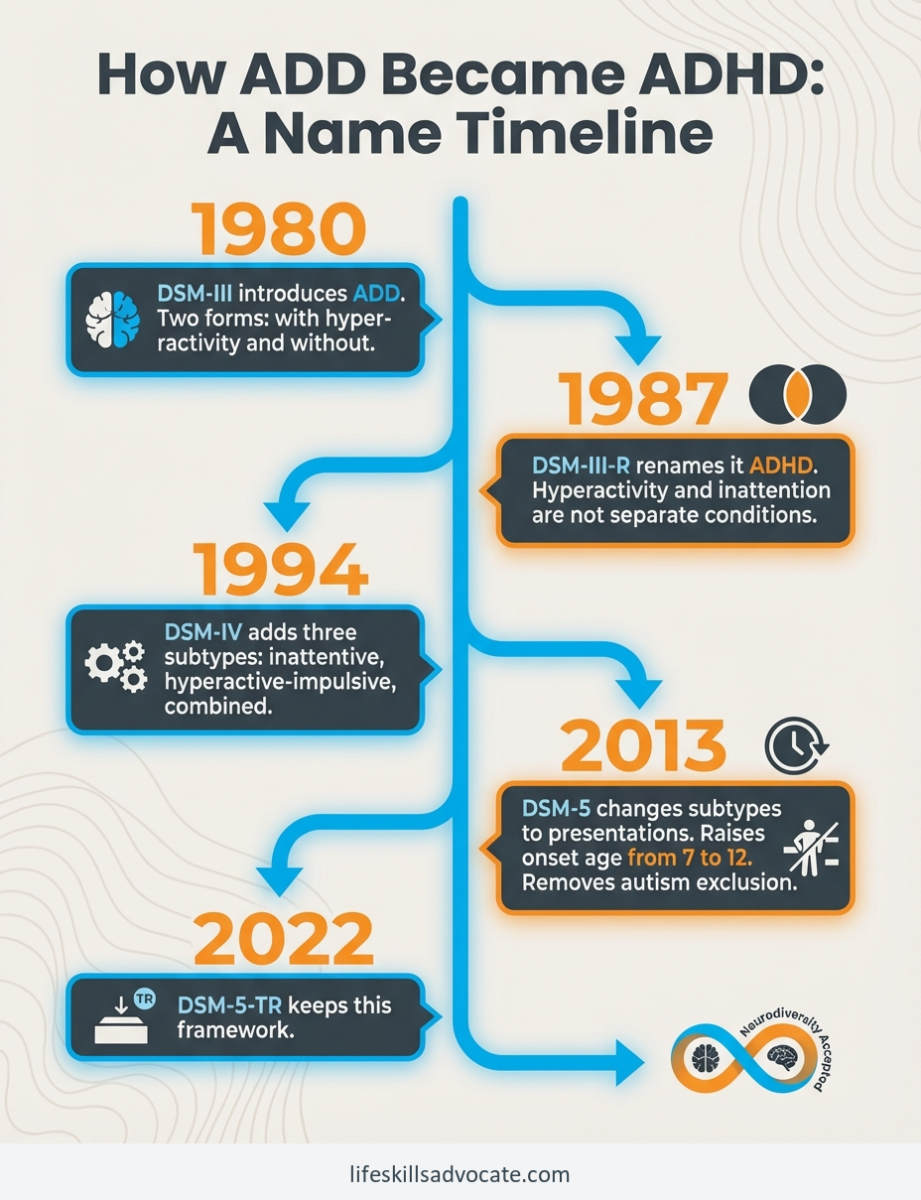
The ADD vs ADHD naming history is messier than most people realize. Each revision changed who got identified and who got overlooked.
In 1980, the DSM-III introduced “Attention Deficit Disorder,” or ADD. It came in two forms: with hyperactivity and without. This was the first time inattention got recognized as a core feature on its own.
In 1987, the DSM-III-R merged everything under one name: ADHD. Research showed that hyperactivity and inattention weren’t separate conditions but different expressions of the same profile. That single change is the reason “ADD” stopped appearing in clinical settings.
The DSM-IV in 1994 introduced three subtypes (inattentive, hyperactive-impulsive, combined), which gave clinicians a way to describe different presentations without reverting to separate diagnoses.
Then in 2013, the DSM-5 made several updates. It changed “subtypes” to “presentations,” raised the age of onset from 7 to 12, expanded adult criteria, and removed the rule that ADHD couldn’t coexist with autism. The age change mattered because it meant people whose symptoms showed up in middle school rather than early childhood could finally qualify. The DSM-5-TR (2022) kept this framework intact.
| Fact | Detail | Source |
|---|---|---|
| ADD was renamed to ADHD | The DSM-III-R made the change in 1987 | APA |
| Three ADHD presentations exist today | Inattentive, hyperactive-impulsive, and combined | DSM-5-TR (2022) |
| ADHD vs ADD: the same condition | ADD is the former name; ADHD is the current clinical term | APA, CHADD |
| Symptom onset age was raised | Changed from "before age 7" to "before age 12" in the DSM-5 (2013) | DSM-5 |
| US children diagnosed with ADHD (2022) | ~7.1 million aged 3-17 | CDC |
ADHD vs ADD: What the Three Presentations Mean
If ADD and ADHD are the same thing, what’s the actual breakdown? The three presentations clear up most of the confusion.
Inattentive (What People Used to Call ADD)
This is what most people mean when they say “ADD.” It centers on difficulty with sustained attention, following through on tasks, and keeping track of things. No visible hyperactivity, which is why it gets missed so often.
In daily life, this might look like reading the same paragraph four times, losing your keys in the same spot you always put them, or sitting down to work and realizing 40 minutes later that you’ve been doing something else entirely. The pattern isn’t occasional forgetfulness. It’s consistent enough to disrupt work, school, and relationships.
The inattentive presentation is significantly underidentified in women, girls, and adults. Many people with this profile spent years without knowing why everything felt harder than it should. They didn’t match the hyperactive stereotype, so nobody flagged it.
Hyperactive-Impulsive
This presentation involves physical restlessness, difficulty waiting, and acting on impulse. It’s the most visible version of ADHD. In children, it looks like constant movement. In adults, it might show up as internal restlessness or making quick decisions without thinking them through.
Combined
Combined means someone meets the threshold for both inattentive and hyperactive-impulsive features. This is the most commonly identified presentation in clinical settings, partly because the visible hyperactivity and impulsivity symptoms are more likely to prompt a referral.
One key detail: presentations can shift over time. A child with the combined presentation may present as mostly inattentive in adulthood as the hyperactivity becomes more internal. Restlessness doesn’t always disappear. It just stops looking like running around a classroom and starts looking like an inability to sit through a meeting without feeling like you’re going to crawl out of your skin. That’s why the DSM-5 uses “presentations” instead of “subtypes.” It’s a description of how things show up right now, not a fixed category.
Why “No Hyperactivity” Does Not Mean “No ADHD”
In the ADD vs ADHD conversation, the real question is often: “Why does everyone assume ADHD means hyperactivity?” For a long time, that’s basically all anyone looked for.
That hyperactivity-first view meant anyone who sat still and got decent grades was considered fine. This hit certain groups hard. ADHD in women and girls has been historically underidentified because the inattentive presentation doesn’t match what most people picture. Girls who daydream, lose track of assignments, or need three times longer to start homework don’t get flagged the same way a child climbing on furniture does.
Adults face a similar gap. Someone who has held a job and managed to get through school can still have ADHD that’s affecting them daily. Compensation strategies, like spending twice the effort to stay organized or relying heavily on other people for reminders, can mask the underlying pattern for years. The result is often a late identification and a lot of time spent wondering why everything feels harder than it seems to be for other people.
Many adults who say “ADD” are distancing themselves from the hyperactivity piece. They don’t see themselves in the stereotype, so “ADD” feels more accurate. That instinct makes sense. The current system accounts for it. ADHD, predominantly inattentive presentation, means “yes, this is ADHD, and no, hyperactivity is not required.”
How ADHD vs ADD Connects to Executive Function
The label matters less than understanding how your brain handles the basics. Starting tasks. Holding information in your head. Controlling impulses. Managing emotions. That’s executive function, and it runs through every ADHD presentation.
Working Memory and Task Initiation
In the inattentive presentation, challenges cluster around working memory and task initiation. Working memory is your brain’s ability to hold info while using it. Like keeping a phone number in your head long enough to dial it. Working memory load is the thing that kills most “just try harder” approaches. Tools like a visual countdown timer can help by making time visible, which reduces the load on working memory and makes it easier to start and stay on a task.
Task initiation is the ability to start something even when you know you need to. It’s not laziness. It’s a real gap between intention and action. Executive function develops at different rates, so that gap varies widely.
Emotional Regulation and Impulse Control
In the hyperactive-impulsive presentation, the profile leans toward inhibition and emotional regulation. This might look like snapping at someone before you can stop yourself or having emotional reactions that feel too big for the moment.
This isn’t a character flaw. It’s the same executive function system showing up in a different area. Some researchers have questioned whether the current name captures what’s actually going on, arguing that the label places too much emphasis on attention and hyperactivity when executive function may be the more central issue.
Why This Matters More Than the Label
Whether someone’s profile leans inattentive, hyperactive-impulsive, or combined, executive function is the shared foundation. Your specific EF profile gives you better information than any diagnostic label. It tells you where to focus when building a morning routine with ADHD or setting up systems.
What the ADD to ADHD Name Change Means for You
The ADD vs ADHD debate is interesting, but only useful if it changes something. So here’s what the shift changes in practical terms.
If you were told you have ADD, you don’t need a new evaluation just because the name changed. Your identification is still valid. The criteria have been updated (especially for adults), so a fresh look might be worth it for other reasons. But the name alone doesn’t require action.
If you’re researching for the first time, knowing they’re the same thing saves you from going down two rabbit holes that lead to the same place. Search for “ADHD presentations” and you’ll find the most current information. You’ll also get better search results, since most current research and resources use “ADHD” exclusively.
If you’re talking to a professional, use whichever term feels right. Any good provider will understand either way. What matters more is that they use current criteria and look at the full picture, including how things show up in your daily life and not just whether you match a checklist.
FAQ
Is it correct to say ADD or ADHD?
Both terms point to the same condition. ADHD is the current correct term. ADD hasn’t appeared in professional settings since 1987. In everyday conversation, saying ADD is fine.
Can you have ADHD without being hyperactive?
Yes. The inattentive presentation of ADHD involves no notable hyperactivity. This is what people used to call ADD. It’s one of three recognized ADHD presentations. Many people with this profile go years without being identified because they don’t fit the hyperactive stereotype. Women, girls, and adults are especially likely to be overlooked. The lack of visible hyperactivity doesn’t mean ADHD isn’t present. It just means it shows up differently.
Do people with ADD have ADHD?
Yes. ADD and ADHD are the same condition. If you were told you have ADD, you have what’s now called ADHD, predominantly inattentive presentation.
Could ADHD get renamed again?
It’s possible. Several prominent researchers have argued that “ADHD” is misleading because the core issue isn’t really attention or hyperactivity. It’s executive function. Russell Barkley and Thomas Brown have proposed names that center self-regulation and executive function instead. Scientific American has published arguments along these lines too. Renaming a condition in the DSM is a slow, consensus-driven process. There’s no active proposal on the table right now. Any change would need broad agreement across researchers, clinicians, and insurance systems. It could happen in a future revision, but no timeline exists. The name has already changed multiple times, so another shift isn’t out of the question. For now, ADHD is the term that professionals, researchers, and insurance systems all use. The naming debate may not be done yet.
Does the name change affect my evaluation?
Not directly. The switch from ADD to ADHD didn’t create new criteria on its own. But the DSM-5 updates in 2013 did expand criteria, especially for adults. If you were evaluated under older rules and feel something was missed, a current evaluation could be worth it.
Next Steps
- Take the free executive functioning assessment to see where your specific strengths and challenges are. It takes about 5 minutes and gives you a starting point that’s more useful than any label.
- Figure out where your EF challenges actually cluster. Once you know that, you can build supports that match your brain instead of following generic advice.
- If you want help building systems that work for your brain, executive function coaching with Life Skills Advocate focuses on practical skills rather than just understanding the label.
- Whether you call it ADD or ADHD, the important part is understanding how your brain works and setting up your life to work with it, not against it.
Further Reading
- What Is ADHD? – American Psychiatric Association
- DSM-5-TR Fact Sheets – American Psychiatric Association
- The History of Attention Deficit Hyperactivity Disorder – PMC
- Changes to ADHD in the DSM-5 – PMC
- Inattentive Presentation of ADHD – PMC
- Q&A: ADD vs. ADHD, What’s the Difference? – CHADD
- Attention-Deficit/Hyperactivity Disorder: What You Need to Know – NIMH
- We Need to Rename ADHD – Scientific American
- Data and Statistics on ADHD – CDC
- Executive Function Skills by Age – Life Skills Advocate
- ADHD in Women and Girls – Life Skills Advocate
- Morning Routines for People with ADHD – Life Skills Advocate
- Free Executive Functioning Assessment – Life Skills Advocate
- Executive Function Coaching – Life Skills Advocate
- Time Timer MOD Visual Timer – Amazon