
If you’re on an ADHD waitlist, you can start getting support now, even before a diagnosis.
Maybe you finally made the call, filled out the forms, and then heard: “Our next appointment is in 7 months.” That can feel like someone hit pause on your life. If you’re a parent, it can feel worse, because school keeps moving whether your child is ready or not.
This matters because long waits often mean more missed assignments, more workplace stress, more family friction, and more “What is wrong with me?” self-talk, even when the real problem is access to care.
This guide gives you a step-by-step plan for what to do while you wait, including US-first school supports (504/IEP) plus a short UK note for NHS waitlists.
If you’re looking for executive function support that doesn’t require a waitlist or a diagnosis, executive function coaching can start now. It’s skill-building, not medical care, and it doesn’t replace the medical evaluation.
TL;DR
Being on an ADHD waitlist is frustrating, but you can still take meaningful steps that make daily life easier right now.
- Start a simple “one-page snapshot” of challenges, impacts, and examples to bring to your evaluation.
- Run small executive function experiments (timers, fewer steps, body doubling, environment tweaks) instead of waiting for motivation.
- Ask for school support without waiting for a diagnosis: classroom supports, MTSS/RTI, and written evaluation requests for 504 or IEP when needed.
- Create a low-drama plan for work or college: clearer instructions, written expectations, meeting notes, and flexible workflow supports.
- Use coaching, skills support, and accountability now, while you keep the medical evaluation appointment on the calendar.
- Prepare for the assessment so it produces clear next steps, not just a label.
Note: This article is educational only. It is not medical, mental health, or legal advice. For diagnosis, medication, and individualized care, consult qualified clinicians. For school or workplace rights questions, consult your district, HR, or a qualified advocate.
What Does Being on an ADHD Waitlist Actually Mean?
Being on an ADHD waitlist usually means you’re waiting for a trained professional to assess whether ADHD (or something else) explains your symptoms and day-to-day challenges.
In plain terms: a waitlist is about access, not about whether you “deserve” support. You can start building support systems while you wait, because the things that help ADHD-related executive function friction (planning, follow-through, time awareness, emotional regulation) also help many other brains.
ADHD evaluation vs diagnosis vs treatment
Evaluation is the process. It often includes your history, current symptoms, impairment (how much life is affected), and sometimes rating scales from you and someone who knows you well.
Diagnosis is the clinical conclusion based on criteria. The CDC notes that only trained healthcare providers can diagnose or treat ADHD and outlines how criteria are used during diagnosis. See CDC guidance on diagnosing ADHD.
Treatment and support are the next steps. Those can include medical treatment (when appropriate), therapy approaches, skill-building, accommodations, coaching, and changes to routines and environments. Most people need more than one kind of support over time.
Why are ADHD waitlists so long?
Wait times vary by location, provider supply, insurance networks, and whether you’re seeking a specialist (like a psychiatrist or psychologist) versus primary care. Many families and adults also need evaluations for school paperwork, workplace documentation, or medication decisions, which can add demand.
If your first reaction is “So I’m stuck,” I get it. But you’re not stuck. You’re waiting for a medical step, and you can still build functioning supports in parallel.
If you’re not sure it’s ADHD, start with the “friction”
If you relate to ADHD but you’re unsure, focus on what is hard right now: starting tasks, switching tasks, time management, working memory slips, overwhelm, emotional intensity, or follow-through. Those are executive function skills, and support strategies can be useful even if your eventual diagnosis is something different.
ADHD Waitlist Action Plan: What Should I Do While I Wait?
If you’re on an ADHD waitlist, the best plan is to improve daily functioning now while also preparing for a useful evaluation later.
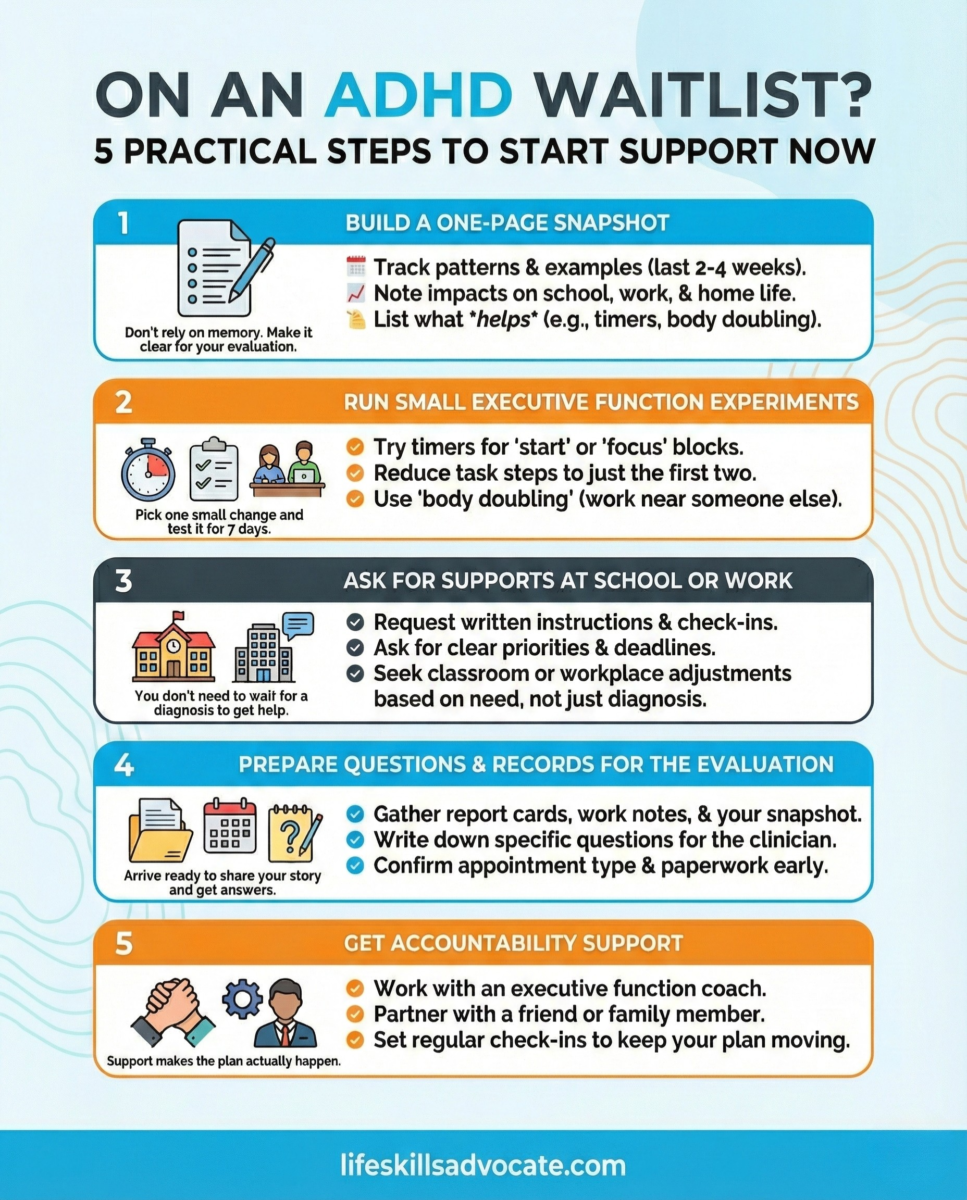
Step 1: Make a one-page snapshot (so your evaluation is clearer)
The fastest way to reduce chaos is to stop relying on memory. Write things down once, in a format you can reuse.
A useful one-page snapshot includes:
- Top 5 struggles (example: task initiation, time blindness, losing items, emotional overwhelm, procrastination loops)
- Real examples from the last 2–4 weeks (specific, not general)
- Where it shows up (home, school, work, social, driving, finances, self-care)
- Impact (missed deadlines, conflict, grades, job performance, sleep, stress, safety)
- What helps (timers, body doubling, movement, music, written steps, external accountability)
If you want a structured way to identify which executive function skills are hardest right now, you can start with Life Skills Advocate’s free executive functioning assessment and use the results as language for goals and supports.
Step 2: Run small “executive function experiments” (not giant life overhauls)
While you wait, treat this like a lab. Pick one friction point and test a small change for 7 days.
Here are some potentially high-payoff experiments that are usually low-risk:
- Externalize time: use timers, calendar alerts, and visual countdowns (not just “I’ll remember”).
- Reduce steps: if a task has 12 steps, your brain treats it like a wall. Turn it into 2 steps: “open document” and “write one ugly sentence.”
- Lower the start barrier: set a 5-minute starter timer. Stopping is allowed after 5 minutes.
- Body doubling: do the hard task while someone else works nearby or on video.
- Make the next step visible: leave your materials out in the “ready position” so starting takes less activation energy.
If task initiation is a major issue, a dopamine menu can help you reset briefly and re-engage without losing an hour to scrolling.
One evidence-informed concept that often fits this phase is behavioral activation, which focuses on doing small, meaningful actions even when motivation is low. See the ABCT’s behavioral activation fact sheet.
Step 3: Get support before diagnosis (yes, that is allowed)
You do not need a diagnosis to start skill-building support. You might need documentation for some formal accommodations, but many supports are available based on current needs.
Support options that can start now:
- Executive function coaching: practical help with planning, follow-through, routines, systems, and accountability.
- Therapy (when relevant): support for anxiety, depression, stress, trauma, or parenting strain that often rides alongside executive function overload.
- Skills groups or ADHD education: building strategies and community support.
- School supports: general education interventions, classroom supports, and evaluation requests (more on this below).
What executive function coaching looks like (including with Life Skills Advocate)
Coaching is skills-and-systems support. It is not therapy, not medical treatment, and not a replacement for an ADHD evaluation. It is a way to make day-to-day life more manageable while you wait.
In coaching, we usually focus on the real-world “sticking points,” like:
- planning and prioritizing homework or work tasks
- getting started when you feel stuck
- building routines that are realistic for a neurodivergent brain
- using tools (calendars, reminders, checklists) in ways that actually get used
- reducing overwhelm by breaking tasks into smaller, visible steps
- self-advocacy scripts for school, college, and work
At Life Skills Advocate, coaching is intentionally neurodivergent-affirming and practical. We focus on building systems that fit real life, not perfect life. If you want the overview, start here: Real-Life Executive Function Coaching.
If you’re wondering, “Okay, but what makes LSA different from generic productivity coaching?” this page explains the relationship-first approach and how our coaches’ lived and professional experience with neurodivergence shows up in the day-to-day work: Discover The Life Skills Advocate Difference.
One more practical note: Life Skills Advocate coaching does not operate with a waitlist. The simplest way to confirm current availability is to check openings for a discovery meeting through the coaching page.
Step 4: Reduce the pain of the wait itself
Some ideas:
- Ask to be on the cancellation list (and ask how often you should check back).
- Confirm paperwork early so you do not lose your spot due to missing forms.
- Ask what records help (report cards, old evaluations, teacher comments, work performance notes).
- Ask about your exact appointment type (ADHD-focused evaluation vs neuropsych testing vs medication consult).
- If you’re in the UK: NHS notes that wait times vary and can be long, and that in England you may be able to use Right to Choose to access a provider with shorter waiting times through your GP.
The 3-lane “ADHD waitlist plan” (print this)
| Lane | Time | What to do | What it helps |
|---|---|---|---|
| Today | 10–20 minutes |
1. Write 3 recent examples of “this is hard for me.” 2. Pick one tiny experiment for the next 7 days (timer, body double, fewer steps). 3. Choose one support person (partner, friend, teacher, coworker) to be your accountability ping. |
Stops the “I forgot everything” problem and builds momentum. |
| This week | 60–120 minutes total |
1. Complete the free executive functioning assessment and mark your top 2 skills to work on. 2. Create a one-page snapshot for your clinician. 3. If school is involved: draft an evaluation request email (template below). |
Turns vague struggle into clear language for support and accommodations. |
| Ongoing | 10 minutes, twice a week |
1. Two check-ins: “What’s one next step?” and “What’s the smallest version?” 2. Track patterns: sleep, stress, workload, appetite, movement, screen time (no perfection, just noticing). 3. Ask for help earlier than you usually do. |
Builds self-awareness and reduces last-minute crisis cycles. |
Key takeaways
- Do not wait for certainty to start support. Start with what is hard today.
- Write down examples now, while they are fresh, so your evaluation is more accurate.
- Small experiments are easier to repeat than big overhauls.
- Support can start before diagnosis, including coaching and many school supports.
What Support Can I Get at School Without an ADHD Diagnosis?
In many cases, schools can provide support without an ADHD diagnosis, especially when the need is clear and documented through observation, data, and the student’s day-to-day functioning.
There are multiple “lanes” of school support. Some supports are informal (teacher-level). Some are structured general education supports (often called MTSS or RTI). And some require an evaluation process for formal plans (504 or IEP). A medical diagnosis can help, but it is not always required to start the process.
| Quick fact | Scope / who this applies to | Year | Source |
|---|---|---|---|
| Executive function relies heavily on working memory, inhibitory control (self-control), and cognitive flexibility. | Applies across childhood, teens, and adulthood, including ADHD-related executive function challenges. | N/A | Harvard Center on the Developing Child |
| Only trained healthcare providers can diagnose or treat ADHD, and diagnosis uses criteria plus evidence of impairment. | Applies to children, teens, and adults seeking evaluation. | 2024 | CDC (Diagnosing ADHD) |
| A medical diagnosis is not required for a student to qualify under Section 504, if the student has a disability that substantially limits a major life activity. | US K–12 students seeking accommodations for access (not specialized instruction). | N/A | CHADD (Section 504) |
| A 504 plan provides accommodations for access, while an IEP provides specialized instruction and services for eligible students. | US K–12 students with disability-related educational impact. | N/A | NCLD (Section 504) |
| A school cannot require a parent to provide a medical diagnosis to evaluate a student for Section 504, although medical information can be helpful. | Washington State guidance for families and schools (helpful reference even if you live elsewhere). | N/A | OSPI (Section 504 overview) |
| In England, NHS ADHD assessment waiting times vary and can be months or years, and Right to Choose may allow referral to another provider through your GP. | Adults in England using NHS pathways. | 2025 | NHS (ADHD in adults) |
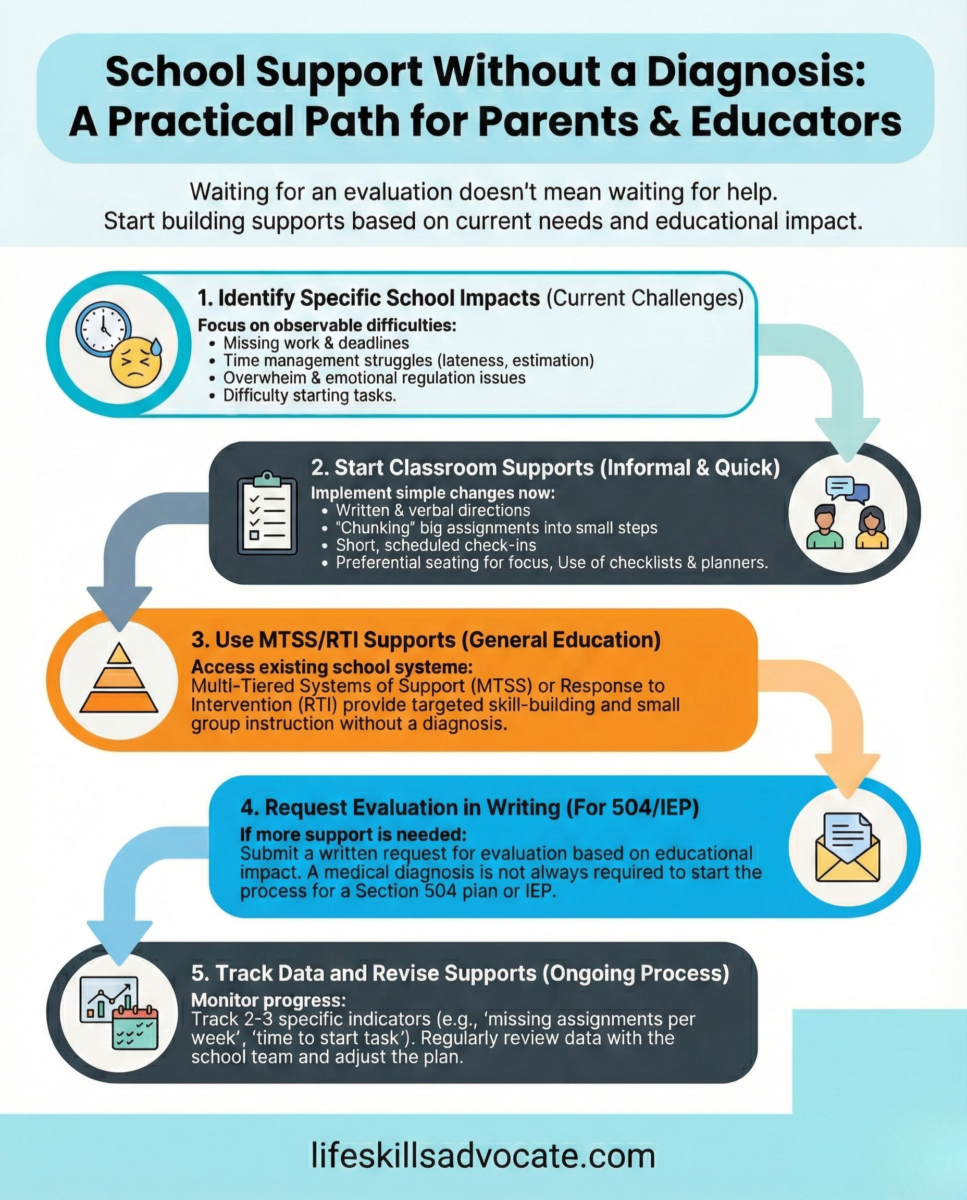
Start with supports that do not require paperwork
Many students benefit from common-sense supports that a teacher can implement quickly. Examples:
- instructions given in writing (not only verbally)
- checklists for multi-step assignments
- chunked deadlines (turn one big due date into smaller checkpoints)
- preferential seating for focus (not as a punishment)
- planner checks, assignment tracking, or a weekly missing-work plan
- short, scheduled check-ins (2 minutes, same time each day)
If you want a deeper set of executive function accommodations and how to talk about them in school meetings, see: executive functioning accommodations in school.
How to request an evaluation in writing (simple template)
If informal supports are not enough, a written request can start a formal process. You can request evaluation based on educational impact, even if you do not have a medical diagnosis yet.
Sample email to school (parent/caregiver):
Subject: Request for evaluation and supports
Hello [School Team/Principal/Counselor],
I’m requesting an evaluation to determine whether my child qualifies for supports under Section 504 and/or special education. We are currently on a waitlist for an ADHD evaluation, but the school impacts are happening now.
Here are the main concerns and examples (last 4 weeks): [2–4 bullets].
Please let me know next steps and timelines. I’m also requesting classroom supports while the evaluation process is underway.
Thank you,
[Name]
If you’re not sure whether to ask about a 504 plan or an IEP, this Life Skills Advocate guide can help you sort the lanes.
If the school says, “We need a diagnosis first”
If a school team says they need a diagnosis before they can help, you can respond calmly and bring the conversation back to impact and evaluation procedures.
Simple response script:
“We are pursuing a medical evaluation, but the school impact is happening now. I’m requesting that the school evaluate based on educational need and provide interim supports while we wait.”
Washington’s OSPI guidance states that a school cannot require a parent to provide a medical diagnosis to evaluate for Section 504, even though medical information can be helpful.
What to track for school (so you’re not stuck in “vibes”)
Tracking does not need to be complicated. Pick 2–3 indicators that show real impact:
- missing assignments per week
- time to start homework (minutes from “sit down” to “first step”)
- late arrivals or class transitions
- meltdowns, shutdowns, or emotional overwhelm patterns
- test completion (finishing vs running out of time)
Key takeaways
- School support can start before diagnosis when impacts are clear.
- Written requests reduce confusion and create a paper trail.
- Track a few simple indicators so meetings stay concrete.
What Can I Ask for at Work or College While I Wait?
Even while you’re on an ADHD waitlist, you can often use practical supports at work or college right away, and you may be able to request formal accommodations once you have documentation.
Think of it as two tracks: (1) changes that help you work better and (2) formal accommodations that may require paperwork.
Work: “low-drama” supports that help many brains
You can ask for clarity and structure without disclosing a diagnosis. For many roles, these are reasonable requests:
- clear written expectations and priorities
- meeting agendas in advance and notes after
- deadline clarity (what is “real due” vs “nice to have”)
- permission to block focus time on your calendar
- a quieter workspace or noise-reduction options
- regular check-ins (10 minutes weekly) to confirm priorities
Quick script to a manager:
“I do my best work when priorities are clear. Can we confirm the top 3 priorities for this week and what ‘done’ looks like for each?”
College: disability services and professor communication
Colleges often route accommodations through disability services. Some schools can offer interim supports with current documentation of functional difficulties, even if you are still waiting on a full ADHD assessment.
If you want a practical system for planning and finishing assignments, we have a strong companion to this article right here.
Email template to disability services:
Subject: Request for support while awaiting ADHD evaluation
Hello,
I’m reaching out to ask about support options while I’m on a waitlist for an ADHD evaluation. I’m currently experiencing significant difficulties with task initiation, time management, and completing exams/assignments on time.
What documentation do you need for interim accommodations or support services? I’m also open to coaching, study skills support, or learning center resources.
Thank you,
[Name]
How Do I Prepare for My ADHD Assessment So It’s Actually Useful?
You can prepare for an ADHD assessment by bringing clear examples, a timeline, and specific questions, so the clinician can see patterns and impacts instead of trying to reconstruct your life from memory.
Before the appointment: gather the right “evidence”
- Your one-page snapshot (from the action plan above)
- School history (report cards, teacher comments, prior testing if you have it)
- Work history examples (missed deadlines, performance reviews, patterns)
- Current supports and what has helped
- Family history (if relevant and you’re comfortable sharing)
The CDC’s overview of diagnosing ADHD is a helpful reference for what clinicians look for (symptoms over time plus impairment).
Questions to ask your evaluator
- “What will today’s appointment include?”
- “Will you use rating scales or collateral information from someone who knows me/my child?”
- “What other conditions do you consider when symptoms overlap?”
- “What are the next steps after diagnosis or ruling out ADHD?”
- “Can you provide documentation suitable for school or workplace accommodations if needed?”
After the appointment: turn the results into an action plan
Whether the result is ADHD, “not ADHD,” or “needs more information,” you still want a plan. Evidence-informed treatment and supports often include a mix of options over time. For an overview of ADHD treatments and supports, these are solid starting points:
When Waiting Isn’t Safe
If waiting for an ADHD evaluation puts you or your child at risk, seek faster support right away.
This can include urgent mental health support, crisis services, or a prompt medical appointment for severe symptoms that affect safety and functioning. Signs that “wait and see” is not the right plan include:
- thoughts of self-harm or suicide
- severe depression, panic, or escalating substance use
- not sleeping for multiple nights, or major appetite changes tied to mental health
- unsafe driving, unsafe impulsivity, or risky behaviors that feel out of control
- a student who cannot attend school consistently due to distress
If you are in the US and safety is a concern, call 988 (Suicide & Crisis Lifeline) or 911 for immediate danger. If you are in the UK, call 999 for emergency services or contact NHS 111 for urgent guidance.
Frequently Asked Questions
Can my child get school accommodations without an ADHD diagnosis?
Yes, many school supports can start without an ADHD diagnosis, especially when the educational impact is clear. Classroom supports and general education interventions (often called MTSS or RTI) can begin based on observed needs. For formal plans, a medical diagnosis can be helpful, but it is not always required for evaluation, and eligibility is typically based on whether a disability substantially limits a major life activity and affects access to education. If you want a clear breakdown of which plan does what, read IEP vs 504 explained in plain language and use the email template in the school section above to request evaluation.
What should I track while I’m waiting for an ADHD assessment?
Track a few patterns that show real-life impact, not every detail. A simple approach is to write 3–5 examples per week that include the setting, what happened, and what the impact was. For example: “Took 90 minutes to start a 15-minute task, missed the deadline, felt panicky, avoided email for two days.” If school is involved, track missing work, late arrivals, and time-to-start homework. If work is involved, track task initiation, time estimation, and follow-through. This kind of tracking helps your clinician see impairment patterns, and it also helps you choose the most helpful strategies to try next.
Do I need neuropsych testing for an adult ADHD diagnosis?
Not always. Many adult ADHD diagnoses are made through a clinical evaluation that includes symptom history, impairment, and sometimes rating scales or collateral information. Neuropsych testing can be useful when learning differences, memory issues, or complex diagnostic questions are in play, but it is not required in every case. If you are unsure what kind of appointment you’re scheduled for, ask directly: “Is this a diagnostic ADHD evaluation, a medication consult, or neuropsych testing?” If you want a plain-language overview of adult ADHD and treatment options, the NIMH ADHD in adults overview is a good starting point.
How do I talk to my employer if I’m struggling but not diagnosed yet?
You can ask for clarity and structure without sharing personal health information. Start with performance-focused requests: written priorities, clearer deadlines, meeting notes, and regular check-ins to confirm expectations. A simple script is: “I want to deliver strong work. Can we confirm the top priorities and what done looks like?” If you later pursue formal accommodations, your HR team may request documentation, but you do not need to wait to use workflow supports that help many employees. If you tend to freeze at task initiation, pairing work blocks with behavioral activation-style planning can also help. ABCT’s behavioral activation fact sheet
What can I do if the NHS wait for ADHD assessment is years?
If you are in England, NHS notes that waiting times vary and can be long, and that Right to Choose may allow referral to another provider through your GP. NHS ADHD in adults overview While you pursue the assessment pathway, you can still start symptom support strategies (sleep, routines, external reminders, task initiation tools) and seek skills support such as coaching. Many people also benefit from addressing co-occurring anxiety, depression, or burnout while they wait, because reducing stress load often improves executive functioning capacity regardless of eventual diagnosis.
How can executive function coaching help while I’m on a waitlist?
Executive function coaching helps you build practical systems for planning, starting tasks, following through, and reducing overwhelm, which can improve day-to-day functioning while you wait for medical evaluation. Coaching is not therapy and does not diagnose or prescribe medication. It is skills-and-systems support with accountability, experimentation, and real-life problem solving. If you want the overview of Life Skills Advocate’s approach, start with Real-Life Executive Function Coaching and Discover The Life Skills Advocate Difference to see how we work with neurodivergent teens and adults.
Next Steps: Put This Into Practice This Week
- Pick one friction point (task initiation, time awareness, overwhelm, losing items).
- Choose one small experiment and run it for 7 days.
- Write 3 examples of impact per week so your evaluation is clearer.
- Ask for supports now at school, work, or college, even if diagnosis is pending.
- Get accountability if your plans tend to evaporate under stress.
If you want support during the wait, Life Skills Advocate coaching can help you build practical systems for school, work, and daily life. We do not operate with a waitlist, and the simplest way to see current openings is to check discovery meeting availability through our executive function coaching page.
Further Reading
- Real-Life Executive Function Coaching – Overview of executive function coaching support for teens and adults.
- Discover The Life Skills Advocate Difference – How LSA approaches coaching in a neurodivergent-affirming, relationship-first way.
- Free executive functioning assessment – Identify strengths and challenges across executive function skills.
- How to build a dopamine menu for ADHD – Practical tool for task initiation and “getting unstuck.”
- IEP vs 504 explained in plain language – Clear comparison to support school advocacy decisions.
- Executive functioning accommodations in school – Concrete school supports and advocacy language.
- Executive function strategies for college students – Practical systems for planning, starting, and finishing work.
- Harvard Center on the Developing Child executive function guide – Clear explanation of executive function and self-regulation components.
- CDC guidance on diagnosing ADHD – Overview of diagnostic criteria and evaluation considerations.
- CHADD Section 504 overview – Parent-friendly summary of 504 protections and accommodations.
- NCLD Section 504 resource – Explanation of Section 504 and school accommodation basics.
- OSPI Section 504 overview (Washington) – Guidance including evaluation and the role of medical diagnosis.
- NHS ADHD in adults overview – UK-specific information including waiting times and Right to Choose.
- ABCT behavioral activation fact sheet – Action-based approach for low-motivation and avoidance cycles.
- AHRQ ADHD overview – Evidence-informed overview of ADHD treatment options.
- NIMH ADHD in adults overview – Adult ADHD basics and treatment options.
- NAMI ADHD overview – Plain-language overview of ADHD and common supports.