
If you have ADHD and you get stuck starting tasks, a dopamine menu can give you a short, pre-chosen set of “reset” options so you can re-engage without losing an hour to scrolling.
You know the moment: you open your laptop to write the email, and suddenly reorganizing the spice cabinet feels urgent. This post is for ADHD teens and adults (and the parents, partners, and educators supporting them) who want a calm, shame-free way to get unstuck.
Why this matters: when task initiation stays hard, school, work, and self-care pile up, and the stress cost adds up fast.
TL;DR
A dopamine menu is a practical “choose-one” tool for task initiation, not a promise to change brain chemistry.
- A dopamine menu is a short list of enjoyable, time-bounded activities you use to reset and then return to your next small step.
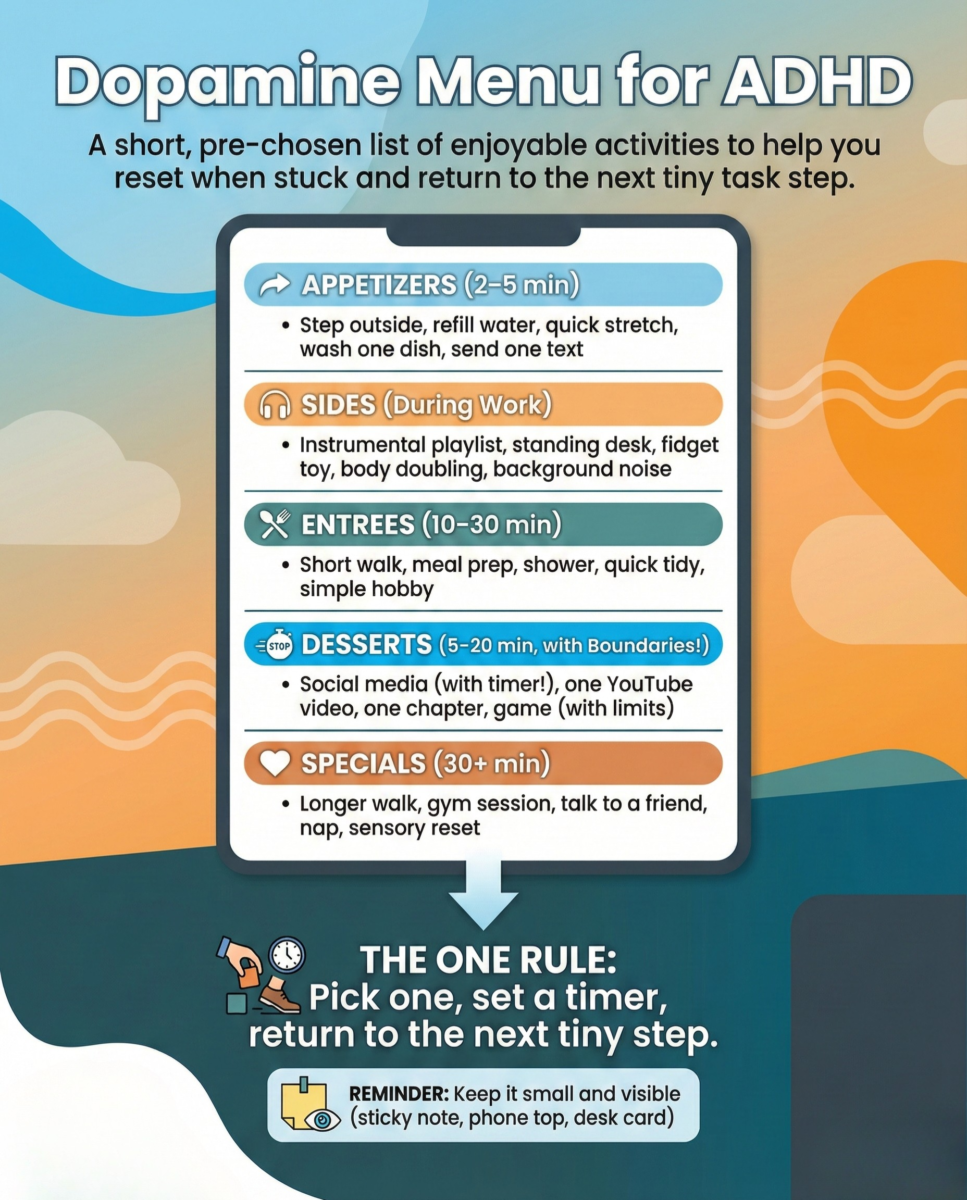
- Build a minimum viable version first: 5 appetizers, 5 sides, 3 entrees, 3 desserts (with guardrails), and 3 specials.
- Use one rule: pick one item, set a timer, then do the next tiny task step.
- The most common snag is “desserts” taking over, so plan boundaries before you need them.
- If nothing helps, it may be a capacity issue (stress, sleep, burnout) and adding professional support can be more helpful than adding more hacks.
Note: This post is for education and self-management support. It is not medical, mental health, or legal advice. For diagnosis, medication, or individualized care, consult a qualified clinician.
What Is a Dopamine Menu for ADHD?
Answer: A dopamine menu is a short list of enjoyable, time-bounded activities you can choose from when you feel stuck, overwhelmed, or understimulated, so you can reset briefly and then return to the next small step of your task. You might also see it called a dopamenu, an ADHD motivation menu, or a task initiation rewards menu.
The concept has been popularized in ADHD communities (including ADHD educator Jessica McCabe of “How to ADHD,” as summarized by UBC Science’s dopamine menu overview), and it is often described in categories like appetizers, sides, entrees, desserts, and specials.
Why it’s called a “menu”
A menu helps because it reduces in-the-moment decision load. When you are already overwhelmed, your brain has to solve two problems at once: “What should I do?” and “How do I start?” Pre-deciding a short list is one way to lower that friction.
This is also why dopamine menus tend to work better when they are small and visible, not a 40-item list hidden in a notes app you never open.
Dopamine reality check (no brain-chemistry promises)
Dopamine is involved in reward, motivation, and attention, but “dopamine” is not a simple on/off switch you can control with one trick. The safest way to think about a dopamine menu is as a behavior tool, not a medical intervention.
That framing lines up with Mayo Clinic’s overview, which connects dopamine menus to behavioral activation, meaning small actions that help you do what matters even when you do not feel like it.
Dopamine menu vs dopamine detox
Answer: A dopamine menu is about adding a few helpful options you can choose on purpose, while “dopamine detox” or “dopamine fasting” is usually about removing high-stimulation activities for a period of time.
Cleveland Clinic notes there is no literal “dopamine detox” because dopamine is not a toxin and your brain needs it to function (see Cleveland Clinic’s explanation of dopamine detox). Harvard Health also describes “dopamine fasting” as a misleading name that has little to do with dopamine itself (see Harvard Health’s dopamine fasting overview).
If limiting certain apps or activities helps you feel calmer, that can be a valid experiment. Just skip the idea that you are “resetting dopamine.” Your goal is better fit between your environment, your nervous system, and what you want to do next.
Why Dopamine Menus Can Help With ADHD Motivation and Task Initiation
Answer: Dopamine menus can help because they lower the activation energy to start, reduce decision paralysis, and create a short, immediate payoff that makes returning to the task more doable.
In plain English: you are not trying to become a different person. You are trying to make the next two minutes possible.
Executive function lens: what skill is getting stuck?
A dopamine menu usually supports several executive functioning skills, especially:
- Task initiation: getting started without ten reminders
- Attentional control: staying with something that is not naturally interesting
- Emotional regulation: moving through stress, dread, or overwhelm
- Cognitive flexibility: shifting from “stuck” to “next small step”
If you want a bigger-picture map of these skills (with lots of strategies), start with the Executive Functioning 101 Resource Hub.
Why “immediate payoff” matters for many ADHD brains
Many people with ADHD find that rewards far in the future do not motivate as strongly as smaller rewards they can feel now. Researchers often describe this pattern as delay discounting, and meta-analyses show it is elevated on average in ADHD compared to controls (for example, Jackson et al. (2016) on delay discounting in ADHD and Marx et al. on immediate vs delayed rewards).
This is not a character flaw. It is a motivation pattern. A dopamine menu uses that pattern by offering a small, immediate “yes” that makes the next step easier to approach.
This is behavioral activation in plain clothes
Behavioral activation is a psychological approach that emphasizes doing small, meaningful, rewarding actions, especially when motivation is low. ABCT describes behavioral activation as routinely involving yourself in personally rewarding activities (see the ABCT behavioral activation fact sheet).
Mayo Clinic’s coverage connects dopamine menus to this same idea: step away briefly, do something that restores energy, then re-engage (see Mayo Clinic’s dopamine menu overview).
In my coaching work, I often see people build beautiful systems they never open when they are stressed. My own brain also hears vague advice like “just take a break” and responds with “cool, but break how?” Dopamine menus work best when they make the choice tiny and obvious.
How Do You Make a Dopamine Menu? (A 10-Minute Build)
Answer: Pick a few options in each category (short resets, “pair-with-work” supports, longer hobbies, and high-grab treats with boundaries), then put the menu where you will actually see it when you are stuck.
Step 1: Start with 5 appetizers (2 to 5 minutes)
Appetizers are tiny resets that do not derail your day. Think: “I can do this even when I have zero motivation.”
Ideas:
- Walk to the mailbox and back
- Refill water, wash face, or step outside for two minutes
- One regulation tool (breathing, grounding, movement)
If calming or regulation strategies are a major need, you can pull ideas from evidence-informed ADHD calming techniques for adults.
Step 2: Add 5 “sides” (supports you can pair with work)
Sides are things you can do while you work to make boring tasks less painful. Many popular dopamine menu versions use “sides” this way (see the category examples in Verywell Mind’s dopamine menu example list).
Ideas:
- Instrumental music or background sound
- Fidget, textured item, or movement breaks built in
- Body doubling (quiet coworking with a friend on video or in person)
- Standing desk, floor sitting, or “change the chair”
Step 3: Pick 3 entrees (10 to 30 minutes)
Entrees are activities that restore you more deeply, but still have a clear end. These work well as planned breaks between work blocks.
- Short workout or yoga video
- Cooking something simple
- Art, gaming with a timer, hands-on hobby
Step 4: Choose 3 desserts (fun, but “sticky”) and add guardrails
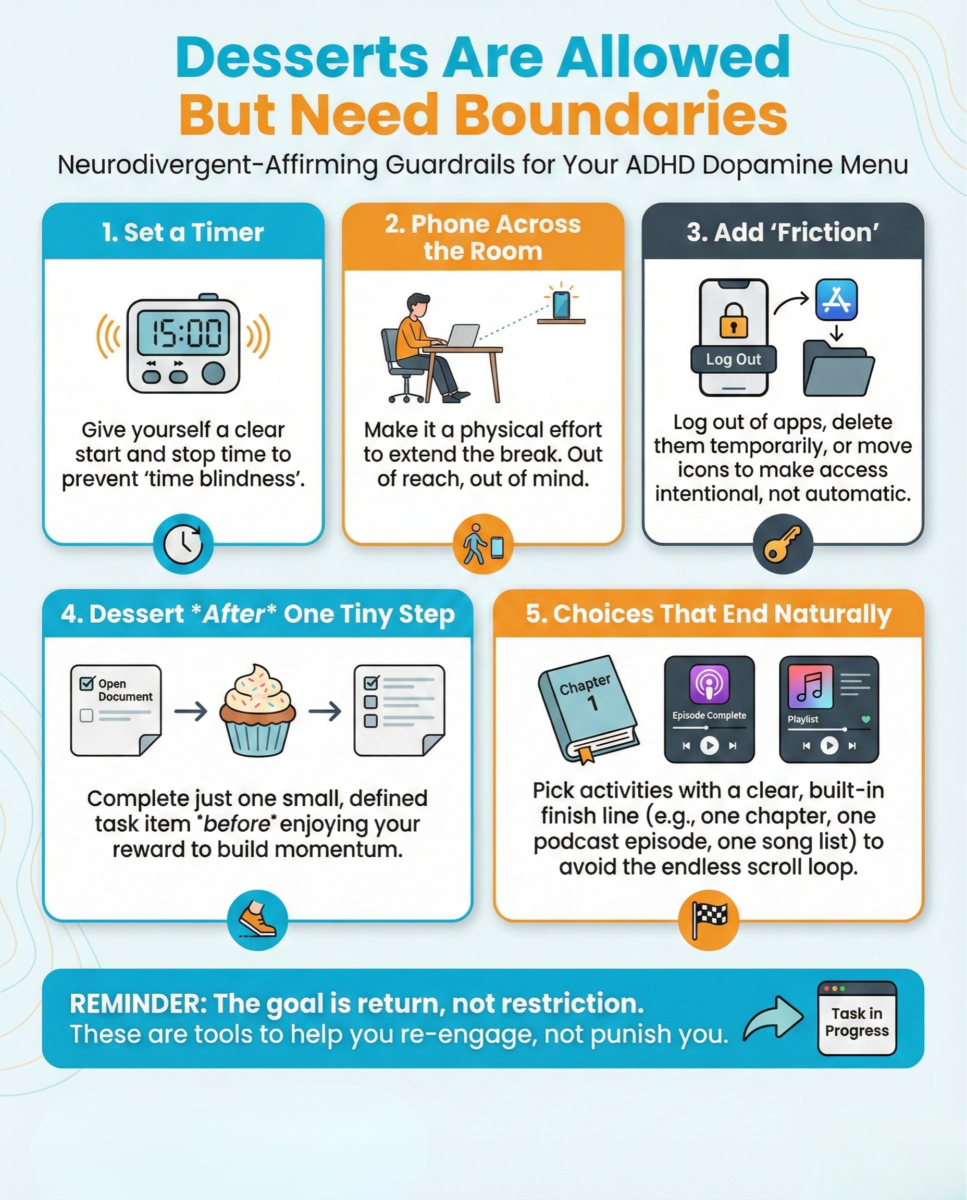
Desserts are high-grab activities that can easily expand into “Where did my afternoon go?” They are not forbidden. They just need boundaries.
Pick 1 to 3 desserts and decide your guardrails now, not when you are already stressed.
- Set a timer (and place the phone across the room)
- Add friction (log out, delete the app, move the icon)
- Use “dessert after” rules (after one tiny task step, after one focus block)
Step 5: Add 3 specials (bigger resets for rough days)
Specials are your “I’m at capacity” options. These are longer or more supportive, and they are allowed to be boringly basic.
- Short nap, shower, or a real meal
- Call a supportive person
- Walk outside with music, then come back and do the smallest next step
Step 6: Make it visible and default
Pick one place your dopamine menu will live, and make it obnoxiously easy to open. Options:
- A sticky note on your laptop
- A printed card taped to your desk
- A phone note pinned to the top of your notes app
Reference asset: Minimum Viable Dopamine Menu (printable + copy/paste)
Use this as your first draft. Keep it small. You can always expand later.
Printable-first template (screenshot or print):
| Category | Time | What it’s for | Your picks (write 3 to 5) |
|---|---|---|---|
| Appetizers | 2–5 minutes | Quick reset to start or restart | |
| Sides | During work | Make boring tasks easier to stick with | |
| Entrees | 10–30 minutes | Deeper break that still ends | |
| Desserts (with guardrails) | 5–20 minutes | Fun, but can expand without limits | |
| Specials | 30+ minutes | High-support options for rough days |
Copy/paste template (phone notes):
- APPETIZERS (2–5 min): ____ / ____ / ____ / ____ / ____
- SIDES (during work): ____ / ____ / ____ / ____ / ____
- ENTREES (10–30 min): ____ / ____ / ____
- DESSERTS (5–20 min, with limits): ____ / ____ / ____
- SPECIALS (30+ min): ____ / ____ / ____
Three “if-then” scripts you can copy:
- If I feel frozen, I will pick one appetizer for 3 minutes, then open the task and do the next tiny step.
- If I want to scroll, I will do one work sprint first, then dessert for 10 minutes with a timer.
- If I cannot restart after a break, I will switch to a side (music, body doubling) and do a 2-minute “starter step.”
Dopamine Menu Examples (Adults, Students, Sensory-Friendly, Low-Energy)
Answer: The best dopamine menu examples are short, specific, and matched to your real life, including your energy level, sensory needs, and the situations where you get stuck.
Example dopamine menu for ADHD adults (work and home)
- Appetizers: step outside for 2 minutes, refill water, quick stretch, wash one dish, send a “starting now” text
- Sides: instrumental playlist, standing desk, fidget, body double coworking, “camera-off” focus call with a friend
- Entrees: short walk, meal prep, shower, quick tidy with a timer
- Desserts (with limits): social media (10 minutes), one YouTube video, one chapter of a book
- Specials: longer walk, gym, therapy or coaching session, calling a supportive person
Example dopamine menu for studying and homework
This version is built around “start, sustain, reward.” UBC’s student-focused dopamine menu explainer frames the tool as especially helpful when you open your textbook and your brain shuts down (see UBC’s dopamine menu post for students).
- Appetizers (starter): 2 minutes of movement, set up snacks/water, open the doc and write the title, preview headings
- Sides (during): study playlist, fidget, chew gum, body doubling, standing or floor sitting
- Entrees (break): short walk, shower, small hands-on hobby
- Desserts (after a sprint): one show episode with a timer, quick game, social time
If a teen or young adult needs structured “getting started” supports, pull a few ideas from task initiation strategies for high school students and turn them into appetizers or sides.
Sensory-friendly options (ADHD + autism overlap)
If sensory input is part of what makes starting hard (too loud, too quiet, too scratchy, too bright), make the menu sensory-aware. The goal is not to eliminate sensory needs. The goal is to support regulation so your brain can re-engage.
- Appetizers: noise-canceling headphones on, change lighting, pressure input (weighted lap item), step outside for fresh air
- Sides: textured fidget, rocking chair, standing and shifting, background white noise
- Specials: longer sensory reset (bath, quiet room, predictable movement)
Low-energy menu (burnout, stress, “I can’t” days)
When energy is low, pick options that are small and kind, not heroic. A low-energy dopamine menu might include: protein snack, shower, 5-minute tidy, sit in the sun, short walk, or asking for help.
If low energy is frequent or intense, consider talking with a clinician. ADHD can overlap with sleep issues, anxiety, depression, and burnout, and it is reasonable to get support. NIMH’s overview lists common treatment and support approaches (see NIMH’s ADHD overview).
How To Use a Dopamine Menu When You’re Stuck
Answer: Open the menu, pick one appetizer, set a short timer, then return to the task and do the next tiny step. The timer is important because it protects you from “breaks that eat the day.”
This aligns with the way Mayo Clinic describes the tool: step away briefly, do something that feeds energy, then re-engage (see Mayo Clinic’s dopamine menu overview).
The 3-minute “activation appetizer”
When you feel stuck, do not ask, “What do I feel like doing?” Ask, “Which appetizer can I do for three minutes?”
- Pick one appetizer.
- Set a 3-minute timer.
- When it ends, open the task and do one tiny step (not the whole task).
Examples of tiny steps: open the doc, write one sentence, put the book on the desk, or find the file. Starting is the goal.
The “side dish” method for boring tasks
Some tasks are not going to become interesting. That is not a failure. It is math.
Sides let you pair the task with a supportive stimulus, like music, movement, or body doubling. If you want example categories, see a dopamine menu category example, then adapt it to your actual life.
After-task rewards without losing the afternoon
Rewards work best when they are specific and time-bounded. Try one of these structures:
- One sprint, then dessert: 15 minutes of work, then 10 minutes of dessert with a timer.
- One “done,” then dessert: send the email, then dessert.
- Dessert with friction: dessert is allowed, but the phone lives across the room.
Two tools that pair well with dopamine menus are the Pomodoro technique for ADHD and time blocking for ADHD, because both create a clear “work, break, return” rhythm.
Troubleshooting (When a Dopamine Menu Doesn’t Help)
Answer: If a dopamine menu is not helping, the most common issues are decision paralysis, dessert drift, or a mismatch between the menu and your real capacity that day. The fix is usually to make the menu smaller, add boundaries, or adjust for energy level.
If you cannot choose (decision paralysis)
When choosing feels impossible, reduce the decision to almost nothing:
- The “two-option rule”: limit yourself to two appetizers. Pick the left one.
- Pre-pick defaults: write “Default appetizer: walk + water.”
- Randomizer: roll a die or spin a wheel with 4 appetizers.
Then move to one tiny task step. The menu is not the goal. Starting is the goal.
If breaks turn into lost hours
This is the classic “dessert drift.” Try these guardrails:
- Make desserts end naturally (one chapter, one song playlist, one episode)
- Use a timer with a physical cue (phone across the room, kitchen timer)
- Put the restart step on a sticky note before the break
- Do dessert after one sprint, not before you start
If everything feels “meh”
Sometimes “nothing works” is not a menu problem. It is a capacity problem. Common reasons include sleep debt, chronic stress, burnout, depression, anxiety, grief, or sensory overload.
If motivation has been flat for weeks, or functioning is dropping across settings, it is reasonable to talk with a clinician. NIMH provides an overview of ADHD supports that can include medication and psychosocial interventions, depending on age and needs (see NIMH’s ADHD overview).
When to consider professional support
A dopamine menu can be a helpful self-management tool, but it is not a replacement for medical care, therapy, accommodations, or coaching.
- If ADHD symptoms are causing significant impairment at school, work, or home, a clinician can help with evaluation and treatment planning (see NIMH’s ADHD overview).
- If you want structured support for planning, routines, task initiation, and follow-through, LSA’s neuroaffirming executive function coaching for adults can be one skills-focused option to explore alongside medical and mental health care (not instead of it).
For readers who like the “why,” research on ADHD and motivation suggests differences in reward pathways may play a role (see Volkow et al. on motivation deficits and the dopamine reward pathway). This is not destiny. It is context for why certain strategies feel harder.
Frequently Asked Questions
What is a dopamine menu for ADHD, in plain English?
A dopamine menu for ADHD is a short, pre-made list of enjoyable activities you can choose from when you feel stuck, so you can reset briefly and then return to the next small step of your task. A dopamine menu is meant to reduce decision overload and support task initiation, not to be a treatment. Mayo Clinic describes dopamine menus as a popular rebrand of behavioral activation, meaning small actions that help you do what matters even when motivation is low (see Mayo Clinic’s dopamine menu overview).
Does a dopamine menu actually “boost dopamine”?
A dopamine menu does not reliably “boost dopamine levels” in a measurable way, and most people cannot track dopamine in daily life. A dopamine menu is best understood as a behavior tool that helps you shift state, reduce overwhelm, and re-engage with what you want to do. If you see claims that a dopamine menu “resets dopamine,” treat those as oversimplifications. A safer framing is that dopamine is involved in reward and motivation, and choosing a short, rewarding activity can make returning to a task feel more doable (see Mayo Clinic’s explanation).
What should I put on my dopamine menu if everything feels boring?
If everything feels boring, start with “body-based” options rather than “fun” options. Body-based options include movement, water, food, fresh air, light changes, and sensory supports. These often work even when motivation is low because they change your physical state first. Then include one social option (text a friend, body double), one low-effort comfort option (music, shower), and one “tiny win” option (two-minute tidy). If boredom and flat mood last for weeks, consider checking in with a clinician because ADHD can overlap with other factors like sleep issues or depression (see NIMH’s ADHD overview).
How do I stop my dopamine menu from turning into doomscrolling?
You stop dopamine menus from turning into doomscrolling by making desserts time-bounded and adding friction. Pick dessert activities that end naturally, set a timer, and place the phone across the room so you have to stand up to continue. Another simple guardrail is “dessert after one sprint,” meaning scrolling is allowed only after a 10 to 25 minute work block. If you want a structured work-break rhythm, pairing a dopamine menu with the Pomodoro technique for ADHD can help because it gives breaks a clear start and stop.
Is a dopamine menu the same thing as a dopamine detox?
A dopamine menu is not the same thing as a dopamine detox. A dopamine menu adds intentional options you can choose from when you are stuck, while “dopamine detox” is usually described as removing high-stimulation activities for a period of time. Cleveland Clinic notes there is no literal dopamine detox because dopamine is not a toxin and your brain needs it to function (see Cleveland Clinic’s dopamine detox explainer). If limiting certain apps helps you, that can be a reasonable experiment, but the goal is healthier habits and better fit, not “resetting dopamine.”
Can I use a dopamine menu for studying or homework?
You can use a dopamine menu for studying by creating a “starter, side, reward” routine that is easy to repeat. Pick one appetizer to start (open the doc, preview headings, two minutes of movement), one side to sustain (music, fidget, body double), and one dessert reward that is time-bounded (10 minutes of a show). UBC’s student-focused dopamine menu overview describes the tool as useful when motivation is low and procrastination shows up (see UBC’s dopamine menu explainer). For teens, it can also help to build appetizers from task initiation supports like timers and warm-up routines (see task initiation strategies for high school students).
When should I consider ADHD coaching, therapy, or medication instead of more strategies?
You should consider professional support when ADHD-related challenges are causing ongoing impairment at school, work, or home, or when stress and coping demands are climbing. A dopamine menu is a useful tool, but it is not a comprehensive support plan. NIMH describes common ADHD supports that can include medication and psychosocial interventions, depending on age and needs (see NIMH’s ADHD overview). If you want skills-focused support for planning, routines, and follow-through, LSA’s neuroaffirming executive function coaching for adults can be one practical option to explore alongside medical and mental health care.
Putting It Into Practice (A Realistic 7-Day Plan)
Here’s a simple way to test this tool without turning it into a new “project.”
- Day 1: Build your minimum viable menu (keep it small).
- Day 2: Use it once when you are mildly stuck (not your hardest task).
- Day 3: Add one guardrail for desserts (timer plus friction).
- Day 4: Add one side that helps you focus (music, movement, body doubling).
- Day 5: Pair the menu with one structure tool, like time blocking for ADHD or the Pomodoro technique for ADHD.
- Day 6: Make the menu more visible (print it, pin it, tape it).
- Day 7: Review: What did you actually use? Keep those. Delete the rest.
If you want a deeper executive function framework to build on, explore the Executive Functioning 101 Resource Hub. If you want personalized support with routines, task initiation, and follow-through, executive function coaching for adults is one option we offer at Life Skills Advocate (skills-focused coaching, not therapy).
About this post
Written by: Chris Hanson, founder of Life Skills Advocate (executive function coach, former special-education teacher, neurodivergent-led team).
Last updated: January 25, 2026.
How this was sourced: Medical and professional organization overviews (NIMH, Mayo Clinic, ABCT) plus peer-reviewed research summaries (meta-analyses and an open-access research paper).
Scope and limits: Educational content only. Not medical or mental health advice. For diagnosis, medication, or individualized care, consult a qualified professional.
More support: See our Executive Functioning 101 Resource Hub for more executive function tools and strategies.
Further Reading
- Mayo Clinic News Network: Dopamine menus – High-trust overview that frames dopamine menus as behavioral activation and emphasizes returning to the task.
- UBC Science: Dopamine menu explainer – Student-friendly overview and attribution for the popular “menu” format.
- ABCT Behavioral Activation fact sheet – Plain-language definition of behavioral activation.
- NIMH ADHD overview – ADHD definition and support options, including treatment and resources.
- Delay discounting meta-analysis in ADHD (PubMed) – Research summary showing elevated delay discounting in ADHD on average.
- Immediate vs delayed rewards in ADHD (PubMed) – Meta-analysis on reward timing in ADHD.
- Motivation deficits and dopamine reward pathway (PMC) – Open-access research paper on motivation and reward circuitry in adults with ADHD.
- Cleveland Clinic: Dopamine detox – Explains why “dopamine detox” is not literal and how to think about it more accurately.
- Harvard Health: Dopamine fasting – Clarifies the misleading “dopamine fasting” label and what the concept is closer to in practice.
- Verywell Mind: Dopamine menu examples – Example-rich category list that can help readers brainstorm options (use cautiously for science claims).
- Executive functioning skills – Definitions and examples of executive function subskills like task initiation and emotional control.
- Executive Functioning 101 Resource Hub – Collection of executive function resources and strategy guides.
- Pomodoro technique for ADHD – Structured focus and break method that pairs well with dopamine menus.
- Time blocking for ADHD – Planning approach for turning intentions into time-on-calendar.
- ADHD calming techniques for adults – Regulation tools that can work well as dopamine menu appetizers.
- Task initiation strategies for high school students – Getting-started supports that can be turned into menu items for teens.
- Executive function coaching for adults – Neuroaffirming and skills-focused coaching support for planning, routines, and follow-through.