
If you have spent any time around autism content, you have probably been told that autistic people lack empathy. The line is repeated in textbooks, parenting forums, and HR trainings.
It is also wrong, in a way that has cost a lot of people a lot of years.
The double empathy problem is the reframe. Coined in 2012 by autistic researcher Damian Milton, it says that miscommunication between autistic and non-autistic people is mutual. The breakdown is not located inside one brain. It happens between two brains that read each other through different defaults.
That shift sounds simple. The follow-on effects, for self-image, relationships, and workplaces, are not.
TL;DR
The double empathy problem reframes a piece of common wisdom about autism that turns out to be wrong.
- The double empathy problem is the theory that miscommunication between autistic and non-autistic people is mutual, not caused by one person lacking empathy.
- Damian Milton, an autistic researcher at the University of Kent, coined the term in 2012 as a direct challenge to older “mind-blindness” accounts of autism.
- Research since 2020 shows that same-neurotype pairs (autistic-to-autistic, allistic-to-allistic) tend to have higher rapport and cleaner information transfer than mixed pairs.
- The practical takeaway is not that someone is broken. It is that small communication shifts on both sides reduce the breakdown.
This is educational content about an autism research concept, not a professional evaluation or substitute for working with a qualified therapist or coach. If communication breakdowns are causing real distress in a relationship, a therapist who actually understands autistic experience can help.
What Is the Double Empathy Problem?
Damian Milton coined the term in a 2012 paper for the journal Disability and Society. The whole idea fits in one line: When communication breaks down between an autistic person and a non-autistic person, both of them are missing each other.
That was not the framing autism research had been using for decades. Older “mind-blindness” accounts treated the breakdown as one-sided. Autistic people were said to have a deficit in reading other minds. Non-autistic people were the social baseline. Milton, who is himself autistic, pushed back hard. The “double” points at the part earlier frames had quietly skipped. Non-autistic people also struggle to read autistic minds. They do it at roughly the same rate.
The everyday version is something most autistic adults can describe in detail. You have a meeting that you think went fine. You stated your point. You answered the question. Two days later your coworker tells someone you seemed annoyed, or dismissive, or “off.” You were not. You were just being direct. They read directness through a default that expects warmth signals you did not include. You read their warmth signals as filler. Same conversation, two completely different reads of what happened.
This is not a fringe academic position anymore. The original Milton paper has been cited over a thousand times in peer-reviewed work. The National Autistic Society has a professional-practice page on the theory authored by Milton himself. What is still catching up is the rest of the world: workplace trainings, IEP meetings, parenting books that still describe autism mainly as a social cognition deficit.
Why the Reframe Matters
The double empathy problem is not just a tidier way to talk about autism. It is a reassignment of who carries the cost of a failed conversation, and the reassignment is the part that changes lives.
When the older deficit frame was the only story available, autistic adults who felt depleted by ordinary social interaction had two options. They could assume they were broken. Or they could fight a research field that said they were. Most picked the first option without knowing it was a choice. The reframe gives them a third option: the interaction itself is hard work for both sides.
The shift has stakes beyond self-image. Research from Mitchell, Sheppard, and Cassidy in 2021 links being misperceived to higher rates of mental health distress in autistic adults. A person can spend years being read as cold or rude when the inside experience is the opposite. The gap accumulates. The cost often shows up as patterns like autistic inertia, where social labor reads as “shutdown” from the outside.
Late-identified autistic adults often describe encountering the theory as a turning point. Older shame about “not being good at people” finally has a counter-explanation. The mismatch is also a good starting point for readers curious about why some non-autistic people find it hard to understand autistic experience.
That counter-explanation is the entire reason this article exists.
What the Research Says About Double Empathy
The double empathy theory has experimental support. Most of it has built up since 2020. The two most cited studies both come from research teams led by Catherine Crompton at the University of Edinburgh.
In the first Crompton et al. study, published in Autism, the team set up “diffusion chains.” One person told a story to a second person, who passed it to a third, and so on. Some chains were autistic-to-autistic. Some were allistic-to-allistic. Some were mixed. The story degraded fastest in the mixed chains. The two same-neurotype chains held it together about equally well.
A second Crompton paper, in Frontiers in Psychology, asked observers to rate rapport in recorded pair conversations. Same-neurotype pairs scored higher, regardless of whether the pair was autistic or allistic. Mixed pairs scored lower.
A 2024 study by Szechy, Turk, and O’Donnell in Autism in Adulthood extends the finding into hiring. Non-autistic raters consistently misread autistic candidates’ workplace behaviors. They downgraded the same answers they would have rated favorably from a non-autistic candidate.
When autistic people interact with each other
One surprising finding is that autistic-to-autistic interactions do not show the breakdown earlier theories predicted. If autism were mainly a social cognition deficit, two autistic people in a room together should struggle even more, not less. They do not. Information passes cleanly. Rapport is real. The breakdown lives in the mismatch, not in the autistic side of it.
The current limits of the evidence
The honest version of this story includes its limits. Most experimental work has used adult, western, verbal autistic samples without intellectual disability. Generalizing to autistic children or to higher-support populations is not yet supported by the same evidence weight. Milton himself flagged this in a 10-year retrospective from 2022.
How the Double Empathy Problem Shows Up in Everyday Life
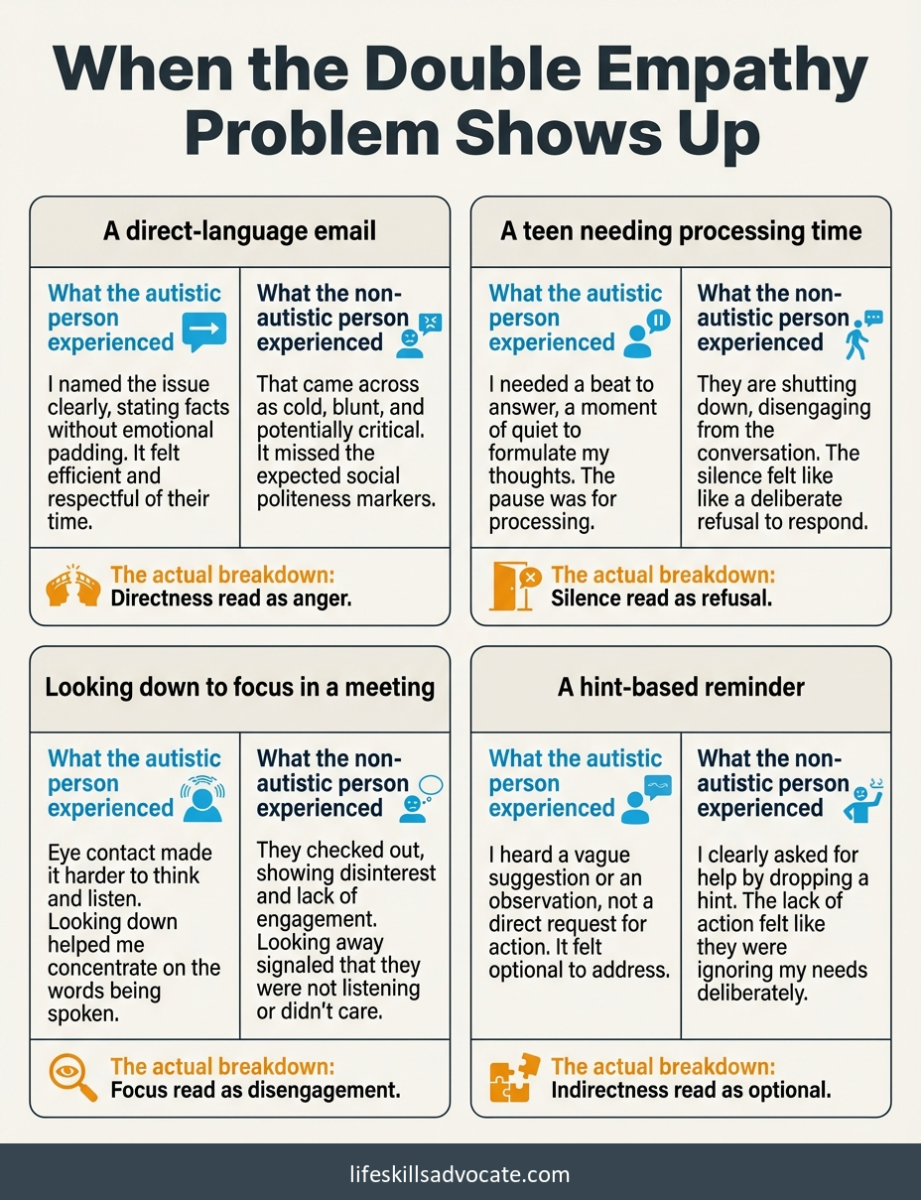
So what does the double empathy problem actually look like in a Tuesday afternoon meeting, or at a kitchen table, or in a third-period English class? The theory is clean. The lived version is messy and recognizable.
Most of the time, the breakdown happens in moments small enough that nobody flags them.
Someone says something direct. Someone else takes it as cold. The first person notices the chill but cannot place where it came from. They assume it was them. The second person feels unsettled and decides not to bring it up. Both walk away with a slightly worse read on each other than before.
At work and in meetings
At work, the breakdown shows up most clearly in feedback. Direct language is the kind that names the problem and asks for a fix. To non-autistic colleagues, it often reads as blunt. The autistic person, meanwhile, reads the soft wrapper as filler. Both leave the meeting having heard something different than what was said. The cost of constant translation is part of why masking and the cost of constant social translation shows up in burnout patterns.
In families and close relationships
Inside families, the breakdown is gentler and more painful at the same time. A parent asks an autistic teen “how was your day” and gets a one-word answer. The parent reads brevity as shutting down. The teen is not shutting down. The teen is answering with the information they have. They are also still in recovery from the school day’s social load. Declarative language for neurodivergent communicators is one of the better practical adjustments for this moment.
At school and in classrooms
In classrooms, the misread is usually about engagement. A student who looks down at the desk to focus is read as disengaged. A student who repeats a phrase to process it is read as not paying attention. A student who answers literally instead of inferring what the teacher meant is read as off-topic. Each of these tends to land in a behavior chart instead of a conversation.
All of this happens before anyone says the word autism.
| Term | Definition | Source |
|---|---|---|
| Double empathy problem | The theory that breakdowns in communication between autistic and non-autistic people are mutual, not caused by one person's lack of empathy. | Milton 2012, Disability and Society |
| Origin of the term | Coined by Damian Milton, an autistic researcher at the University of Kent, in a 2012 paper challenging mind-blindness accounts of autism. | Milton 2012 (KAR open-access PDF) |
| Key supporting study | A 2020 experiment found that information passed cleanly through autistic-to-autistic and allistic-to-allistic chains, but degraded in mixed-neurotype chains. | Crompton et al. 2020, Autism (Sage) |
| Current limits of the evidence | Most studies use western adult samples. Generalizing to autistic children, higher-support populations, and non-western settings is still uncertain. | Milton, Gurbuz and López 2022 (10-year retrospective) |
Bridging the Gap: What Better Communication Looks Like
The practical version of double empathy work is unglamorous. There is no script that fixes neurotype mismatch in five steps. There are, however, communication shifts that lower the cost for both sides.
- Ask, don’t guess. Instead of inferring what someone meant from tone, ask them. This is closer to declarative language than to the soft requests that pass for “polite” in many settings. It takes the load off both people.
- Communication preferences belong out loud. A two-line note in an email signature works. So does a quick “I do better with written feedback” said early in a working relationship. Both remove a huge amount of guesswork. The real-world self-advocacy guide covers a longer version.
- Processing time matters more than people realize. Many autistic and ADHD adults do not answer in the rhythm a non-autistic conversation expects. A beat of silence is usually all that is needed. Pushing past it is where the misread starts.
- Repair, when it works, is mutual. When a cross-neurotype conversation goes sideways, treating the breakdown as shared makes it easier to come back. Blame routes around the fix. Curiosity gets you somewhere. The post on communication exercises that translate well across neurotypes has structured ideas. They work in classrooms, families, and workplaces.
The fix is mutual, or it is not happening.
Frequently Asked Questions
Why is it called a double empathy problem?
The “double” names the fact that the breakdown runs both ways. Non-autistic people miss autistic cues at roughly the same rate that earlier theories said autistic people missed theirs.
Does the double empathy problem apply to ADHD?
Informally, yes, and many ADHD adults will say so. They describe the same kind of cross-neurotype mismatch with allistic colleagues, especially around pacing, interruption norms, and unstated social rules. The published research base is still mostly autism-focused, so treat ADHD applications as a likely extension of the theory rather than a confirmed experimental finding.
Is the theory actually proven, or is it just a reframe?
Both, depending on what “proven” means. The two-way nature of the breakdown has experimental support that mind-blindness accounts do not. The strongest single studies are Crompton et al. 2020, the diffusion-chain and rapport experiments. They do real work. The evidence base is not yet broad enough to claim the theory explains every autistic communication challenge, and Milton himself has flagged this. Most participants in the research have been adult, verbal, and western, without intellectual disability. Critics also argue the theory underweights individual sensory and processing differences. The reframe is solid. Whether it should fully replace earlier accounts is still being argued, including by people who agree with most of it. That tension is part of what keeps the theory feeling alive in the field, instead of frozen as a textbook entry from a decade ago.
Does this mean autistic people don’t need to work on social skills?
No, but the framing changes. The theory does not say skill development is pointless. It says the burden has been one-sided. Effort on the non-autistic side does more to reduce the breakdown than another decade of autistic people studying neurotypical norms could. Skills work that helps an autistic person feel less depleted is fine and useful. Skills work designed to make someone indistinguishable from a non-autistic person is the part the reframe pushes back against.
How do I explain the double empathy problem to a parent or partner who isn’t autistic?
The shortest version compares it to two people speaking different dialects of the same language. Neither dialect is wrong. Neither speaker is failing. Both of you are doing translation work the other one does not see. The practical takeaway is to ask each other what you meant instead of guessing, and to slow down enough to let the answer actually land. The National Autistic Society’s page on the topic is short, written by Milton himself, and worth sharing if you want one concrete reading you can look at together. That comparison is usually enough to open the conversation in a useful direction.
Next Steps
How this lands depends on which side of a difficult conversation you have been on. For an autistic adult, the reframe arrives as relief and grief at the same time. For a parent or partner, it arrives as a quiet reassignment of who has been doing the translation work all along.
- Try the “ask, don’t guess” shift in the next cross-neurotype conversation you have. One round of explicit checking is enough to feel the difference.
- If you support an autistic teen or adult, the post on declarative language is the shortest practical version of “ask, don’t guess” we have, and it works in families.
- For longer-term practice, executive function coaching is a low-stakes place to safely test the shifts the theory recommends. It helps when home and work feel too high-stakes to experiment in.
Further Reading
- On the Ontological Status of Autism: The “Double Empathy Problem” – Milton 2012, Disability and Society
- Open-access PDF of the original 2012 paper – Milton 2012, Kent Academic Repository
- Crompton et al. 2020 diffusion-chain study – Autism (Sage)
- Crompton et al. 2020 rapport study – Frontiers in Psychology
- Mitchell, Sheppard and Cassidy 2021 review on misperception and mental health – British Journal of Developmental Psychology
- Szechy, Turk and O’Donnell 2024 employment study – Autism in Adulthood
- Milton, Gurbuz and López 2022 ten-year retrospective – Autism (Sage)
- National Autistic Society professional-practice page on the topic – autism.org.uk
- Why some non-autistic people find it hard to understand autistic experience – Life Skills Advocate
- Autistic inertia: start, stop, switch – Life Skills Advocate
- What is ADHD masking? – Life Skills Advocate
- Declarative language for neurodivergent communicators – Life Skills Advocate
- Practicing real-world self-advocacy – Life Skills Advocate
- 13 communication exercises for diverse learners – Life Skills Advocate
- Free Executive Functioning Assessment – Life Skills Advocate
- Executive Function Coaching – Life Skills Advocate