
You finish a four-hour deep-work sprint Tuesday morning. The counter is clear, the inbox is empty, three things you had been avoiding for weeks are done. And you cannot tell whether that was a good ADHD day or the start of a hypomanic week.
That question is the article.
If you live with both ADHD and bipolar, you already know the diagnostic-comparison pieces are not the ones that help. They are written for prescribers. What you actually need sits one layer down, in the daily-life patterns adults with both conditions recognize the moment somebody names them.
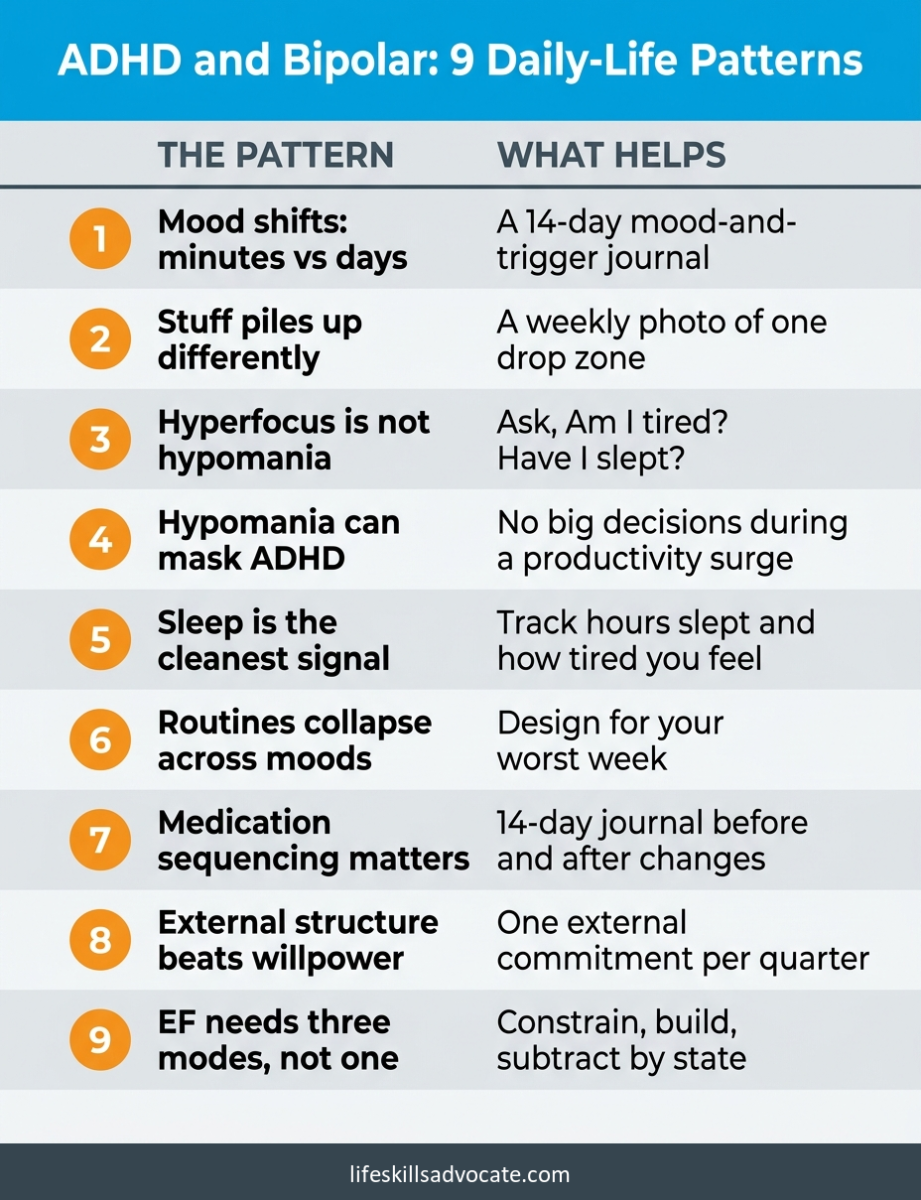
What follows is nine patterns, each paired with one practical move that holds across mood states rather than collapsing inside one of them.
TL;DR
If you live with both ADHD and bipolar, the diagnostic-comparison articles do not help much. Here is what does.
- Duration is the cleanest distinguisher: ADHD mood shifts last minutes to hours; bipolar mood states last days to weeks.
- Sleep is the cleanest mood signal you have. Track both how long you slept and how tired you felt.
- Routines built in a hypomanic week collapse in a depressive one. Design for your worst week, not your average self.
- Hyperfocus is task-locked; hypomania is everything-locked. The difference is whether your body is still tired.
- Your EF approach adapts to your current state. Three states, three kits, no single routine to fall off of.
This is educational, not medical advice. We are an executive function coaching team writing about daily life patterns and what helps. Medication choices, formal diagnosis, and the order conditions get addressed in are the prescribing clinician’s domain. If you are working with one already, treat this as a supplement to that conversation.
Five Things to Know About ADHD and Bipolar
Five quick facts about ADHD and bipolar, each with a direct source. The block exists for the readers, writers, and journalists who quote articles like this one.
| Fact | Detail | Source |
|---|---|---|
| How often ADHD and bipolar co-occur | About one in five adults with bipolar also meet criteria for ADHD; the reverse rate is similar. | Bipolar UK |
| The range across studies | Reported co-occurrence rates range from 5.1% to 47.1%. The wide range reflects how often the second condition is missed in either direction. | ADDitude (2025) |
| Hypomania duration threshold | Hypomania requires at least four consecutive days of elevated or irritable mood; mania requires at least seven. | Salvi, PMC8151516 (2021) |
| The 48-hour rule | When hypomania is suspected, wait two full days and two full nights of sleep before any major decision. | Psychology Today (Honos-Webb, 2022) |
| Residual cognitive load | 30% to 50% of mood-stable bipolar adults show persistent executive function impairment, and the effect is more pronounced when ADHD is also present. | Salvi, PMC8151516 (2021) |
Pattern 1: Mood Shifts in Minutes vs Days
Duration is the single cleanest line between ADHD and bipolar mood patterns. ADHD-driven shifts last minutes to hours and follow a visible trigger: a frustration, a deadline, a sensory pile-up, a rejection sting. The shift lifts when the trigger does.
Bipolar mood states do not work that way. They persist for days or weeks regardless of what is happening around you. Per a Good Health Psychiatry summary of DSM-5-TR criteria, hypomania requires at least four consecutive days of elevated or irritable mood, and mania at least seven. A bad ADHD afternoon does not last four days.
This is where emotional regulation in ADHD gets muddled with bipolar shifts in real time. Two snappy hours can come from very different sources, and the source decides what helps.
The move that helps: a 7-to-14-day mood-and-trigger journal. Write down each shift, the trigger if there was one, and how long it took to lift. Within two weeks the duration pattern is usually visible, and the journal becomes a useful object to bring to a prescriber.
Pattern 2: Stuff Piles Up Differently Inside Each State
ADHD and bipolar each leave a different fingerprint on your kitchen, your inbox, and your laundry pile. ADHD chaos has a recognizable shape: mail unopened, dishes accumulating, partial projects on every surface. The energy is there. The structure is not.
Depressive chaos looks different. Nothing is started at all, including the things ADHD would have at least begun. Hypomanic chaos looks different again: too many things started at once, new projects mid-conversation, a half-built bookshelf in the dining room.
The standard intervention of breaking a pile into smaller steps only addresses one of the three.
Depressive chaos needs subtraction. Hypomanic chaos needs containment.
The move that helps: pick a single physical drop zone and photograph it once a week, dated. Over two or three months the photos become a visual diary of which state you have been in. You stop relying on memory, which is the data source most damaged by mood shifts in the first place.
Pattern 3: Hyperfocus and Hypomania Are Not the Same
Hyperfocus and hypomania feel similar from the inside, which is why so many adults with both diagnoses misread one as the other for years. Both involve elevated energy, narrowed attention, and time distortion.
The scope is different, and the aftermath is different.
How to Tell Them Apart in Real Time
Hyperfocus is task-locked. You are absorbed in one specific thing, you can be interrupted with some friction, your body still tires, and you sleep that night.
Hypomania is everything-locked. The energy is not attached to a task. Sleep loss arrives without fatigue, new projects appear, risk tolerance rises, social and spending judgment compresses. You feel sharp, but a HealthCentral summary of the sleep distinction notes the body is no longer giving you the usual tired-by-bedtime signal.
The move that helps is a one-line check, inserted at any deep-work session past hour three: Am I tired? Have I slept? If the answer is no and no, the next move is the 48-hour rule from Pattern 5, not another two hours of work.
Pattern 4: Hypomania Temporarily “Fixes” the ADHD
There is a week, every few months, where the ADHD seems to lift.
You initiate without dread. You finish what you start. You return texts. You feel, briefly, like the person you imagine you would be if your brain just worked the way other people’s brains seem to. The temptation is to credit a new app, a new supplement, the new routine you finally stuck with. Sometimes it is one of those things. More often it is the front edge of a hypomanic phase, and the apparent ADHD relief is the side effect, not the result.
This is the week where adults with both diagnoses make the decisions they later regret. Quitting the job. Buying the equipment. Restarting the relationship.
The move that helps: a personal rule that nothing larger than a grocery-list decision happens during a productivity surge until two full nights of normal sleep have passed without the energy lifting. If the energy is real, it survives. If it is hypomania, it shifts.
Pattern 5: Sleep Is the Cleanest Mood Signal You Have
Sleep is the most reliable mood signal you have, and the cleanest line between an ADHD off day and a bipolar mood shift. For ADHD, less sleep produces predictable next-day consequences: worse executive function, more fatigue, slower reaction time.
For bipolar, the tell is different. Going from a normal schedule to one to three hours of sleep without daytime fatigue is the hallmark mania signal Allison Harvey documented in her 2008 American Journal of Psychiatry review. ADHD makes you tired and slow. Mania makes you feel fine while you should not.
This is where the link between ADHD and sleep matters most: tracking duration alone is not enough. You need two numbers.
The move that helps: a 7-to-14-day sleep log that records both hours slept and a perceived-fatigue score from one to ten the next afternoon. Short sleep with high fatigue is the ADHD pattern. Short sleep with low fatigue is the signal worth showing your prescriber.
Pattern 6: Routines Built in Hypomania Collapse in Depression
Routines built with this combination of conditions have to survive both directions of the mood curve. A beautiful spreadsheet routine designed during a high week, color-coded, twelve recurring tasks a day, works the week it is built. Two weeks later the depressive shift arrives, and the routine collapses inside three days.
The temptation is to blame willpower. That is not what is happening. The routine was calibrated to a self that could do twelve things. The current self can do three.
The fix is not a better spreadsheet. Run any new routine through one question: does this survive my worst week?
If a depressive week breaks it, it was never a routine. It was a hypomanic plan that worked for as long as the energy lasted. Our 6-step ADHD time management plan that survives past Wednesday goes deeper on building this kind of low-floor system.
Pattern 7: ADHD and Bipolar Medication Sequencing
Should you take stimulants for ADHD if you also have bipolar? That depends, and it is not a decision you make alone.
This Is the Prescriber’s Call, Not Yours and Not Ours
Most psychiatrists stabilize mood first and add a stimulant cautiously second, because an untreated mood condition plus a stimulant can destabilize the mood side. But a 2020 LiSIE mirror-image cohort study found central stimulant treatment may reduce self-injury risk in dual-diagnosis adults, so reflexively withholding stimulants is not always right either. This is a prescriber-side trade-off, not the kind this article should adjudicate.
What EF coaching can support is the data the prescriber needs. The move that helps: a 14-day-before, 14-day-after medication-change journal. Daily, log hours slept, energy on a one-to-ten scale, mood on a one-to-ten scale, and one note on focus. At the appointment, the prescriber gets 28 days of data instead of a vibes-based update.
Pattern 8: External Structure Outperforms Self-Imposed Routine
Adults with ADHD and bipolar tend to find that routines they build for themselves, alone, with no external accountability, lose to this combination. Not because of willpower. Every self-imposed routine needs internal motivation to maintain, and internal motivation is one of the first things mood shifts unmake.
External structure is different. A job with a start time. A class with a syllabus. A body-doubling partner. A weekly check-in with someone who notices when you stop showing up.
These hold because the work of maintaining them is not entirely yours.
Job loss or leaving school can hit dual-diagnosis adults harder than expected for exactly this reason. The scaffolding doing invisible work disappears, and the self-imposed systems were never load-bearing.
The move that helps: swap one self-imposed routine for one external commitment per quarter. The same logic behind building consistent routines for neurodivergent teens and young adults applies here. One commitment that does not depend on you being motivated that day.
Pattern 9: EF Needs Three Modes for ADHD and Bipolar Together
EF advice for ADHD and bipolar has to drop the assumption that there is one stable baseline self the reader will always be.
There is no average self at the center of the mood curve to design for. There are three selves, on rotation. The hypomanic-week self has too much energy and too little judgment. The euthymic-week self (mood-stable, neither high nor low) is the closest thing to a usable baseline. The depressive-week self has very little energy and a flattened sense that anything matters.
The move that helps is to build three kits, not one.
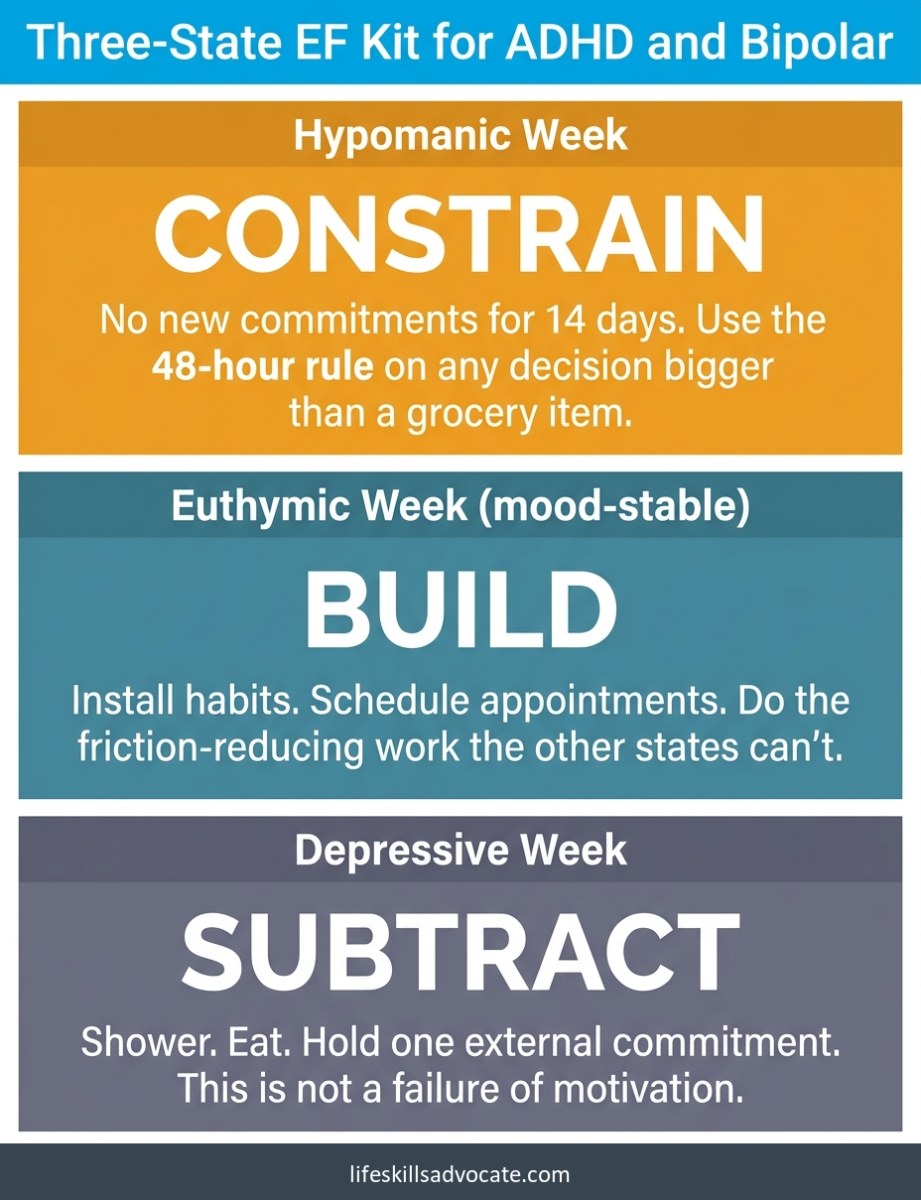
The constrain kit (hypomanic week): no new commitments for 14 days, the 48-hour rule on any decision bigger than a grocery item, a daily check-in with one person who can flag drift. The build kit (euthymic week) is where habits get installed and appointments scheduled. The subtract kit (depressive week) is the smallest: shower, eat, hold one external commitment, and read the foggy, wired, tired pattern of ADHD fatigue as data about which kit you are in.
This is ongoing pattern recognition, not a fix.
Frequently Asked Questions
How common is ADHD and bipolar together?
About one in five adults with bipolar also have ADHD. The reverse rate is similar.
What is the 48-hour rule for bipolar disorder?
When hypomania is suspected, wait two full days and two nights of sleep before any major decision: purchases, quitting, moving, restructuring. The judgment that feels urgent is the signal. Two nights of normal sleep usually settles the question.
Are my mood swings ADHD or bipolar?
Duration is the cleanest test you can run on yourself. ADHD-driven shifts last minutes to hours and follow a trigger; bipolar mood states last days to weeks and persist after the trigger is gone. A two-week mood-and-trigger journal usually surfaces the pattern, and if it does not, that is worth bringing to a prescriber alongside any prior thinking on ADHD or anxiety daily-life differences.
Why does my routine collapse every few weeks with ADHD and bipolar?
Because most routines are designed for a self that does not exist. The average self between hypomanic and depressive weeks is a mathematical fiction. A routine built in a high week assumes more energy than the low week can produce, and a routine built in a low week under-uses the high one. The fix is the three-state kit from Pattern 9, not a single better routine, and the willingness to swap kits as the state shifts rather than blaming yourself for falling off the one you built three weeks ago when you felt unstoppable.
Can I take stimulants for ADHD if I also have bipolar?
That is a prescriber’s call, not ours. Most psychiatrists stabilize mood first and add a stimulant cautiously second to avoid destabilizing the mood side, but recent research suggests reflexively withholding stimulants is not the right default for every dual-diagnosis adult. The EF-coaching scope here is helping you track sleep, energy, mood, and focus for 14 days before and after any medication change so your prescriber has data, not a vibes-based update. The dosing decision, the choice of compound, and the timing belong to whoever writes the prescription. If you do not have a prescriber yet, finding one experienced with both conditions matters more than the medication choice itself, because the sequencing is most of the actual work, not which compound lands on the chart.
Next Steps
If Pattern 6 hit closest, start there. The highest-leverage habit at this comorbidity is the data you collect about yourself, not the productivity system you try to install on top of it.
- Start a one-week sleep, mood, and energy log. Two numbers per day: hours slept and perceived fatigue. Two more if you can, mood and focus, each on a one-to-ten scale. Bring it to your next prescriber appointment.
- Build the EF side with structure. The Real-Life Executive Functioning Workbook by Chris Hanson and Amy Sippl is the digital workbook our coaching clients work through for the ADHD-side habits. It does not address the mood side; that one belongs in a clinical setting.
- If one-on-one help is the right next step. Our executive function coaching is for adults who want a coach to help build the three-state kit and the external structures Pattern 8 names. Coaching is not therapy; if you do not have a prescriber and a therapist already, those are the first calls.
- Find your weakest EF subskill first. The Free Executive Functioning Assessment takes about ten minutes and surfaces which subskill is most worth working on next.
Further Reading
- ADHD in Bipolar Disorder: Clinical Aspects and Treatment – Salvi, PMC (2021)
- Bipolar and ADHD – Bipolar UK
- The Bipolar Disorder + ADHD Puzzle – ADDitude Magazine (2025)
- Impulsivity and Bipolar Disorder: 5 Skills That Can Help – Psychology Today, Honos-Webb (2022)
- Sleep and Mood Across Bipolar States – Harvey, American Journal of Psychiatry (2008)
- DSM-5-TR Duration Criteria Summary – Good Health Psychiatry
- Sleep as the Hyperfocus vs Hypomania Distinguisher – HealthCentral
- Treatment Sequencing for ADHD with Bipolar – Ubie Health
- Central Stimulant Treatment in Dual-Diagnosis Patients (LiSIE Mirror-Image Study) – PMC (2020)
- Emotional Regulation in ADHD – Life Skills Advocate
- The Connection Between Trouble Sleeping and ADHD – Life Skills Advocate
- The 6-Step ADHD Time Management Plan That Survives Past Wednesday – Life Skills Advocate
- 5 Ways to Build Consistent Routines for Neurodivergent Teens and Young Adults – Life Skills Advocate
- ADHD Fatigue: The Foggy, Wired, Tired Pattern – Life Skills Advocate
- ADHD or Anxiety: Daily-Life Differences – Life Skills Advocate
- Real-Life Executive Functioning Workbook – Life Skills Advocate
- Executive Function Coaching – Life Skills Advocate
- Free Executive Functioning Assessment – Life Skills Advocate