
You sit down with a new board game, crack open the rulebook, and somewhere around the third page you have quietly checked out. That is not a character flaw, and it is not a sign these games are not for you. It is usually the single biggest reason board games for executive functioning get recommended to ADHD adults and then left on a shelf.
Most lists of board games for executive functioning, though, are built for somebody’s seven-year-old. The titles say executive function, the photos show primary-colored counting games, and the advice assumes a parent reading over a kid’s shoulder. This is the grown-up version, for ADHD and autistic teens and adults who want a game that respects an adult brain and still works with it.
We picked these by the executive function skill each one trains, flagged the ones that are heavier than they look, and added a section on how to actually stay in a game when executive function is the thing already running low.
TL;DR
The short version, if you want board games for executive functioning and you are an adult or teen with ADHD, not the parent of a kindergartner:
- The best ones are chosen by the EF skill they train: planning, working memory, cognitive flexibility, and impulse and attentional control.
- For an ADHD brain, the upkeep (rules, downtime, tracking other people) is usually the problem, not the thinking, so cooperative and low-maintenance games tend to win.
- Learn by playing a round and looking rules up as you go. You do not have to read the whole rulebook first.
- Three picks were cut this update for being kids’ games or a feelings card deck rather than real board games.
- Games are a low-stakes way to practice EF and have fun, not a substitute for real support.
A quick note before the list: this is educational, not medical or diagnostic advice. If you are working on executive function with a professional, treat these games as a supplement to that, not a replacement.
How Board Games for Executive Functioning Work
Board games for executive functioning quietly recruit the exact skills that executive function is made of: holding rules in mind, planning a few steps out, switching tactics when the board changes, waiting your turn, and handling a loss. That is the appeal and the catch at once, because those are also the skills an ADHD brain finds expensive.
The research is promising but modest, and worth stating plainly. A 2021 longitudinal study in Trends in Neuroscience and Education found that board-game play was associated with stronger executive function later on, though it followed young children rather than adults. A 2023 randomized trial found that playing modern board and card games activated core executive functions in players, again with a small group of kids. Most of this work is done with children, so treat it as a reason to expect practice effects, not a promise of the same results for a grown-up brain.
Broader research on game-based learning points the same way: play tends to keep people engaged where worksheets do not. So these games are a genuinely good place to practice, not a magic solution and not a substitute for support that actually helps with ADHD. We sort them the way we sort everything, by the executive function skill each one leans on, lined up against the 11 executive functioning skills these games practice.
| What the research says about board games for executive functioning | Detail | Source |
|---|---|---|
| Board-game play is associated with stronger executive function | 2021 longitudinal study of young children; associational, small sample | Gashaj et al., 2021 |
| Playing modern board and card games activated core executive functions in players | 2023 randomized trial; small group of children | Moya-Higueras et al., 2023 |
| Game-based learning tends to keep people more engaged than worksheets do | 2020 journal article on game-based learning; broad engagement finding, not ADHD- or board-game-specific | Simulation & Gaming (SAGE), 2020 |
Planning and Strategy Games
The board games for executive functioning that lean hardest on planning all ask the same thing: hold a goal in mind, work backward, and adjust when the board shifts. If long-horizon planning is the exact thing that wears you out, start at the top and work down, because they get heavier as you go.
1. Ticket to Ride
Ticket to Ride is the gateway planning game for a reason: collect train cards, claim routes toward a few secret destinations, and the whole thing clicks inside one round. The planning is real and it never buries you in rules, though another player can grab the route you were saving.
Best for: a first strategy game that will not punish you for learning as you play.
2. Splendor
Splendor hands you a small economy: collect gem tokens, buy cards that make future cards cheaper, and build toward points. It is almost pure delayed-gratification planning with very little to read, though the abstract look can feel a little dry without a theme to latch onto.
Best for: reward-delay and sequencing practice with almost no rules overhead.
3. Kingdomino
Kingdomino is domino-laying with a spatial twist: draft tiles and slot them into your kingdom to score matching terrain. Rounds are short and the choices sit right in front of you.
Best for: spatial planning in short bursts, and a low-barrier pick for mixed-age tables.
4. Cascadia
Cascadia has you lay habitat tiles and place wildlife to score several patterns at once. It is calm, good-looking, and forgiving, with a shifting tile market that keeps you re-adapting the plan, though juggling several scoring goals at once can feel busy on the first play.
Best for: low-stress spatial planning, with a solo mode for practice.
5. Settlers of Catan
Settlers of Catan is the classic on-ramp to heavier planning: forecast resources, trade for what you lack, and build out a settlement network. The constant trading keeps everyone involved between rolls, though a bad run of dice can starve you through no fault of your plan.
Best for: resource forecasting and negotiation with three or four players.
6. 7 Wonders
7 Wonders solves the biggest ADHD complaint about strategy games: downtime. Everyone drafts and plays at the same time, so you never wait six turns to act, and the long-game planning stays genuine once the card symbols click, which takes a game or two.
Best for: bigger groups where you do not want to sit and wait.
7. Dominion
Dominion is the deckbuilder that launched a genre: buy cards into your own deck and sequence them into an engine that snowballs. The payoff grows as your deck gets stronger, though the wide-open card choices can stall you on a day when too many options is the problem.
Best for: sequencing and engine-building when you want more depth.
8. RoboRally
RoboRally makes you program a robot’s full move sequence, then watch it run, often straight into a wall. The current in-print version is the Renegade Game Studios 2023 edition. It is planning, prediction, and laughing at your own crashes, since other robots bumping yours can send even a perfect plan sideways.
Best for: anyone who learns planning better when the failures are funny.
9. Chess
Chess is the gold standard for look-ahead planning, and it counts as executive function practice without anyone’s permission, though, being one-on-one and slow, it asks for focus that not every day has. If a blank board is the barrier, No Stress Chess uses action cards to teach the moves while you play.
Best for: deep, deliberate planning with a single opponent.
10. Agricola
Agricola is worker-placement under real scarcity: you run a farm, never have enough actions, and have to plan tightly to keep your family fed. It works the forward-planning muscle hardest, and it is genuinely heavy, with a real rules lift before game one.
Best for: players who want a serious planning challenge, including solo.
11. Terraforming Mars
Terraforming Mars is long-horizon engine-building at its most ambitious: play projects across a full game to make the planet livable, where an early choice echoes an hour later and the long sessions ask for stamina, not just a free evening.
Best for: a big, immersive planning project when you have the time.
Problem-Solving Games You Play as a Team
Here is where co-op games earn their place on any list of board games for executive functioning. When the table solves a problem together instead of competing, a loss stops being a verdict on you, which takes the sting out of the rejection sensitivity that turns game night into a shutdown for a lot of ADHD adults.
12. Forbidden Island
Forbidden Island is the easiest co-op problem-solver to get going: the island sinks a little each turn, and the team grabs four treasures and escapes before it goes under. Everyone works out the move order together, and on the harder settings it can still beat you soundly.
Best for: a short, low-cost first co-op game for a nervous or mixed group.
13. Pandemic
Pandemic taught a generation how to lose together gracefully: you are a team racing to contain outbreaks across a world map. Every turn is a shared problem with no single right answer, though one confident player can end up quarterbacking the table, so agree to share the calls up front.
Best for: groups who want teamwork without anyone going home a loser.
14. Sagrada
Sagrada turns each turn into a small logic puzzle: draft dice and place them into a stained-glass window without breaking the color and number rules. Calm and contained, though it is competitive rather than co-op, so the team buffer from the games above does not apply here.
Best for: puzzle-minded players who like a clear problem each turn.
Working Memory Games
These games lean on working memory, the executive function skill that holds and juggles information in the moment. If that is your sticking point, the same supports from our guide to working memory apply at the table too: write things down, say them out loud, and pick games that let you.
15. Hanabi
Hanabi flips your hand around so you see everyone’s cards except your own, and the team gives limited clues to play a fireworks display in order. You track what you have been told and what you can infer, which can be tiring on a low-capacity day.
Best for: a short co-op that trains working memory with no board to manage.
16. The Crew
The Crew is a co-op card game where you complete space missions almost silently: each player reveals only one card to signal, so the table remembers what has been played and reads meaning into the rest. It won a major adult-gamer award, though that near-silent inference can feel like pressure on a quiet table.
Best for: a regular group ready for a clever, escalating campaign.
17. Chronicles of Crime
Chronicles of Crime runs through a companion app while you investigate scenes and cross-reference clues. The detective work is one long working-memory exercise, and the app carries the rules upkeep for you, though leaning on it makes for less of an unplugged night.
Best for: story-driven players who would rather solve a mystery than track a rulebook.
Games for Cognitive Flexibility
Cognitive flexibility is the executive function skill of shifting your thinking when the situation changes, the opposite of getting stuck. These games reward dropping your first idea, and our flexible thinking guide and the free Flexible Thinking Disruptions Deck work the same skill away from the table.
18. Codenames
Codenames is one word against the whole table: a clue-giver links several hidden words with a single hint, and teammates think sideways to guess them. Lateral thinking dressed up as a party game, best with four players or more.
Best for: a loud, social way to stretch lateral thinking with a crowd.
19. Dixit
Dixit hands everyone surreal illustrated cards and asks for a clue that is not too obvious and not too obscure. It rewards divergent, perspective-shifting thinking that rarely shows up on game night, though with no single right answer, literal thinkers can find it slippery.
Best for: creative, word-and-image players who like a gentle, imaginative table.
20. Magic: The Gathering
Magic: The Gathering is the deep end of adapting on the fly: build a deck, then adjust your plan turn by turn as the board shifts under you. A two-player Starter Kit is a low-cost on-ramp for ages 13 and up, even though the wider game gets expensive and complicated fast.
Best for: players who want a lifelong game and real in-the-moment adaptation.
21. Race for the Galaxy
Race for the Galaxy is a fast card game about building a space empire, and it rewards changing your whole plan based on the cards you draw. It is excellent, but it is taught almost entirely through dense icons, and that icon language is a real wall on the first play or two.
Best for: symbol-comfortable players who do not mind a steep first game.
Time Management, the Hardest Category to Fill
Genuinely good time-management board games barely exist. Most games measure turns, not minutes, so this is the thinnest executive function category on the shelf, and real time-management skill is better built with a system like our ADHD time-management plan than with any board game. One title does put the clock front and center.
22. Quicksand
Quicksand is a real-time co-op built around sand timers: the team races to keep things moving before the sand runs out, so pacing and tempo are the whole game. Managing time, not turns, is the point, though it is newer and less proven than the classics.
Best for: anyone who wants to feel time pressure in a low-stakes way.
Games for Emotional Control, Attention, and Self-Monitoring
This last group is a grab bag, and we want to be straight about it. A competitive loss in any game is a chance to practice emotional control, and our guides to impulse control and emotional regulation go deeper. The three below are filed by the specific executive function skill each leans on, even when it is closer to a social or physical skill than strategy.
23. Awkward Yeti Anxiety Attack
Awkward Yeti Anxiety Attack is a light, themed game about spotting and defusing anxiety triggers, based on the popular comic. We file it under emotional control for the conversation it starts, not as a strategy trainer.
Best for: naming and talking about feelings in a low-pressure, slightly silly way.
24. KLASK
KLASK is a fast magnetic tabletop game, part air hockey and part dexterity contest, that demands sustained focus and quick attention shifts. It trains focus and reflexes more than thinking.
Best for: burning off energy while practicing locked-in attention.
25. The Resistance: Avalon
The Resistance: Avalon is a hidden-roles game where good and evil players bluff and deduce across a big table. Watching your own tells and reading the room is self-monitoring in real time, more social skill than board play, and it needs at least five players to get going.
Best for: a bigger group that likes bluffing and reading people.
Compare These Board Games for Executive Functioning by Skill
Here are all 25 board games for executive functioning, in the order they appear above, so you can scan by the EF skill you want to stretch, the player count you have, and how heavy a night you are up for.
| Game | EF Skill | Players | Complexity | Why it suits an ADHD brain |
|---|---|---|---|---|
| Ticket to Ride | Planning | 2-5 | Light | Clicks in one round, low rules wall |
| Splendor | Planning | 2-4 | Light | Quiet and abstract, almost no upkeep |
| Kingdomino | Planning | 2-4 | Light | Short rounds, choices in plain view |
| Cascadia | Planning | 1-4 | Light to medium | Calm and forgiving, with a solo mode |
| Settlers of Catan | Planning | 3-4 | Medium | Trading keeps you busy between rolls |
| 7 Wonders | Planning | 3-7 | Medium | Simultaneous turns, almost no downtime |
| Dominion | Planning | 2-4 | Medium | Satisfying engine that snowballs |
| RoboRally | Planning | 2-6 | Medium | Failure is funny, not shameful |
| Chess | Planning | 2 | Heavy | No Stress Chess on-ramp to learn by doing |
| Agricola | Planning | 1-4 | Heavy | Deep planning for a high-focus day |
| Terraforming Mars | Planning | 1-5 | Heavy | Big project for when you have stamina |
| Forbidden Island | Problem-solving | 2-4 | Light | Cheap, short, cooperative |
| Pandemic | Problem-solving | 2-4 | Medium | Lose together, not alone |
| Sagrada | Problem-solving | 1-4 | Medium | One clear puzzle each turn |
| Hanabi | Working memory | 2-5 | Light | Co-op, no board to manage |
| The Crew | Working memory | 3-5 | Medium | Escalating missions, quiet teamwork |
| Chronicles of Crime | Working memory | 1-4 | Medium | App handles the rules upkeep |
| Codenames | Cognitive flexibility | 2-8 | Light | Loud, social, fast |
| Dixit | Cognitive flexibility | 3-6 | Light | Imaginative, no math |
| Magic: The Gathering | Cognitive flexibility | 2 (up to 5) | Medium-heavy | Starter Kit is a gentle on-ramp |
| Race for the Galaxy | Cognitive flexibility | 2-4 | Medium-heavy | Great game, steep icon learning curve |
| Quicksand | Time management | 1-7 | Light | Time pressure without keeping score |
| Awkward Yeti Anxiety Attack | Emotional control | 2-6 | Light | Names feelings in a light way |
| KLASK | Attentional control | 2 | Light | Physical focus, burns energy |
| The Resistance: Avalon | Self-monitoring | 5-10 | Light | Big-group bluffing, needs five or more |
How to Play Board Games With an ADHD Brain
Picking the right board games for executive functioning is half the work. The other half is a handful of habits that keep an ADHD brain in the game instead of bailing on it. None of this is about playing dumbed-down games. It is about removing the executive function tax that has nothing to do with whether the game is fun.
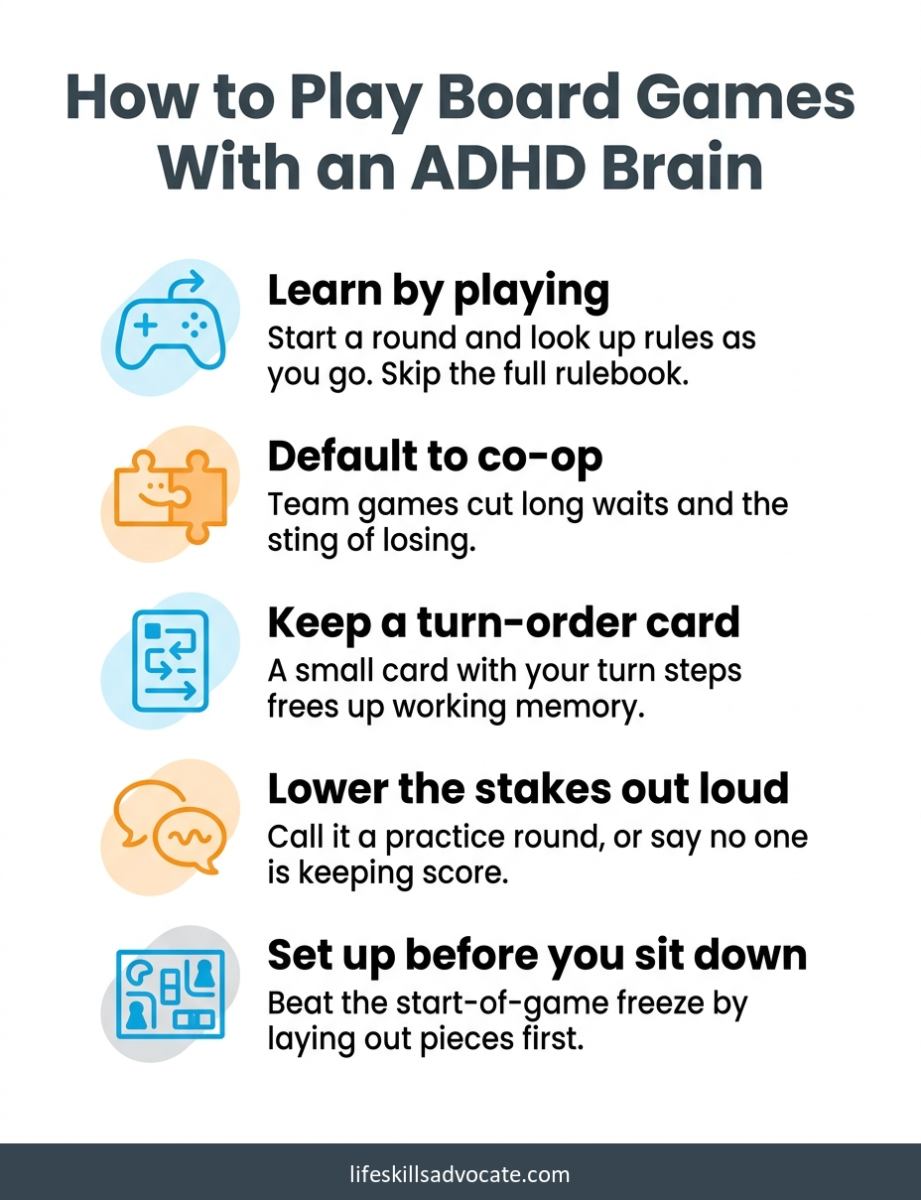
- Learn by playing. Set up, start a round, and look rules up as you hit them. The full rulebook lecture is where most games die for ADHD adults, and almost no game actually requires it.
- Default to co-op. Cooperative and same-time games cut the two things the community complains about most: long waits between turns and the sting of losing.
- Keep a turn-order card in front of you. A small card listing the phases of your turn offloads the part working memory keeps dropping.
- Lower the stakes out loud. Say before you start that this is a practice round or that nobody is keeping score. Rejection sensitivity is real, and naming it takes some of its power.
- Set up before you sit down. Start-of-game paralysis is its own hurdle, so get the box open and the pieces out before the pressure of go time.
If one of these is clearly your wall, that is useful information. The step that stalls the game is often the same executive function skill that stalls the rest of your week, which is worth knowing.
Frequently Asked Questions
What are the best board games for executive functioning for ADHD adults?
It depends on which executive function skill you want to work and how much rules overhead you can spare that day. For a lot of ADHD adults the best entry point is a cooperative, low-upkeep game like Forbidden Island or a fast, same-time one like 7 Wonders, because they cut the two biggest pain points: waiting through other people’s turns and losing on your own. From there, match the game to the skill you want to stretch using the comparison table above. Heavier titles are rewarding, but they ask for focus you may not have on a hard day. Best-of lists cannot tell you which skill is your sticking point or how much energy you have tonight. The honest answer is that the best game is the one you will actually take off the shelf a second time. So start light and trade up from there.
What activities boost executive function?
Plenty of everyday things do, not just games. Activities that make you plan ahead, hold details in mind, and change course when something shifts all give executive function a workout: cooking from a recipe, planning a trip, learning an instrument, team sports, and yes, board games. What matters is steady, low-pressure practice you will actually come back to, which is why a game you enjoy beats a worksheet you dread. Games are a good place to start, not a replacement for support that helps directly with ADHD.
Do board games for executive functioning actually work?
A qualified maybe. The studies above link board-game play to stronger executive function, but they are small and mostly done with children, so this is not settled. What games clearly do is give you a low-stakes, genuinely fun place to practice planning and working memory. Whether that practice carries over to daily life is still an open question.
What if you freeze at the rules or lose track on your turn?
First, that is one of the most common things ADHD adults say about board games, so you are in good company. The fixes are practical: learn by playing a round instead of reading the whole rulebook, keep a turn-order card next to you, and lean toward co-op games where a teammate can catch what you drop. None of this makes the freeze vanish. On a low-capacity day it may still happen, and that is allowed.
Are these executive functioning games good for teens too?
Most of them, yes. Plenty are rated for ages 10 and up and work well for neurodivergent teens, especially the lighter co-op and gateway picks. The heavier planning games and the social bluffing ones suit older teens and adults better. The one thing to skip is anything built for young children, which is why two kid-focused games and a feelings card deck came off this list.
Where to Start This Week
If the same executive function step keeps stalling the game, that is usually the thing worth working on away from the table too. A few ways to start this week:
- Pick one game by skill, not cover art. Use the table above, choose the executive function skill you most want to stretch, and grab the lightest game in that row.
- Start co-op. A first night with Forbidden Island or Hanabi and a turn-order card next to you removes most of the usual friction.
- Take the free executive functioning assessment to see which skills are pulling the most weight right now.
- For practice off the table, the Real-Life Executive Functioning Workbook and one-on-one executive function coaching for adults work the same skills directly. Coaching is skill-building and practical rather than therapy, so it fits the everyday executive function stuff, not mental health support.
- Write down the step that stalls you. The phase of the game where you freeze, lose track, or snap-decide is the single most useful note you can take away today.
Further Reading
- Board games and executive function in young children (longitudinal study) – Gashaj et al., Trends in Neuroscience and Education (2021)
- Modern board and card games and executive functions (randomized trial) – Moya-Higueras et al., NIH PMC (2023)
- Game-based learning and engagement – Simulation & Gaming, SAGE (2020)
- The 11 Executive Functioning Skills – Life Skills Advocate
- Working Memory Supports for Diverse Learners – Life Skills Advocate
- Impulse Control Supports for Diverse Learners – Life Skills Advocate
- Flexible Thinking Skills – Life Skills Advocate
- Emotional Regulation and ADHD – Life Skills Advocate
- An ADHD Time-Management Plan – Life Skills Advocate
- Flexible Thinking Disruptions Deck (free) – Life Skills Advocate
- Free Executive Functioning Assessment – Life Skills Advocate
- Real-Life Executive Functioning Workbook – Life Skills Advocate
- Executive Function Coaching for Adults – Life Skills Advocate