
Most problem solving frameworks assume your brain can hold a problem in working memory, calmly generate a list of options, evaluate trade-offs, pick one, and then reflect on how it went. That is five separate cognitive tasks stacked on top of each other. For a lot of neurodivergent learners, the stack collapses somewhere around step two.
The IDEAL problem solving method, developed by Bransford and Stein in the 1980s, is one of the few step-by-step models that educators and coaches still use by name decades later. The reason it has stuck around is that it breaks problem solving into pieces small enough to actually teach. But the model was designed for general audiences, not specifically for brains that run into executive function bottlenecks at every turn.
This article walks through each step, names the executive function skill it depends on, and offers adjustments for the places where ADHD, autism, and other forms of neurodivergence tend to make things harder than they need to be.
A quick note: this is educational content, not medical or diagnostic advice. If executive function challenges are significantly affecting daily life, a conversation with a qualified professional is the right next step.
TL;DR
The IDEAL problem solving method is a 5-step framework created by Bransford and Stein. Each step maps to specific executive function skills, which is why neurodivergent learners often need adjustments at each stage.
- Identify the problem requires attentional control and enough self-awareness to name what is actually wrong, not just react to the frustration.
- Define the outcome puts working memory to work holding both the problem and a goal at the same time.
- Explore options depends on cognitive flexibility, which is where rigid “first idea only” thinking tends to stall things out.
- Anticipate outcomes and act is the task initiation bottleneck, plus the impulse control to evaluate before jumping.
- Look back and learn calls on self-monitoring and metacognition, and it is the step that gets skipped most often.
What Is the IDEAL Problem Solving Method?
The IDEAL problem solving method is a structured approach to working through problems, created by cognitive psychologists John Bransford and Barry Stein. They first published it in 1984 in their book The Ideal Problem Solver, with a second edition in 1993. The name is an acronym: Identify the problem, Define the outcome, Explore options, Anticipate outcomes and act, Look back and learn.
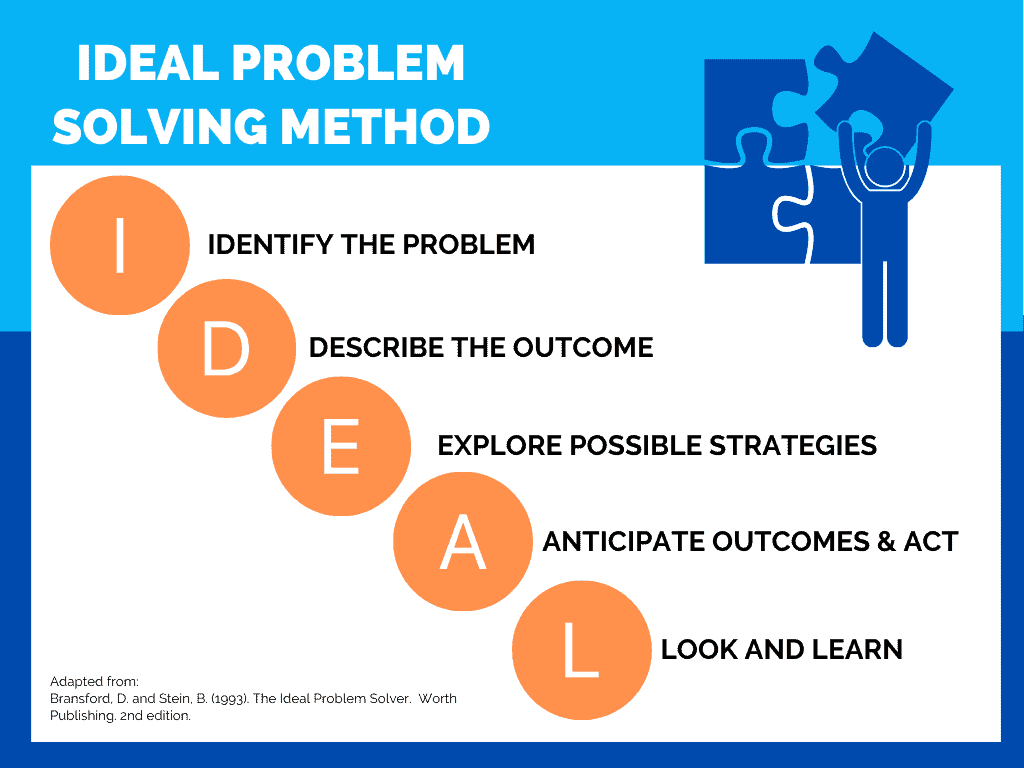
It has been used in K-12 classrooms, college courses, workplace training programs, social work, and clinical settings for over 40 years. Of all the problem solving models floating around in education, this is the one I hear referenced most often in coaching conversations and IEP meetings, probably because the acronym is easy to remember and the steps are concrete enough to actually practice. Problem solving sits within a broader set of executive function skills that develop across the lifespan, and understanding where your learner is developmentally can help set the right expectations for each step.
Bransford and Stein emphasized that the model is iterative. You do not have to move through it in a straight line, and looping back to an earlier step is part of the process, not a failure. That detail matters for neurodivergent learners, because “start over” and “you did it wrong” sound very different from “let’s loop back to the Define step and adjust.”
The 5 Steps of the IDEAL Model (and Where ND Brains Get Stuck)
Each of these five steps sounds simple on paper. The problem is that each one also leans on a specific executive function skill, and those skills are exactly where ADHD, autism, and other neurodevelopmental differences tend to create friction. Research consistently shows that people with ADHD are roughly 30% behind neurotypical peers in executive function development, which means the gap between “understands the concept” and “can reliably do it in the moment” is real and measurable.
Here is what each step asks the brain to do, what tends to go sideways, and what actually helps.
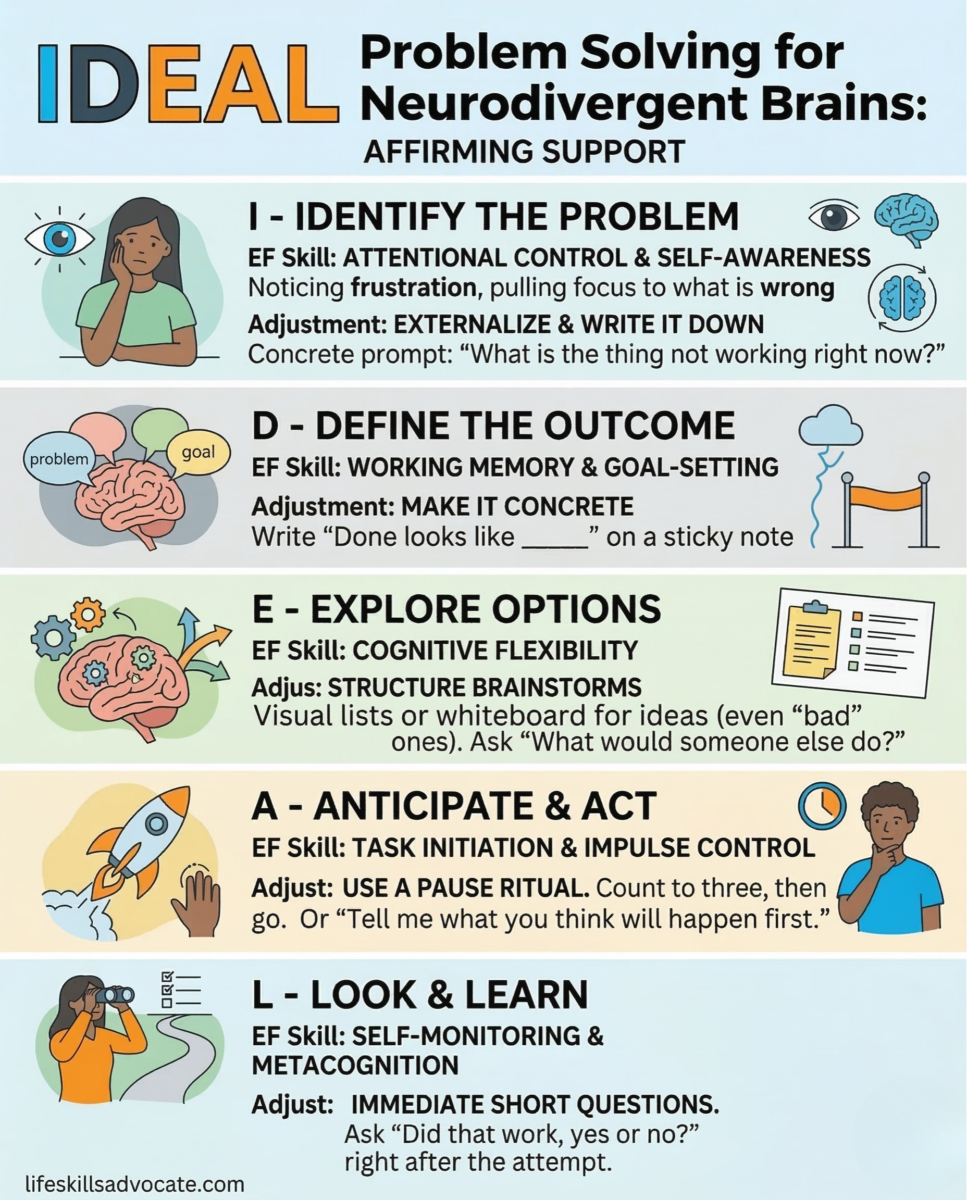
I: Identify the Problem
The EF skill: attentional control and self-awareness.
Before you can solve anything, you have to notice that a problem exists and name it accurately. That requires pulling your attention away from whatever you are currently doing (or feeling) and directing it toward something that may not feel urgent yet.
For a student who just got a failing grade back, the problem might look like “I didn’t study enough,” but the actual problem could be “I didn’t know when the test was” or “I couldn’t start studying because I didn’t know where to begin.” Neurodivergent learners, especially those with ADHD, often react to the emotional hit of the situation (frustration, shame, shutdown) before they get anywhere near identifying the actual problem. Some learners with autism may recognize the problem clearly but struggle to articulate it verbally under pressure, which can look like “not caring” to the people around them.
What helps: Externalize the identification step. Ask “What happened?” before “What should you do?” Write it down or draw it. Keep the prompt concrete: What is the thing that is not working right now? If emotions are high, this is where a pause (what some coaches call “Step 0”) earns its place. The identification step only works when the brain is calm enough to think, which is not a given.
D: Define the Outcome
The EF skill: working memory and goal-setting.
Once a problem is identified, this step asks the learner to hold the problem in mind while simultaneously defining what a good outcome would look like. That is a dual-task working memory demand, and working memory is one of the most consistently affected EF skills in ADHD.
At home, this can look like a teen who knows the kitchen is a mess (problem identified) but cannot articulate what “clean enough” means, so they either do nothing or clean obsessively for two hours. Defining the outcome does not have to be ambitious. “The dishes are done and the counters are wiped” is a defined outcome. “The kitchen is clean” is not, because it leaves the finish line invisible.
What helps: Make the outcome concrete and external. Write it on a sticky note: Done looks like ____. For younger learners, a photo of “done” can work better than a verbal description. The more specific the outcome, the less working memory it costs to hold onto.
E: Explore Options
The EF skill: cognitive flexibility.
This is the step where I see the most breakdowns in coaching. The model asks learners to brainstorm multiple possible solutions before picking one. That requires cognitive flexibility: the ability to shift perspectives, consider alternatives, and resist locking onto the first idea that shows up.
Cognitive rigidity is common in both ADHD and autism. It can look like a learner who insists their first idea is the only option, or who gets stuck in a loop of “but that won’t work” without generating anything new. In one study, researchers found that adults with ADHD spent about the same amount of planning time on easy problems as controls, but did not increase their planning time when problems got harder. They defaulted to their first approach regardless of complexity.
What helps: Structure the brainstorm. Instead of “think of some options,” try “give me two ideas, even bad ones.” Use a list, sticky notes, or a whiteboard so ideas exist outside the brain. One technique that works well: ask the learner what someone else would do. (“What would your friend try? What would a teacher suggest?”) Shifting perspective externally is often easier than generating new ideas internally.
A: Anticipate Outcomes and Act
The EF skill: task initiation and impulse control.
Two things tend to happen here, and they are opposites. Some learners (especially those with impulsive ADHD profiles) skip the “anticipate” part entirely and jump straight to action. Others get stuck in evaluation mode, turning the decision over and over without ever starting. Both patterns are executive function problems, not personality flaws.
Research on ADHD and problem solving describes this well: people with ADHD tend to favor speed over accuracy, not because they do not care about getting it right, but because the executive brake that says “wait, think about what might happen” is less reliable. In workplace settings, this is the colleague who fires off the email before reading it through. In a classroom, it is the student who blurts out an answer and then realizes it was wrong.
What helps: For impulsive actors, a brief pause ritual before action (“count to three, then go” or “tell me what you think will happen first”). For stuck evaluators, reduce the decision to two options instead of five, and set a time limit on choosing. The goal is not perfect decisions. It is decisions that happen.
L: Look Back and Learn
The EF skill: self-monitoring and metacognition.
This is the step that gets skipped. Once a problem is solved (or abandoned), the brain wants to move on. Looking back requires self-monitoring (“How did that go?”) and metacognition (“What would I do differently?”), both of which are high-demand EF tasks that feel like extra work when the problem is already behind you.
I will be honest: this is also the step with the thinnest practical guidance for neurodivergent learners specifically. Most of the research on reflection and metacognition was conducted with neurotypical populations, and the “just journal about it” advice does not land for a lot of the people I work with. What I have found is that reflection works better when it is short, specific, and happens immediately, not as a separate homework assignment three days later.
What helps: One question, right after the attempt: Did that work, yes or no? If yes, name what worked. If no, name one thing to try differently. Keep it to 30 seconds. A coach, parent, or teacher can prompt this, but the goal is for the learner to eventually ask themselves. Over time, that is how problem solving skills become more automatic rather than effortful.
IDEAL Problem Solving Method: Quick Reference
| Fact | Detail | Source |
|---|---|---|
| IDEAL problem solving method origin | Created by John Bransford and Barry Stein | Bransford & Stein, 1984 |
| Acronym | Identify, Define, Explore, Anticipate & Act, Look & Learn | Bransford & Stein, 1993 (2nd edition) |
| Primary use settings | Education (K-12 and higher ed), workplace training, coaching, clinical practice | ERIC |
| Executive function skills involved | Working memory, cognitive flexibility, inhibition, task initiation, self-monitoring | Cleveland Clinic |
| ADHD executive function delay (average) | Roughly 30% behind neurotypical peers in self-regulation development | Barkley, via ADDitude |
How to Teach the IDEAL Problem Solving Method
A few years into coaching, I started keeping a list of the problems my clients brought to sessions. Not the big life problems, but the Tuesday-afternoon ones: a confusing homework assignment, a disagreement with a roommate, a parking ticket they did not know how to handle. What I noticed was that the learners who had practiced with structured problem solving, even informally, moved through those Tuesday problems faster. Not because they had memorized steps, but because they had a starting place that was not panic.
The single most effective way to teach this method is to practice it with problems that do not matter much. Low stakes, low emotion, high repetition. Use scenarios like “the printer is out of paper” or “you forgot your lunch” before tackling “you failed the test” or “your friend is not talking to you.”
A few approaches that work:
- Role-play a scenario using the 5 steps out loud. The learner does not need to be good at it. They need to be familiar with the sequence so it is available when things get harder.
- Use a visual reference card or poster with the 5 steps. Reducing working memory load during the process makes every step easier. The Stop Think Act method pairs well with IDEAL as a simpler front-end for younger learners.
- Practice in pairs or small groups. Some learners think better out loud, and hearing someone else walk through a problem builds pattern recognition.
- After a real problem comes up, revisit it later using the five steps as a debrief. Not as a correction (“you should have done this”), but as a low-pressure replay (“let’s walk through that with the steps and see what we notice”).
If you want structured exercises for this, the Real-Life Executive Functioning Workbook includes activities that target problem solving alongside other executive function skills in real-world contexts.
FAQ
What does IDEAL stand for in the IDEAL problem solving method?
Identify the problem
Define the outcome
Explore options
Anticipate outcomes and Act
Look back and Learn.
It was created by John Bransford and Barry Stein in 1984.
Can the IDEAL problem solving model help with ADHD?
Yes, with adjustments. The model gives a concrete sequence that reduces the “where do I even start?” problem, which is a common task initiation barrier in ADHD. The key is adapting each step to account for working memory limits, cognitive rigidity, and impulse control. Without those adaptations, the steps can feel like one more thing to remember, which is the opposite of helpful. If ADHD-related executive function challenges are a significant factor, pairing the method with other supports (like visual checklists, coaching, or problem solving IEP goals) often makes the difference between a model that sits on a poster and one that actually gets used.
At what age can you start teaching the IDEAL method?
Simplified versions work with children as young as 7 or 8, especially if you reduce it to three visible steps (What happened? What can I try? Did it work?). The full five-step model is generally a better fit for teens and adults who can handle the working memory and metacognitive demands. Keep in mind that executive function development varies a lot between individuals, so age is a rough guide, not a cutoff.
What if my learner gets stuck on one step and won’t move forward?
That is useful information, not a failure. The step where someone gets stuck is usually the step where the executive function demand exceeds what they can handle right now. If a learner keeps stalling at “Explore options,” that points to cognitive flexibility as the bottleneck, and you can address that directly rather than pushing through the whole model again.
Sometimes getting stuck also signals that the emotional load of the problem is too high for structured thinking. Backing up to a regulation step (breathing, movement, a break) before returning to IDEAL is not cheating. It is realistic. There is no universal fix for when a learner digs in and refuses to engage. Some days the model works, and some days it does not. The goal is familiarity over time, not compliance in any single moment.
Is the IDEAL method the same as cognitive-behavioral problem solving?
Not exactly. CBT-based problem solving models (like those used in therapy) share similar structures: identify the problem, generate alternatives, evaluate, act, review. But CBT models are embedded in a therapeutic framework that also addresses thought patterns and emotional responses. IDEAL is a general-purpose educational model. They overlap, but the contexts and goals are different. Whether one is a better fit depends on what the learner needs right now.
Next Steps
If any of those five steps felt like a description of what goes wrong on homework night, or during a disagreement, or at the start of any task that feels uncertain, that recognition is the starting point.
- Write down which IDEAL step tends to break down most for your learner (or for you). That tells you where to focus, instead of trying to teach all five steps at equal depth.
- Try one low-stakes practice round this week. Pick a problem that does not matter much and walk through the five steps out loud.
- Use the free executive functioning assessment to get a clearer picture of which EF skills are creating the most friction. Problem solving rarely breaks down in isolation.
- If you want structured support, executive function coaching can help build these skills through real-life practice with accountability. Coaching is skill support, not therapy or medical care.
About This Post
This post was written by Chris Hanson, founder of Life Skills Advocate. Chris is a neurodivergent former special education teacher and executive function coach who has worked with teens, young adults, and families for more than a decade. The research cited here draws on Bransford and Stein’s original IDEAL framework, peer-reviewed neuroimaging and cognitive studies (Shaw et al., 2007; Young et al., 2007), and clinical overviews from Dr. Russell Barkley and the Cleveland Clinic. Nothing in this article is medical or diagnostic advice. If you have concerns about ADHD, autism, or executive function, please talk to a qualified clinician.
Further Reading
- Bransford, J., and Stein, B., “The Ideal Problem Solver” (1993), W.H. Freeman.
- Cleveland Clinic: Executive Dysfunction Overview
- ADDitude: 7 Executive Function Deficits Linked to ADHD (Barkley)
- APA: Adults with ADHD and Problem Solving (Young et al., 2007)
- ERIC: The IDEAL Workplace (Bransford et al., 1998)
- Executive Function Skills by Age (Life Skills Advocate)
- Executive Dysfunction: Signs and Strategies (Life Skills Advocate)
- Problem Solving: Long-Term Strategies and Supports (Life Skills Advocate)
- Flexible Thinking Activities (Life Skills Advocate)
- Stop Think Act (Life Skills Advocate)
- Problem Solving IEP Goals (Life Skills Advocate)
- Real-Life Executive Functioning Workbook (Life Skills Advocate)
- Free Executive Functioning Assessment (Life Skills Advocate)
- Executive Function Coaching (Life Skills Advocate)
What year did you write this blog? Thanks!
2021