
You are forty minutes into a meeting and your back teeth have found the inside of your cheek again. Or a pen cap. Or the drawstring on your hoodie. Something has to go in your mouth for your attention to stay in the room, and whatever is within reach is usually the thing that leaves you with a sore spot by Thursday.
A chew necklace for adults is the tool built for that exact problem, and the market around it is a mess. Most of what sells was designed for children, shaped like dinosaurs and donuts, and photographed on a seven-year-old. Plenty of listings say “adult” in the title and then show you the same product.
We do not sell chew necklaces, which is the only reason this comparison can exist. Below are eight, ordered by the thing adults ask about first: whether anyone at work is going to notice.
TL;DR
Most chewelry on sale today was designed for children, so buying a chew necklace for adults turns into three questions stacked on each other: will it hold up, will it hurt, and will anyone notice.
- Five picks read as ordinary jewelry: the ARK Krypto-Bite crystal, the ARK Guitar Pick, the Munchables Leaf Pendant, the ARK Chew Tags, and the KongNai dog tag.
- One lands in between: the Chewigem Raindrop.
- Two are plainly chew tools and are built to survive you: the ARK Brick Stick and the Tilcare pencil three-pack.
- Match the firmness level to what you already chew through, and start softer than your instinct says.
- Breakage is usually a thickness problem rather than a hardness problem.
- Nobody has studied chew necklaces and teeth directly, so that section covers what is known and when to ask a dentist.
This is educational, not dental advice. If you already have jaw pain or grind your teeth, that is a conversation with your dentist before it is a shopping decision.
Why So Many Adults Chew, and Why It Helps With Focus
Chewing is not a childhood behavior people are meant to grow out of, and an adult shopping for a chew necklace for adults is doing something ordinary. It is oral sensory input, and for a lot of neurodivergent adults it does the work leg-bouncing does, giving the body a steady repetitive job so attention can settle elsewhere.
The research on whether chewing sharpens focus is mixed, and that is worth knowing before you buy. A review of mastication as a stress-coping behavior found some studies linking gum chewing to better alertness and others finding no benefit at all.
What is less ambiguous is what adults do when they have no tool.
Cheeks, lips, nails, shirt collars, pen casings, straws. These are the defaults, which is why a chew tool is better understood as harm reduction than as an upgrade. Swapping the inside of your cheek for food-grade silicone is a smaller change than it sounds and a bigger one than it looks.
Our guide to regulating your nervous system covers the non-product side of this, and why you fidget so much gets into the attention mechanics behind repetitive movement. This article stays on the buying decision.
How to Choose a Chew Necklace for Adults
Most people shopping for a chew necklace for adults reach for the toughest thing available, because the last one broke. That instinct is understandable and it is backwards. Four things are worth sorting on instead.
Chew Level: Match It to What You Already Chew Through
ARK Therapeutic publishes the deepest firmness system in this category. Their chewing guide sorts every shape into three color-coded levels. Standard is the softest. XT is short for “Xtra Tough,” and XXT for “Xtra Xtra Tough.” They put XT at roughly the firmness of a Pink Pearl eraser, which is the most useful reference point anyone in this market has published.
Their advice is to start at the softest level, move to XT only if you already chew through what you chew on, and not to buy XXT first.
Forum advice runs the other way, toward buying the toughest thing on the first try. Both camps are solving real problems. The maker is protecting your jaw; the forum is protecting your wallet.
Your own history breaks the tie. If pen caps survive you, start soft. If you go through them weekly, start in the middle. Three days of noticing usually answers it, and our free How My Body Pays Attention exercise gives you a place to log what your body reaches for and when.
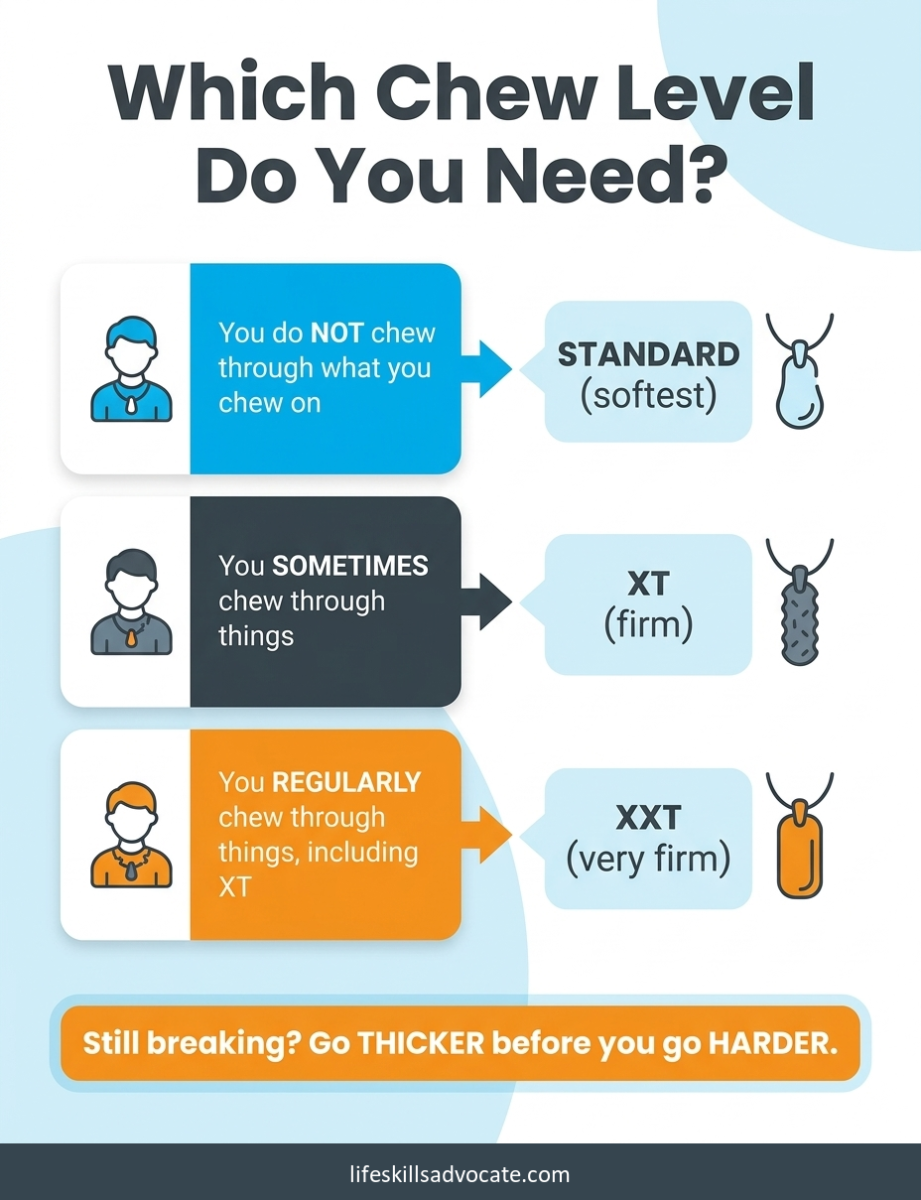
Thickness: Go Thicker Before You Go Harder
When a chew necklace fails in two weeks, the reflex is to buy a harder compound. The better lever is a thicker pendant.
Hardness is what puts wear on teeth, and a thin shape gets crushed under a strong bite whatever it is made of. ARK makes the same point from the other direction, noting that geometry carries part of the firmness: their slender Brick shape at the toughest level feels less tough than a wider, beefier shape at that same level.
More material means longer life without asking your molars to bite down on something closer to a rock.
Reach: Front Teeth, Back Molars, or Both
Where you chew decides what shape works. ARK’s guidance is that back-molar chewers need a long, slender extension that can get back there, while front-teeth and premolar chewers can use almost any shape. If you are unsure, a back-molar shape covers both.
This is the spec most listings skip, and it separates a pendant you use from a pendant you fiddle with.
Discretion: Will It Read as Jewelry?
This is the criterion the market leaves as an unspoken worry, so we scored it directly. Each pick carries one of three values, judged against the product photography and the shape and colorway rather than the seller’s marketing copy.
Passes as jewelry means a colleague reads it as a pendant. Semi-discreet means it draws a second look. Obviously a chew means it reads as a sensory tool, which is fine if you do not need it to be anything else.
It is a judgment call rather than a measurement, and reasonable people will disagree on one or two.
8 Best Chew Necklaces for Adults Compared
Every chew necklace for adults below was confirmed in stock the week this published, uses food-grade silicone, and comes on a breakaway clasp, so that last one is not a column.
Two notes before the table. ARK appears four times because it is the only brand publishing a firmness level and dimensions for every shape, not because anyone paid for placement. We earn a commission if you buy through these links, and nothing here is ordered by what pays more. Where a column says “Not published,” that is the finding: the seller does not state it anywhere.
| Chew necklace for adults | Chew level | Thickness | Reach | Discretion | Price |
|---|---|---|---|---|---|
| ARK Krypto-Bite Chew Necklace | XT (firm) | 0.5 in | Back molars | Passes as jewelry | ~$21 |
| ARK Guitar Pick Small Thin Chew Necklace | Standard (softest) | 0.3 in | Front teeth | Passes as jewelry | ~$19 |
| Munchables Chewable Leaf Pendant | Medium (mild to moderate) | Not published | Not published | Passes as jewelry | ~$17 |
| ARK Chew Tags Chew Necklace | XXT (very firm) | 0.3 in | Front teeth | Passes as jewelry | ~$28 |
| KongNai Silicone Dog Tag Chew Necklace | Not published | Not published | Not published | Passes as jewelry | ~$10 |
| Chewigem Raindrop Chew Necklace | Not published | Not published | Not published | Semi-discreet | ~$28 |
| ARK Brick Stick Textured Chew Necklace | XXT (very firm) | 0.5 in | Back molars | Obviously a chew | ~$24 |
| Tilcare Chew Chew Pencil Sensory Necklace | Not published | Not published | Not published | Obviously a chew | ~$9 |
Prices are approximate and can change; check the current price on each product page before you buy.
1. ARK Krypto-Bite Chew Necklace (XT, Firm)
ARK Krypto-Bite Chew Necklace is a faceted prism about three inches long, and that length is the point: it reaches the back molars, where most adult chewing happens. At XT it sits mid-range, firm but still chewable, on a thirty-inch adjustable cord.
The discretion read is the strongest here, because it looks like the crystal pendants people already wear. The catch is a color one. ARK sells a translucent finish on their own site that sells the illusion best, while the best-stocked Amazon listing is teal.
Best for: Someone who chews with their back teeth and needs the pendant to read as a necklace in a meeting.
2. ARK Guitar Pick Small Thin Chew Necklace (Standard, Softest)
ARK Guitar Pick Small Thin Chew Necklace is the smallest thing here at a third of an inch thick, and the one to hand someone starting from zero, because it matches what ARK itself recommends: begin soft, move up only if you chew through it.
The shape suits front-teeth and premolar chewers, and a light grey guitar pick on a cord is simply a necklace. The thinness that makes it comfortable also makes it the least durable option here for a hard biter, and it is a newer listing with only a handful of ratings so far.
Best for: First-time buyers, front-teeth chewers, and anyone whose jaw has objected to a thick pendant before.
3. Munchables Chewable Leaf Pendant
Munchables Chewable Leaf Pendant is the most convincing piece of jewelry in the group, a silver leaf that reads as costume jewelry from a foot away. Munchables is a Canadian family-run brand and states recognition from the Canadian Association of Occupational Therapists going back to 2017.
It is a medium chew, and the brand is upfront that aggressive chewers should look at a firmer design of theirs. One thing to expect when you click through: the listing title still says “for Girls” while the same listing’s own age field says Adult, which is the kids-first framing problem in a single product page.
Best for: Mild to moderate chewers who want the pendant to be unremarkable.
4. ARK Chew Tags Chew Necklace (XXT, Very Firm)
ARK Chew Tags Chew Necklace solves a combination almost nothing else does: toughest-level firmness in a shape nobody asks about. Two dog-tag-style pendants in dark grey, two inches long, sized for front teeth and premolars.
This is the priciest ARK option here, and by the brand’s own guidance XXT is not where a first-time buyer should start. It earns its place for someone who already knows they are a heavy chewer and works somewhere a visible sensory tool would start a conversation they would rather skip.
Best for: Heavy chewers in offices, classrooms, and client-facing roles.
5. KongNai Silicone Dog Tag Chew Necklace
KongNai Silicone Dog Tag Chew Necklace costs under ten dollars and is the cheapest way to find out whether chewing on a pendant does anything for you. A plain black tag, dishwasher safe, breakaway clasp, over a thousand ratings behind it.
What you give up is information. No published firmness level, no thickness, no reach guidance, so you are guessing at fit. For a first experiment that is a fair trade. For a heavy chewer replacing a broken one, less so.
Best for: Anyone testing the idea before spending twenty-five dollars on it.
6. Chewigem Raindrop Chew Necklace
Chewigem Raindrop Chew Necklace comes from one of the two brands adults name most often in sensory forums, and the teardrop is a real pendant shape rather than a novelty. Silicone, free of lead, latex, BPA, PVC and phthalates, on an adjustable break-away cord.
It is the most expensive item here, and the patterned colorway pulls more of a second look than the plain picks, which is why it scores semi-discreet. One note from the brand: the clasp contains small parts and is not meant to be chewed.
Best for: People who want an established sensory brand and prefer a teardrop to a geometric shape.
7. ARK Brick Stick Textured Chew Necklace (XXT, Very Firm)
ARK Brick Stick Textured Chew Necklace is the pick for someone who has broken everything else. Two and a half inches long, half an inch thick, large bumps on one side and small bumps on the other, at the toughest level ARK makes.
The texture is the underrated part, since varied surfaces give the jaw more to work with than a smooth pendant does, and the length gets to the back molars. In royal blue covered in raised bumps it has exactly one read, and it is not jewelry.
Best for: Back-molar chewers who need durability more than they need cover.
8. Tilcare Chew Chew Pencil Sensory Necklace (3-Set)
Tilcare Chew Chew Pencil Sensory Necklace arrives as three pencil-shaped pendants for under nine dollars, which makes it the only option here that lets you keep one at work, one in the car, and one at home without buying three things.
The shape aims squarely at people who chew pens, and the maker states the set suits men, women and teens alongside children. The pastel colorways read as a children’s product, though, and like the other budget pick there is no published firmness level to match yourself against.
Best for: Pen and pencil chewers who want spares in more than one place.
Are Chew Necklaces Bad for Your Teeth?
Here is the part every search result skips. Nobody has run a study on a chew necklace for adults and its effect on teeth, so anyone telling you these are definitively safe, or definitively not, has gone past the evidence.
What does exist is research on the surrounding habits, and it points one way.
A 2021 study in Brazilian Oral Research comparing 90 adults found that people with painful jaw-joint clicking reported gum chewing, nail biting, leaning the jaw on a hand, and daytime clenching more often than controls did. A larger 2016 study of just over a thousand adolescents found the same habits stack up: two of them raised the odds of painful jaw problems, and three raised them a good deal further.
Both are cross-sectional studies from Brazil, so they show associations rather than causes, and neither studied a silicone chew tool. Read them as a signal about load on the jaw, not a verdict on a product.
That load framing is why the thicker-not-harder principle matters. The harder the thing between your molars, the more force lands on enamel. Veterinary dentistry studies bite damage more directly than human dentistry does, and the University of Wisconsin School of Veterinary Medicine puts the rule simply: an object you can bend or flex is less likely to fracture a tooth.
Silicone bends. That is most of why a chew tool sits in a different category from a pen casing or an ice cube.
Three things belong with a dentist rather than a comparison table: jaw pain that appears or worsens once you start, teeth that turn sensitive to cold, and grinding you already knew about. Some people with existing jaw pain find they cannot use a chew tool much at all.
When a Chew Necklace for Adults Is Not the Right Answer
Sometimes the right answer is that a chew necklace for adults is not what you need at all.
Sugar-free gum does much of the same work and rarely draws a comment, though people reject it because it runs out and it is little use in a two-hour meeting. Crunchy food covers part of the need. If the underlying issue is night grinding, a dentist-fitted appliance is a different tool for a different job, and a better one.
Two substitutes come up often enough to name.
Dog chew toys. The logic is appealing: built for stronger jaws, so surely one survives a human. The problem is that hardness is what fractures teeth.
Cornell University’s College of Veterinary Medicine reports that fractured teeth are commonly caused by chewing very hard objects. Most veterinary dentists use a thumbnail test: if you cannot dent it with a fingernail, it is too hard. Plenty of popular dog chews fail that test for dogs, whose teeth are built for it more than yours are.
Pen casings and bottle caps. This is what most people are already doing, and the case against it is not a moral one. Hard plastic shatters, the pieces are sharp, and the edges are rough on a cheek. A silicone pendant is the same behavior with a better material.
If chewing turns out to be one piece of a bigger sensory picture, matching sensory needs to the right tool works through the other channels, and our comparison of sensory swings for adults covers the movement side.
What the Research Says About Chew Necklaces for Adults
| Finding | What it means | Source |
|---|---|---|
| Chew tools sell in graded firmness levels, described by one maker as Standard, XT and XXT, with XT roughly as firm as a Pink Pearl eraser. | Firmness is a spec to match to yourself, not a quality ranking. | ARK Therapeutic Chewing Guide (2026) |
| That maker recommends starting at the softest level and moving up only after you chew through it. | Buying the toughest chew necklace for adults first runs against the maker’s own guidance. | ARK Therapeutic Chewing Guide (2026) |
| Among 90 Brazilian adults, those with painful jaw-joint clicking reported gum chewing, nail biting and daytime clenching more often than controls. | Oral habits and jaw pain travel together, though the design cannot show which causes which. | Poluha et al., Brazilian Oral Research (2021) |
| In 1,094 Brazilian adolescents, two such habits raised the odds of painful temporomandibular disorders about 4.6 times and three raised them about 13.7 times. | The habits stack, so replacing one of several can still be worth doing. | Fernandes et al., Brazilian Oral Research (2016) |
| Veterinary dental guidance holds that an object you can bend or flex is less likely to fracture a tooth than a rigid one. | Hardness, not chewing itself, is the property that damages teeth. | UW School of Veterinary Medicine (2026) |
Frequently Asked Questions
Is a chew necklace for adults bad for your teeth?
No study has tested chew necklaces and teeth directly, so the accurate answer is that it depends on hardness, force and duration, and that the evidence is indirect.
Cross-sectional research from Brazil has found that people reporting gum chewing, nail biting and daytime clenching also report painful jaw problems more often, with the odds climbing as those habits accumulate. Those studies show associations rather than causes, and none of them looked at a silicone chew tool.
The mechanical principle is clearer than the studies are. Harder material puts more force through enamel, which is why veterinary dentists apply a bend-or-flex test to chew objects, and why the sensible move after a breakage is a thicker pendant rather than a harder one. Food-grade silicone flexes, which puts it in a different category from a pen casing, an ice cube, or a bone.
If you already grind your teeth, have jaw pain, or notice new sensitivity after starting, that is a dentist conversation and not a shopping one.
Do chew necklaces for adults look obvious at work?
Some do and some genuinely do not, and it comes down to shape and color rather than to whether a product is labeled for adults. The shapes people already wear are the ones that disappear: a crystal, a guitar pick, a leaf, a dog tag.
Neutral and translucent colors help more than the shape does. The ARK Krypto-Bite and the Munchables Leaf Pendant read as ordinary jewelry most reliably, and what gives the category away is the animal and food shapes: dinosaurs, owls, unicorns, donuts.
What is a chew necklace called?
Chewelry is the common name, and you will also see chewable jewelry, oral sensory chews, and chew pendants. Searching “chewelry for adults” surfaces different products than “chew necklace,” so try both.
How long does a chew necklace for adults last before it needs replacing?
Anywhere from a couple of weeks to about a year, which is an unhelpful answer because the real range is that wide. It depends on your bite strength, how many hours a day you use it, and whether the firmness level was matched to you in the first place.
The pendant itself is the better signal. Deep teeth marks that change its shape mean it is on the way out, and once a piece can be torn off it needs to go in the bin. Replace on damage rather than on a calendar.
Can I just use a dog chew toy instead?
No, for reasons of physics rather than dignity. Dog chews are made hard, and hardness is what fractures teeth. Cornell’s veterinary school notes that broken teeth in dogs commonly come from chewing very hard objects, and veterinary dentists screen chews with a thumbnail test. If you would not want to be hit in the kneecap with it, it does not belong between your molars.
How do you clean a chew necklace?
Mild soap and warm water, rinsed well, then air dried. Several are dishwasher safe on the top rack, including the KongNai dog tag. Skip antibacterial soap, which leaves a residue you will taste.
Next Steps
The firmness level matters more than the shape does, so if only one thing gets decided today, make it that one.
- Spend three days noticing what you already put in your mouth and when. If you chew through pen caps, you want the middle level. If they survive you, start soft.
- Pick your discretion tier before you pick a product, because it narrows eight options to two or three faster than any other filter.
- Buy one, not three. The most common mistake here is buying a bundle at the wrong firmness and finding out in week two.
- If chewing is one of several things your attention needs, executive function coaching helps build the rest of the system around it. It is skills-focused educational work, distinct from therapy.
Further Reading
- Chewing Guide – ARK Therapeutic
- Mastication as a Stress-Coping Behavior – Kubo, Iinuma and Chen, BioMed Research International
- Oral Behaviors, Bruxism, Malocclusion and Painful Temporomandibular Joint Clicking – Poluha et al., Brazilian Oral Research
- Parafunctional Habits Are Associated Cumulatively to Painful Temporomandibular Disorders in Adolescents – Fernandes et al., Brazilian Oral Research
- Protect Your Pet’s Teeth: Top Tips From a Veterinary Dentist – University of Wisconsin School of Veterinary Medicine
- Risks From a Fractured Tooth – Cornell University College of Veterinary Medicine
- How to Regulate Your Nervous System When Calm Won’t Come – Life Skills Advocate
- Why Do I Fidget So Much? – Life Skills Advocate
- Fidget Tools for Regulation – Life Skills Advocate
- 6 Best Sensory Swings for Adults – Life Skills Advocate
- How My Body Pays Attention Exercise – Life Skills Advocate
- Executive Function Coaching for Adults – Life Skills Advocate