
A teenager can ace a calculus exam and still freeze at the thought of calling to book their own dentist appointment. A young adult can hold down a part-time job and still have no real idea how to read the lease they just signed.
These gaps are not about intelligence or effort. They are about daily living skills for teens and young adults: the practical, teachable abilities that let a person run their own life, from communicating clearly to managing time, handling money, staying safe, and taking care of a body and a home.
School rarely teaches these things head-on, so plenty of capable teens and young adults reach adulthood having never actually been shown.
That matters more than it sounds. Independent living skills are not a soft extra. Researchers who study what happens after high school list them among the evidence-based predictors of post-school success for students with disabilities, right alongside self-determination and self-advocacy.
The encouraging part is that daily living skills are concrete and learnable, and they keep developing well into the early twenties. Below are 25 of them grouped into seven areas, each paired with a short reflection question so you can spot where a teen or young adult actually stands. There is also a free printable checklist to work through together.
TL;DR
Daily living skills for teens and young adults are the everyday abilities a person needs to run their own life. We group 25 of them into seven areas you can teach, talk through, and check off:
- Communication covers asking for things, starting and stepping into conversations, and saying no.
- Executive functioning splits into task skills (calendars, checklists, organizing) and behavior skills (focus, handling disappointment, rolling with change).
- Primary needs are the basics: food, movement, safety, chores, medication, and online safety.
- Secondary needs move outward into goals, getting around, work, and money.
- Advanced and advanced-plus round it out with hobbies, stress care, and knowing your basic rights.
This is educational, not a formal evaluation. If a teen or young adult is working with a therapist, an occupational therapist, or an IEP team, use this as a supplement to that work, not a replacement for it.
How We Group Daily Living Skills for Teens and Young Adults
A flat list of 25 things to learn is overwhelming, and overwhelm is where good intentions go to die. So we organize daily living skills the way they actually build on each other, from the foundation up.
Two skill sets sit at the base: communication and executive functioning. They are the engine underneath everything else. A teen who cannot ask for help or keep track of a deadline will struggle with cooking, budgeting, and job hunting too, because those bigger tasks all lean on the same underlying abilities.
On top of that foundation sit the daily living skills themselves, in three tiers. Primary needs keep a person safe and fed. Secondary needs support participation in the wider world: work, money, getting around. Advanced and advanced-plus needs cover well-being and citizenship, the things that make a life feel like yours rather than just functional.
You do not have to teach them strictly bottom to top, and you almost never will. Real life jumps around. But the order is a useful map: when an older skill keeps stalling, the gap is often a foundational one underneath it.
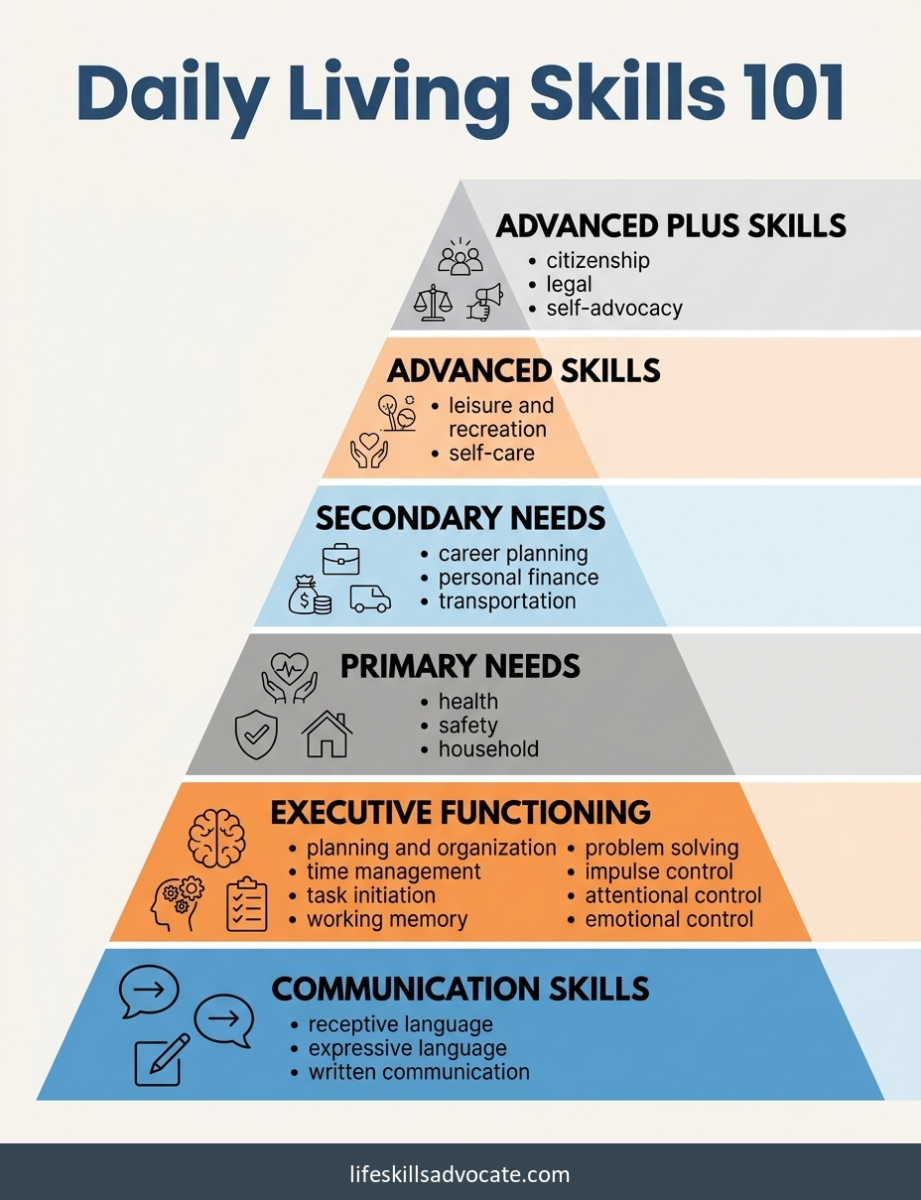
The 25 Daily Living Skills Every Teen and Young Adult Should Know
Here is the full set of 25 daily living skills for teens and young adults. The skill names stay the same for a 14-year-old or a 22-year-old; what changes is the context, which is why each one comes with a reflection question you can ask about your own teen or young adult. The questions are the point. They turn a generic list into a real read on where someone is right now.
Communication Skills
Communication is the skill that unlocks asking for help, and asking for help is what makes every other skill recoverable when it goes sideways.
- Make appropriate requests. Can they ask a teacher, a manager, or a stranger for help or information without shutting down or going silent?
- Initiate conversations. Can they start a conversation when they need something, in person or over text?
- Appropriately interrupt. Do they know how to break into a conversation politely when something genuinely cannot wait?
- Politely refuse. Can they say no to a request, an invitation, or peer pressure without either caving or blowing up?
Executive Functioning: Task Skills
These are the nuts-and-bolts organizing skills. They are also some of the most coachable, because they live in tools and routines rather than personality.
- Use a calendar. Do they keep appointments, due dates, and shifts somewhere other than their own memory?
- Create and prioritize a checklist. Can they turn a vague “get ready for the week” into a written list and decide what comes first?
- Organize a space. Can they set up a desk, a bag, or a room so they can actually find things later?
If task skills are the sticking point, our executive functioning resource hub goes deeper on the systems that make calendars and checklists stick.
Executive Functioning: Behavior Skills
Behavior skills are the harder-to-see half of executive functioning. They are about regulating attention and emotion, and they tend to wobble most under stress.
- Sustain 30 minutes of attention on a task. Can they stay with a boring-but-necessary task for half an hour, with or without supports like timers or music?
- Accept disappointment. When plans fall through or a grade stings, can they recover without the whole day derailing?
- Accept an alternative. When their first choice is off the table, can they take a reasonable plan B?
Primary Daily Living Skills: Health, Safety, and Household
One of the most common executive functioning challenges in adolescence is keeping the basics running. These six daily living skills cover the non-negotiables of staying safe and healthy day to day.
- Eat a well-balanced diet. Can they put together meals that keep them fueled, even simple ones?
- Get 30 minutes of physical activity. Do they have a way to move their body most days that they will actually do?
- Follow a safety plan. Do they know what to do in a fire, a medical scare, or a situation that feels unsafe?
- Use a chore list. Can they keep a living space functional with a routine, instead of a once-a-month crisis clean?
- Take medication safely. If they take anything, can they manage doses, refills, and timing themselves?
- Stay safe online. Can they spot a scam, a phishing text, or an oversharing moment before it becomes a problem?
Secondary Daily Living Skills: Career, Finance, and Transportation
This is where the young-adult version of the list gets real. The same six skills that look like “homework practice” for a teen become rent, paychecks, and bus routes for someone launching.
- Set and achieve a SMART goal. Can they turn “I want to save for a car” into something specific and time-bound?
- Navigate using a smartphone. Can they get themselves to a new place using maps and transit apps?
- Read a job description. Can they read a posting and tell whether they qualify and what the job actually involves?
- Answer mock interview questions. Can they practice and get through common interview questions without freezing?
- Save for a long-term purchase. Can they set money aside over weeks or months for something bigger than today?
- Use a credit card responsibly. Do they understand interest, minimum payments, and spending within a limit?
Advanced Daily Living Skills: Leisure, Recreation, and Wellness
These two are easy to treat as optional. They are not. A life made only of obligations burns people out, and the ability to rest on purpose is its own skill.
- Make time for a hobby. Do they protect time for something they genuinely enjoy, not just things they have to do?
- Use basic mindfulness and meditation techniques. Do they have a way to settle their nervous system when stress spikes?
Advanced-Plus: Citizenship, Legal, and Personal Advocacy
The final skill is the one that turns a capable young adult into a self-advocating one.
- Understand basic public safety and workplace laws. Do they know their basic rights at work and in the community, and where to look them up when they are not sure?
What the Research Says About Daily Living Skills
The case for teaching daily living skills for teens and young adults directly, and for teaching them past the teen years, is stronger than most people assume. A few findings are worth quoting and citing.
| Finding | What it means | Source |
|---|---|---|
| Independent living skills, self-determination, and self-advocacy are evidence-based in-school predictors of post-school employment and independent living for students with disabilities. | Teaching daily living skills for teens and young adults, and the agency to use them, is linked to better adult outcomes. It is not just a nice-to-have. | NTACT:C, Predictors of Post-School Success |
| Daily living skills keep developing through childhood and adolescence, and for autistic young adults they often sit below age-level expectations into the early twenties. | It is normal to still be building these skills at 18, 20, or 22. Keep teaching past the teen years. | Bal, Kim, Cheong, and Lord (2015), Autism |
| A successful move to independent living is shaped by skills plus support: money, family expectations, paid work, and some help, not by doing everything alone. | Needing some ongoing help is normal and fully compatible with living independently. | Qualitative study of young adults with disabilities (2024) |
| Students who get structured instruction in setting goals and making choices show significantly greater growth in self-determination than peers who do not. | Self-determination is teachable. The agency to use daily living skills can be built on purpose. | Wehmeyer and colleagues (2010), Journal of Special Education |
One caveat worth stating plainly: this is a general framework, not a developmental timeline. Every teen and young adult builds these skills in their own order and on their own clock, and some will need steady support with a few of them for a long time. That is not a failure of the framework or the person. It is just how skill-building actually works.
How to Figure Out Where to Start
A list of 25 daily living skills for teens and young adults is a map, not a to-do list for Saturday. The goal is not to drill all of them. It is to find the one or two that, if they clicked, would make the biggest difference right now.
The fastest way to do that is to go through the list with the reflection questions and mark each skill as solid, shaky, or not yet. Our free 25 Daily Living Skills checklist lays all of this out as a printable PDF with the guiding questions built in, so a parent, a teen, and a teacher can each fill one out and compare notes. The gaps that show up on more than one copy are usually the place to start.
Then pick one. Just one. A young adult who can suddenly keep a calendar will feel that win ripple into work, money, and appointments, which is exactly why the foundational skills are worth starting with.
If you want a sense of what tends to come online at which age, our guide to daily living skills by age maps the typical sequence, and the month-by-month guide to teaching life skills in high school turns it into a teaching plan you can actually follow.
If you would rather hand your teen a single, readable guide than assemble a lesson for each of these skills yourself, one book covers a lot of this ground.
Life Skills for Teens (Karen Harris)
It walks teens through the practical skills this list covers, cooking, cleaning, money, time management, and basic self-care, in plain, teen-friendly language they can read on their own. It is a way to hand over a ready-made guide instead of teaching each skill from scratch.
Best for: Teens and young adults building independence, and parents who want a single readable book to work through together. It is a broad starting guide, so pair it with hands-on practice for the skills that matter most to your teen.
Frequently Asked Questions About Daily Living Skills for Teens
What if a young adult missed learning these daily living skills as a teen?
This is the most common worry, and the research is genuinely reassuring on it. Daily living skills are not a window that closes at 18.
Longitudinal work on autistic young people found that daily living skills keep developing well into the early twenties, often still below age-level expectations, which means there is real room to grow precisely when families fear it is too late. A separate qualitative study of young adults with disabilities living on their own found that successful independence came from a mix of skills and support, not from having every skill locked in before moving out.
So a young adult who missed this in high school has not missed it. The teaching just starts now, from wherever they actually are, and “needing some help” stays a normal part of an independent life.
At what age should a teen have these daily living skills?
There is no single age, and chasing one usually backfires. Skills come online at wildly different points depending on the person, their support, and how much practice they have had. A more useful question is which skill is the next reasonable stretch from where they are now. Our daily living skills by age guide lays out the typical sequence if you want a benchmark, but treat it as a rough map, not a deadline.
How do I assess daily living skills for teens and young adults?
Use the reflection questions here, ideally written down. Go skill by skill and mark each one solid, shaky, or not yet, based on what you actually see. Better still, have the teen or young adult rate themselves and compare it with a parent’s or teacher’s read. The free checklist makes that comparison easy.
Where should we start with daily living skills for teens and young adults?
When in doubt, start at the foundation: communication, or an executive functioning skill like using a calendar. Those two sit underneath almost everything else, so progress there tends to make the bigger skills easier to reach.
That said, the real answer is “it depends.” If a specific gap is causing friction this week, like missed medication or a money mistake, start there instead. The best first skill is usually the one that is hurting most right now, not the one that comes first on a list. It is also fine to switch after a week or two if the first pick turns out not to be the real bottleneck.
Are daily living skills the same as life skills?
Mostly, yes. “Life skills” is the broader, everyday term; “daily living skills” is the more specific one used in education and transition planning. We use them interchangeably here.
Where to Go From Here
The skills above are only useful if they turn into one small, concrete next move. A few worth considering:
- Write down the single skill that creates the most friction in your week, or your teen’s week. That is your starting line, and you can name it today without buying anything.
- Run the checklist together. Download the free 25 Daily Living Skills checklist, have two people fill it out, and look for the gaps that overlap.
- Pick a tool, not a lecture. Most of these skills live in a system: a shared calendar, a chore routine, a savings rule. Set up one supportive tool rather than trying to talk someone into being more organized.
- If the foundational skills keep stalling, a coach can help. Executive function coaching is educational and skills-focused, built around practicing daily living skills in real life. It is not therapy, and it is not a requirement, just one option among several for the times when working on this alone is not getting traction.
Further Reading
- Predictors of Post-School Success – NTACT:C
- Daily Living Skills in Individuals With Autism Spectrum Disorder From 2 to 21 Years of Age – Bal, Kim, Cheong, and Lord (2015)
- Understanding Successful Transition to Independent Living: A Qualitative Study of Young Adults With Disabilities – PMC
- Intervention to Promote Self-Determination and Enhanced Student Self-Determination – Wehmeyer and colleagues (2010)
- Smart but Scattered Teens – Peg Dawson and Richard Guare
- Free 25 Daily Living Skills Checklist – Life Skills Advocate
- Daily Living Skills by Age – Life Skills Advocate
- A Month-by-Month Guide to Teaching Life Skills in High School – Life Skills Advocate
- Executive Functioning 101 Resource Hub – Life Skills Advocate
- Executive Function Coaching – Life Skills Advocate
It is very great !