
Have you ever walked away from a conversation thinking:
“That isn’t what I meant to say.”
Or maybe you’ve replayed an argument over and over in your head, coming up with the perfect response hours after the conversation ended.
Maybe you’ve avoided bringing up a problem entirely because you were afraid the discussion would turn into an argument. Or perhaps you’ve found yourself becoming louder, quieter, or more emotional than you expected in a social situation.
All of these are very real-life ways we respond to conflict. Conflict resolution skills are learnable, and for neurodivergent teens and young adults they usually start somewhere other than word choice.
TL;DR
Conflict gets hard because a disagreement can set off the same stress response that protects you from physical danger, and that response makes it harder to organize thoughts, manage emotions, and find words. Here is what is below, and every line you are welcome to borrow:
- Why conflict starts in your body before it becomes a communication problem, and what stress research says about the thinking you lose in that moment.
- The four patterns most of us fall into under pressure: fight, flight, freeze, and fawn.
- Five conflict resolution skills for fight mode: asking to share your side, asking for their version, naming the part you are stuck on, pausing until they finish, and solving one issue instead of the whole argument.
- Five for flight mode: opening the conversation, asking for a later time, naming that it feels uncomfortable, setting a specific time to continue, and raising small things early.
- Four for freeze mode, for when the words are gone and the usual advice assumes you can still talk.
- Five for fawn mode: asking for another option, sharing your view, turning down a solution, speaking up inside a relationship you care about, and taking time before answering.
- Three worked examples, what to do when a conflict is bigger than a script, and what to do when you replay it afterward.
This is educational. It is not medical or diagnostic advice, and it is not a clinical evaluation. If conflict is something you are working through with a therapist or another professional, use this alongside that rather than instead of it.
Why Do Some Conversations Feel So Hard?
For many of us, conflict can feel like one of the hardest parts of everyday life. Disagreements don’t just involve choosing the right words. They require you to manage emotions, interpret another person’s perspective, organize your thoughts, solve problems, regulate your body, and communicate clearly all at the same time.
That’s a surprisingly complex task for the human brain, and even harder for individuals with executive functioning challenges.
Conflict Resolution Is a Life Skill, Not a Personality Trait
One of the biggest myths about conflict is that some people are simply “good at confrontation” while others just aren’t. In reality, healthy conflict resolution is a collection of behaviors that can be taught and developed until an individual feels comfortable facing even the most difficult situations.
Successful conflict resolution requires you to:
- recognize when your emotions are escalating
- listen without immediately preparing your defense
- express your needs clearly
- ask questions instead of making assumptions
- set boundaries respectfully
- and work toward solutions instead of “winning”
Like learning to cook, manage money, or organize your schedule, these abilities improve with practice and experience. That is why conflict management is one of the Power Skills in the free Adulting Like a Champ Workbook, and why the Conflict Management Workbook builds on it with guided practice.
Our Learning History Plays a Role in Conflict Resolution
Unfortunately, very few of us were ever taught healthy conflict resolution skills.
Many people learned conflict by watching the adults around them. Some grew up in homes where arguments became shouting matches. Others learned to avoid conflict altogether because disagreements felt unsafe or overwhelming. Some never saw healthy repair after a disagreement, which can make conflict feel like something that permanently damages relationships.
Without realizing it, we often carry those patterns into adulthood.
Why Neurodivergent Brains Can Struggle During Conflict
In addition to learning history, neurodivergence can also create additional barriers to healthy conflict resolution.
Most of us think of conflict as a communication problem, but it often begins as a nervous system problem.
When our brains perceive a disagreement as threatening, whether it’s a raised voice, criticism, uncertainty, rejection, or simply the possibility of disappointing someone, our body’s stress response can activate. The same system that evolved to keep us safe from physical danger also responds to social and emotional threats.
Once that happens, the parts of the brain responsible for flexible thinking, planning, organizing language, and problem-solving become less efficient. Instead of carefully choosing our words, we become more focused on protecting ourselves. A 2015 review in Neurobiology of Stress describes this as a rapid switch: stress weakens the prefrontal systems you use to think flexibly and strengthens the faster, more automatic ones.
It also does not take a crisis for that to happen. Amy Arnsten’s 2009 review in Nature Reviews Neuroscience found that even mild, uncontrollable stress can produce a rapid loss of prefrontal thinking ability.
For neurodivergent individuals, this response can be even more noticeable. Many people with ADHD, autism, anxiety, or sensory processing differences experience emotional and physiological reactions more intensely or take longer to recover after stressful interactions. They may also fall into one of several common patterns that don’t resolve a conflict.
Research supports the pattern. A 2014 review in the American Journal of Psychiatry found emotion dysregulation is common in ADHD across the lifespan and a major contributor to difficulty, and a 2018 review in Autism Research concluded that autistic people have more difficulty regulating emotion and tend to rely on approaches that work less well.
These include:
Fight
Some people become more verbal when they’re stressed. They may interrupt, argue, defend themselves, raise their voice, or focus on proving they’re right. Often, this isn’t because they’re trying to dominate the conversation. It’s because their brain is urgently trying to solve the perceived threat.
Flight
Others avoid conflict altogether. They change the subject, leave the room, ignore messages, cancel plans, or convince themselves that the problem isn’t worth bringing up. Avoidance can bring temporary relief, but unresolved problems often return later.
Freeze
Some people experience what feels like a complete mental shutdown. Their mind goes blank, words disappear, and even simple questions become difficult to answer. Hours later, they may think of exactly what they wanted to say, but the moment has already passed.
Fawn
Others immediately prioritize keeping the peace. They apologize even when they haven’t done anything wrong, agree to solutions they don’t want, or suppress their own needs to avoid upsetting someone else. While this may reduce conflict in the short term, it often leads to resentment or burnout over time.
One caveat before you use these four labels: they come from popular writing about stress and trauma rather than from a validated research model, and no study ties a four-response model to how conflicts turn out. They are a widely used way of describing what people notice themselves doing, which is exactly how the rest of this article uses them.
Most people don’t fit neatly into just one category. Your response may change depending on the relationship, the situation, your stress level, or even how much sleep you’ve had the night before. We do tend to have some patterns in behavior though, and once you recognize these patterns, it becomes easier to choose alternative responses during conflicts.
If naming the feeling is the part that stalls, the Feel Wheel exercise gives you vocabulary to borrow, and the body scan activity helps you catch the physical signal earlier, before the words are needed.
Need more info on Fight/Flight/Freeze/Fawn before you move on? These LSA resources go deeper:
- Evidence-Based ADHD Calming Techniques for Adults: Find Peace & Focus
- Mistaken for ADHD Burnout: 7 Dorsal Vagal Shutdown Signs
- 7 Daily Ways to Regulate Your Nervous System for ADHD Brains
- 7 Emotional Control Strategies for Diverse Learners
- Comfort, Stretch and Panic Zones in Social Skills Development
If you’d like help figuring out your typical conflict management style, try an exercise from our Adulting Like a Champ Conflict Management Workbook. Download this free PDF exercise to get a clearer picture of your own conflict style and get more out of the conflict management tools below:
19 Conflict Resolution Skills: What to Say and Do in the Moment
Once you’ve had a chance to look at your typical conflict management patterns, the next step is learning how to respond differently when your default behavior kicks in.
You don’t have to become perfectly calm or say the “right” thing every time. The goal is to recognize your common response and choose an alternative that moves the conversation forward instead of making it harder.
Think of these as small shifts, not scripts you have to memorize. Even replacing one reactive response with one intentional behavior can change the direction of a conversation. Say them in your own words. A line delivered flatly, word for word, can land as colder than you mean it to.
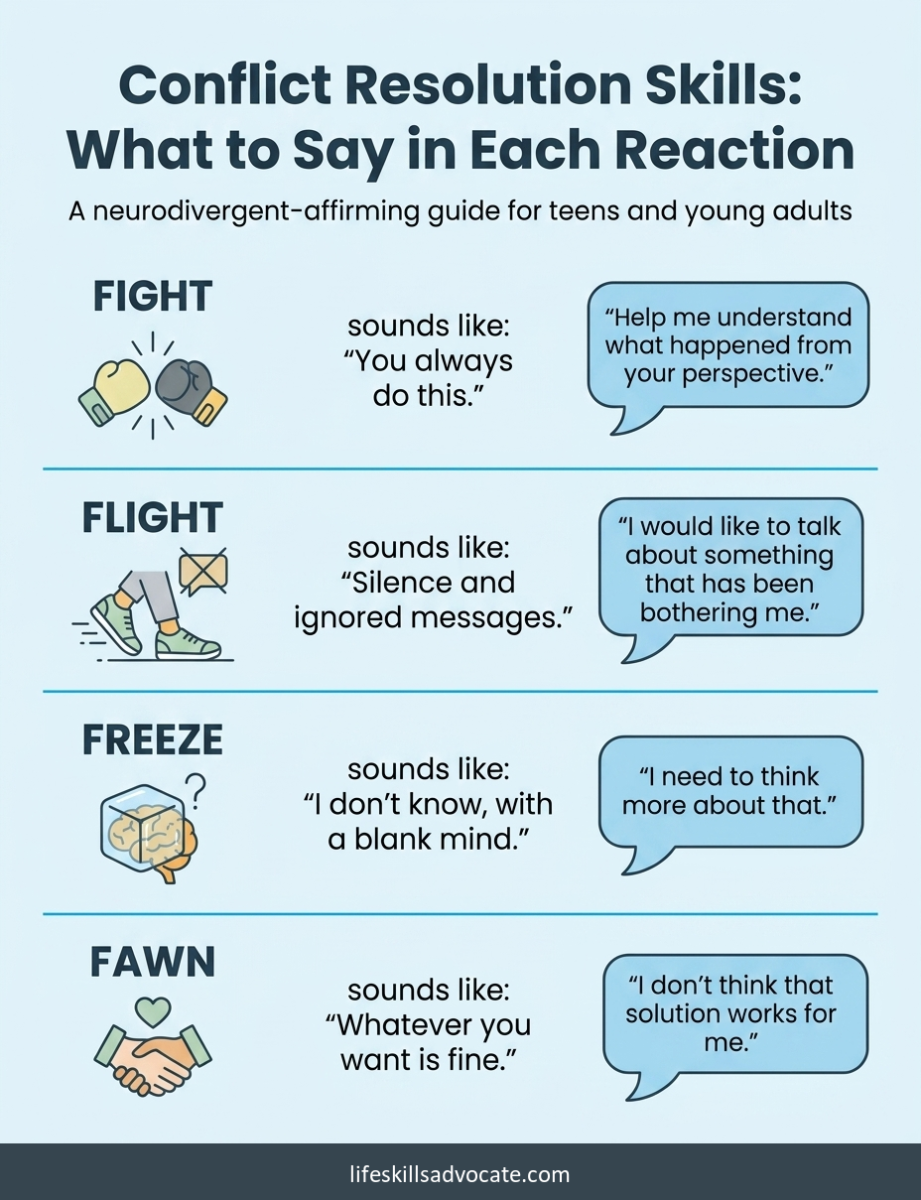
| Reaction | What it sounds like | Conflict resolution skills to use |
|---|---|---|
| Fight | “You’re wrong.” “You always do this.” | “Help me understand what happened from your perspective.” |
| Flight | Silence, ignored messages, “I’m fine.” | “I’d like to talk about something that’s been bothering me.” |
| Freeze | “I don’t know,” while your mind goes blank. | “I need to think more about that.” |
| Fawn | “Whatever you want is fine.” | “I don’t think that solution works for me.” |
If Your Instinct Is to Fight…
When our brains enter “fight” mode, we often feel an urgent need to explain, defend, or convince. We may interrupt, raise our voice, point out every flaw in the other person’s argument, or focus on proving that we’re right.
| # | What fight mode reaches for | What to say instead |
|---|---|---|
| 1 | “You’re wrong.” | “Can I tell you how I experienced the situation?” |
| 2 | “That’s not what happened.” | “Help me understand what happened from your perspective.” |
| 3 | “You always do this.” | “Here’s the part I’m struggling with.” |
| 4 | Interrupting before they finish speaking. | Pause long enough for the other person to finish before responding. |
| 5 | Listing every reason they’re at fault. | Focus on solving one issue instead of winning the entire argument. |
The goal is to replace defensiveness with curiosity and problem-solving, while still advocating for yourself. If anger is the part that arrives fastest for you, ADHD and anger covers what is happening underneath it.
If Your Instinct Is to Flight…
Avoidance can feel relieving in the moment, but most unresolved conflicts don’t go away. They usually become bigger, more confusing, or more emotionally charged over time.
| # | What flight mode reaches for | What to say instead |
|---|---|---|
| 6 | Saying nothing because it feels easier. | “I’d like to talk about something that’s been bothering me.” |
| 7 | Ignoring messages. | “I’m not ready to have this conversation right now, but can we come back to it tomorrow?” |
| 8 | Pretending you’re “fine” when you’re not. | “This feels uncomfortable for me, but I think it’s important.” |
| 9 | Waiting weeks or months before bringing it up. | Set a specific time to continue the conversation. |
| 10 | Hoping the other person figures it out on their own. | Address small problems before they become major ones. |
Healthy conflict simply requires a willingness to return to the conversation, even if that happens later.
If Your Instinct Is to Freeze…
For many people, conflict leads to silence rather than yelling or leaving. Your mind goes blank. You can’t find the words. Questions suddenly feel impossible to answer.
Then, three hours later, every perfect response shows up. Freezing is often a sign that your brain is overwhelmed.
| # | What freeze mode reaches for | What to say instead |
|---|---|---|
| 11 | Saying “I don’t know” when your brain feels stuck. | “I need to think more about that.” |
| 12 | Agreeing just to end the conversation. | “I’d like to come back to this after I’ve had a chance to process.” |
| 13 | Standing silently while becoming increasingly overwhelmed. | “I’m getting overwhelmed. Can we slow down?” |
| 14 | Forcing yourself to keep talking when clear thoughts have disappeared. | “I’m having trouble finding the right words to share what I’m thinking.” |
Many people communicate much more clearly after they’ve had a little time to organize their thoughts. Asking for that time creates the conditions for a better conversation.
If Your Instinct Is to Fawn…
When we enter “fawn” mode, keeping the relationship feels more important than expressing our own needs. You might apologize immediately, agree with things you don’t believe, or say “yes” simply to end the discomfort. While this often reduces tension in the moment, it can slowly teach other people that your needs, ideas, and values come second.
| # | What fawn mode reaches for | What to say instead |
|---|---|---|
| 15 | “Whatever you want is fine.” | “Can we look for another option?” |
| 16 | Apologizing before you’ve even explained your perspective. | “I understand your perspective, and I’d like to share mine too.” |
| 17 | Agreeing with a solution that doesn’t work for you or an expectation you can’t meet. | “I don’t think that solution works for me.” |
| 18 | Taking responsibility for everything to keep the peace. | “I care about this relationship, and I also need to be honest.” |
| 19 | Saying yes when you really mean no. | “I need a little time to think before I answer.” |
Healthy relationships don’t require you to disappear in order to keep everyone else comfortable. Healthy relationships function well over the long run when conflicts are effectively resolved.
Saying the thing directly is its own skill, and assertive communication examples covers it in more depth. When the pattern shows up around shared space and chores, setting boundaries with roommates works through that version of it.
Real-World Examples of Conflict Management Statements
All of those examples sound great, but how do they apply in real-life situations?
Most conflicts don’t begin with dramatic arguments. They start with small misunderstandings, unmet expectations, or assumptions that slowly build over time. Yet the statements above can go a long way to repair and resolve conflicts more effectively. These examples show how a conversation can shift when you move from reacting to calmly responding.
Example 1: “You Never Listen to Me”
Imagine you’ve told a family member several times that you’d rather they ask before giving advice. Despite those conversations, they continue offering opinions about your school, work, or personal decisions. You feel frustrated because it seems like they’re ignoring what you’ve already said.
Your first instinct might be to fight.
“You never listen to me! Why do you always think you know better?”
Or maybe you freeze and say nothing at all, deciding it’s easier to let the conversation end than start another argument.
Neither response addresses the real problem. Instead, follow the examples above and try slowing the conversation down.
“I know you’re trying to help, and I appreciate that. I’ve noticed that when I share something, I often receive advice before you’ve heard me out. Right now, what I need most is someone to listen first. Could we try that?”
This response does four important things:
- It assumes positive intent instead of attacking.
- It describes a specific behavior.
- It explains why the behavior matters.
- It clearly asks for something different in the future.
The goal is to help them understand what support looks like for you.
Example 2: When a Friendship Starts Feeling One-Sided
Your friend has canceled plans several times in a row. They take days to respond to messages, and you’ve started wondering whether they’re pulling away from the friendship. Your brain begins filling in the blanks.
“I guess they don’t really want to be friends anymore.”
Maybe you stop reaching out altogether (flight). Maybe you send an angry text demanding an explanation (fight). Or perhaps you tell yourself you’re overreacting and pretend it doesn’t bother you (fawn). Instead of reacting to assumptions, what if you decide to get curious about the facts?
“I wanted to check in because we’ve had to cancel our plans a few times recently, and I’ve been feeling a little disconnected. Is everything okay? I’d still really like to spend time together if we can find something that works.”
Notice what this conversation doesn’t do: It doesn’t accuse. It doesn’t guilt. It doesn’t assume bad intentions. Instead, it creates room for information you didn’t have before.
Maybe your friend has been overwhelmed at work. Maybe they’re dealing with a family situation. Maybe they genuinely didn’t realize how their cancellations were affecting you.
This scenario could easily end up in a bigger conflict when it doesn’t have to result in conflict at all. Taking a step back with clarifying questions can make a big difference.
Example 3: A Difficult Conversation at Work or School
You’re working on a group project, and one teammate repeatedly interrupts you whenever you begin sharing an idea. After several meetings, you stop contributing because it doesn’t feel worth the effort (fawn). Or you wait until you’re completely frustrated before exploding in anger with:
“Can you stop interrupting me all the time?!?!”
While understandable, this often causes the other person to become defensive instead of hearing your concern.
A more productive approach might be a quick email or text with:
“I’ve noticed that a few times during our meetings I’ve started sharing an idea but haven’t been able to finish before the conversation moved on. I’d really appreciate having a chance to finish my thoughts before we discuss them.”
This keeps the focus on their observable behavior rather than making judgments about the person’s character. Being assertive doesn’t require being aggressive. Sometimes it’s simply a matter of calmly restating what you need.
Try It Out
The situations above are all different, but the pattern stays remarkably consistent.
Instead of reacting to what you assume someone meant, focus on what happened. Describe the behavior you observed, explain how it affected you, and make a clear request for what you’d like to happen next. Those four habits won’t eliminate every disagreement, but they can make even difficult conversations feel more respectful, productive, and easier to get through.
The most important thing you can do right now is to practice, practice, practice.
Conflict management is a set of skills that improve with practice.
Very few people handle every disagreement perfectly. Even people with strong communication skills occasionally become frustrated, misunderstand someone, or wish they had chosen different words.
The goal is to recognize your patterns, pause before reacting, and choose responses that reflect your values instead of your stress.
When a Conflict Is Bigger Than a Script
Every conflict resolution skill on this page assumes something that is not always true: that both people are trying to work it out, and that saying the thing is safe.
Some conflicts are a power problem rather than a communication problem. If the other person controls your housing, your money, your transportation, or your grades, a well-worded request can still get you nowhere, and that is a reflection of the situation and not of your skills. The same is true when someone repeatedly ignores a boundary you have already stated clearly.
If a conflict involves threats, physical harm, or someone making you feel unsafe, it stops being a conversation problem. No script is the right tool for that. Tell a trusted adult, a school counselor, a doctor, or another adult you trust, and if you are in immediate danger, contact emergency services.
Adults have somewhere to escalate at work. Most teens and young adults don’t have an equivalent at home, which is exactly why naming the limits of this page matters more here than it would in an article written for an office.
What to Do When You Replay It Afterward
Conflict resolution skills tend to focus on the conversation itself, but conflict often doesn’t end when the conversation does.
You may find yourself replaying it for hours or days, rewriting your lines, or reading the other person’s tone over and over for evidence they are upset with you. That afterward part is its own experience, and for people who feel rejection intensely it can hurt more than the disagreement did.
Naming it helps. So does deciding, on purpose, what you will do with the replay: write down the one thing you still want to say, then close the loop by saying it or by letting it go. If that spiral is familiar, rejection sensitive dysphoria explains what tends to drive it.
Recommended tool
Adulting Like a Champ: Conflict Management Workbook
A guided workbook that takes you from spotting your conflict pattern to practicing the words for it, with room to work through real disagreements before you are in one.
Best for: A teen or young adult who recognizes their pattern here and wants structured practice rather than a list of lines to remember. (This is a paid LSA workbook, not a free download.)
What the Research Says About Stress and Conflict Resolution Skills
| Finding | What it means | Source |
|---|---|---|
| Stress exposure rapidly weakens prefrontal cognitive function while strengthening the brain’s faster, more automatic systems. | The thinking you need in order to use your conflict resolution skills is the first thing to go offline during an argument. | Arnsten et al., 2015, Neurobiology of Stress |
| Even mild, uncontrollable stress can cause a rapid loss of prefrontal cognitive abilities. | It does not take a crisis. An ordinary tense disagreement is enough. | Arnsten, 2009, Nature Reviews Neuroscience |
| Emotion dysregulation is common in ADHD across the lifespan and a major contributor to impairment. | If regulating emotion mid-conflict is harder for you, that difficulty is well documented in ADHD. | Shaw et al., 2014, American Journal of Psychiatry |
| Autistic people have more difficulty with emotion regulation and tend to rely on regulation approaches that work less well. | Conflict resolution skills that start with regulation, rather than vocabulary, tend to fit better. | Cai et al., 2018, Autism Research |
| A meta-analysis of 424 studies covering 575,361 students found school-based social and emotional learning improved social and emotional skills. | Skills like the ones on this page are teachable, which is the premise the whole article rests on. | Cipriano et al., 2023, Child Development |
Conflict Resolution Skills FAQ
What are the 5 steps to conflict resolution?
There isn’t one agreed set. Different models list four, five, or six steps, and the numbering tends to reflect who wrote it. This article starts somewhere else: notice your stress response first, then pick words that match it.
Why do I shut down during conflict?
Shutting down is a stress response, not a decision you are making. When your brain reads a disagreement as a threat, the systems you use for flexible thinking and organizing language become less efficient, which is why the words genuinely are not there.
For a lot of neurodivergent people that shutdown arrives faster and lasts longer. The practical move is to stop trying to produce a full answer under pressure and instead say one prepared line that buys you time, like “I need to think more about that.”
Which conflict resolution skills help you stop being defensive?
The ones that slow the exchange down, rather than the ones that try to talk you out of the feeling. Pause until the other person has finished speaking, then swap your first sentence for a question about their version of events.
Picking one issue instead of the whole argument helps too. Defending yourself on five fronts at once is what makes a disagreement feel unwinnable.
Can conflict resolution skills be learned, or are some people just better at conflict?
They can be learned. The idea that some people are naturally “good at confrontation” mostly describes who had the chance to practice, and who had adults around them modeling repair after a disagreement.
The research on teaching these skills directly is strong. A 2023 meta-analysis in Child Development pooled 424 studies covering more than 575,000 students and found that school-based social and emotional learning programs improved social and emotional skills.
What that does not tell you is how fast it will feel different for you personally. Skill-building shows up in the moments after the conflict first, when you notice what you did, and only later in the moment itself. A reasonable expectation is that you will catch your pattern sooner each time rather than stop having a pattern at all.
What if using a script makes the conflict worse?
Sometimes it does, and it is worth naming why. A line delivered word for word, in a flat voice, can read as rehearsed or cold, especially to a parent who knows your usual speech patterns. The words on this page are shapes, not lines to perform, so translate them into how you actually talk.
The other possibility is that the script was fine and the timing wasn’t. Opening a hard conversation while either of you is still activated tends to go badly no matter how good the sentence is.
Ready to Practice?
Reading about conflict resolution is a great first step. Building the skill takes practice.
If you’d like more help, check out our Adulting Like a Champ: Conflict Management Workbook. It was created to help teens and young adults move beyond understanding conflict and begin handling it with confidence.
Through guided activities, you’ll identify your own conflict style, learn how your nervous system responds to stress, practice emotional regulation, prepare for difficult conversations, and build communication habits you can use in everyday life.
The exercises work the same way for disagreements at home, with friends, at school, or on the job. They are designed to help you turn insight into action, one conversation at a time.
Like any life skill, conflict resolution gets easier with repetition. Every conversation is a chance to learn something about yourself, your relationships, and the way you communicate.
Some discussions will go well. Others won’t. Both can help you grow.
The next time you find yourself facing a difficult conversation, don’t ask yourself, “How do I win this?” Instead, try asking:
- What am I hoping to accomplish?
- What does the other person need to understand?
- How can I communicate this with honesty and respect?
- What’s one small step that moves us toward a solution?
Those questions won’t solve every disagreement, but they’ll help you approach conflict with greater confidence and clarity.
Next Steps
Conflict resolution skills stick when you start with one, so pick the pattern you notice before you speak rather than working through the whole list.
- Pick the response you recognize most out of fight, flight, freeze, and fawn, and write down the one line from its list you could imagine saying out loud. One line is enough to start.
- Rehearse it somewhere low-stakes. Use it in a minor disagreement about dinner or a group chat before you use it on the conversation you have been dreading.
- If conflict keeps costing you relationships or opportunities, executive function coaching works on the underlying skills, including emotional control and flexible thinking. It is educational skill-building rather than therapy, so it fits the practice side rather than the mental health side. LSA’s executive function coaching is built for teens and young adults.
Educators building goals around this skill for a student rather than for themselves will find peer interaction IEP goals a better fit than this page.
Further Reading
- Stress Weakens Prefrontal Networks – Arnsten, Raskind, Taylor and Connor, Neurobiology of Stress (2015)
- Stress Signalling Pathways That Impair Prefrontal Cortex Structure and Function – Amy Arnsten, Nature Reviews Neuroscience (2009)
- Emotion Dysregulation in Attention Deficit Hyperactivity Disorder – Shaw, Stringaris, Nigg and Leibenluft, American Journal of Psychiatry (2014)
- Emotion Regulation in Autism Spectrum Disorder – Cai, Richdale, Uljarevic, Dissanayake and Samson, Autism Research (2018)
- The State of Evidence for Social and Emotional Learning – Cipriano and colleagues, Child Development (2023)
- The Free Adulting Like a Champ Workbook – Life Skills Advocate
- Adulting Like a Champ: Conflict Management Workbook – Life Skills Advocate
- Feel Wheel Exercise – Life Skills Advocate
- Body Scan Mindfulness Activity – Life Skills Advocate
- 7 Daily Ways to Regulate Your Nervous System for ADHD Brains – Life Skills Advocate
- 7 Emotional Control Strategies for Diverse Learners – Life Skills Advocate
- A Neurodivergent Guide to Sleep – Life Skills Advocate
- Evidence-Based ADHD Calming Techniques for Adults: Find Peace & Focus – Life Skills Advocate
- Mistaken for ADHD Burnout: 7 Dorsal Vagal Shutdown Signs – Life Skills Advocate
- Comfort, Stretch and Panic Zones in Social Skills Development – Life Skills Advocate
- ADHD and Anger – Life Skills Advocate
- Assertive Communication Examples – Life Skills Advocate
- How to Set Boundaries With Roommates – Life Skills Advocate
- Rejection Sensitive Dysphoria Signs – Life Skills Advocate
- Peer Interaction IEP Goals – Life Skills Advocate
- Executive Function Coaching for Young Adults – Life Skills Advocate