
In graduate school for speech-language pathology, we studied code-switching as a normal and useful part of communication. You talk to a toddler differently than you talk to your doctor, and you write to your boss differently than you text your sister. Adjusting your words, tone, and body language to fit the setting was treated as a skill, and a fairly sophisticated one.
Now, if you scroll through social media, you’ll find a lot of posts about masking, and almost all of them describe it as harmful. Some go further and suggest that any time you adjust yourself for other people, you’re abandoning who you are.
I’ve been thinking about the space between those two ideas for a while. I present to rooms full of professionals, and I show up very differently there than I do on the couch with my friends. That doesn’t feel like a loss of myself, and it doesn’t take a huge amount of effort. And yet I know, from my own neurodivergent brain and from years of coaching, that there’s a kind of adjusting that can cost more than anyone can see from the outside.
So is changing how you show up healthy or harmful? The short answer is that it depends on a few specific things, and the research gives us some useful ways to sort them out.
TL;DR
The five questions in this post check choice, cost, style versus a hidden need, a place to stop, and whether you still recognize yourself afterward. Code-switching vs. masking, in short:
- Adjusting how you communicate for different settings is a normal human skill, and speech-language pathologists treat it as one.
- Masking describes something narrower: hiding or suppressing parts of yourself to avoid judgment, often at a real cost to your energy and mental health.
- The difference usually comes down to whether you chose it, what it costs you, and whether you have somewhere to recover and be fully yourself.
This is educational, not a mental health evaluation or advice. If you’re working through masking with a therapist or a coach, use it alongside that work, not instead of it.
What Code-Switching Means
In linguistics, code-switching means moving between languages or dialects depending on the setting or the conversation. Over time, the term widened to include the way we adjust vocabulary, tone, posture, and even appearance depending on who we’re with.
Speech-language pathologists spend a lot of time on a closely related skill called pragmatics: reading a situation and adjusting how you communicate to fit it. Knowing that a job interview calls for different language than a backyard barbecue is a sign of strong communication, and it’s something we actively teach.
That’s the version I learned, and one I know from my own life. I grew up between two cultures, so I have experience with the attention that kind of adjusting can take.
The term also has a history I want to name with care. Much of the workplace research on code-switching focuses on the experiences of Black professionals and other people of color, who often adjust their speech, appearance, and behavior to be treated fairly in spaces built around someone else’s norms.
In a 2019 Harvard Business Review article, Courtney McCluney and her colleagues describe research showing that this kind of code-switching can bring real benefits at work, like being seen as more professional, along with real costs, including drained mental energy and burnout.
I don’t want to borrow that experience to explain ADHD. Masking and racial code-switching aren’t the same thing, and one can’t stand in for the other. The research does show something useful here, though: even ordinary adjusting becomes costly when it’s driven by the threat of being judged.
What Masking Means
Masking, which researchers often call camouflaging, first got serious attention in autism research. Laura Hull and her colleagues, who developed a widely used questionnaire for measuring it, describe three types:
- Compensation: actively working around social difficulties, like studying facial expressions or rehearsing a conversation ahead of time.
- Masking: hiding traits or presenting a more typical-looking persona, like forcing eye contact or watching your face and body language so you look relaxed or interested.
- Assimilation: trying to blend in, sometimes by playing a role and sometimes by avoiding interaction altogether.
The findings on the effects are fairly consistent. A 2025 review of 24 studies found that autistic adults describe camouflaging as exhausting, and that it’s linked with anxiety, depression, stress, and a harder time knowing who you really are (Summerill & Summers, 2025).
Masking isn’t limited to autism. A 2024 study in Autism Research compared matched groups of 105 autistic adults, 105 adults with ADHD, and 105 adults with neither diagnosis. Autistic adults camouflaged the most, and adults with ADHD camouflaged more than the comparison group, and the difference showed up on assimilation, the trying-to-fit-in piece (van der Putten et al., 2024).
In a 2026 study of 202 adults with ADHD, 91.6% said they camouflage (Mylett, Boucher, & Iarocci, 2026). They described hiding and pretending, holding back their ADHD traits, and compensating for their ADHD traits, and they named the costs: exhaustion, mental health problems, less closeness with others, trouble with important thinking skills, and a weaker sense of who they are.
If you have ADHD, this may sound familiar. It’s the professional who checks every deadline three times so nobody notices the scramble, or the parent who stays up until 1 a.m. so the house looks like it’s run by an organized person. From the outside, they look like they have it together. Inside, it takes everything they have to keep it that way.
Side by side, the two terms from these sections compare like this:
| What to compare | Code-switching | Masking |
|---|---|---|
| Where the term comes from | Linguistics: moving between languages or dialects depending on the setting or the conversation | Autism research, where researchers often call it camouflaging |
| What changes | Vocabulary, tone, posture, and even appearance, depending on who we’re with | Hiding traits or presenting a more typical-looking persona |
| What drives it | Reading a situation and adjusting how you communicate to fit it; in the workplace research, often adjusting to be treated fairly | Hiding neurodivergent traits to avoid judgment |
| Typical cost | Can be neutral, but costly when it’s driven by the threat of being judged; the workplace research finds drained mental energy and burnout | Exhaustion, anxiety, depression, stress, and a harder time knowing who you really are |
Where the Line Blurs, and 5 Questions to Sort It Out
Camouflaging has been reported in autistic adults, in adults with ADHD (van der Putten et al., 2024), and even in neurotypical adults (Cancino-Barros et al., 2025).
Everyone adjusts, which is exactly why the two words get tangled. The outward behavior often looks identical: you lower your voice, sit still, and choose your words carefully. What differs is what’s happening underneath. Here are some useful questions to ask.
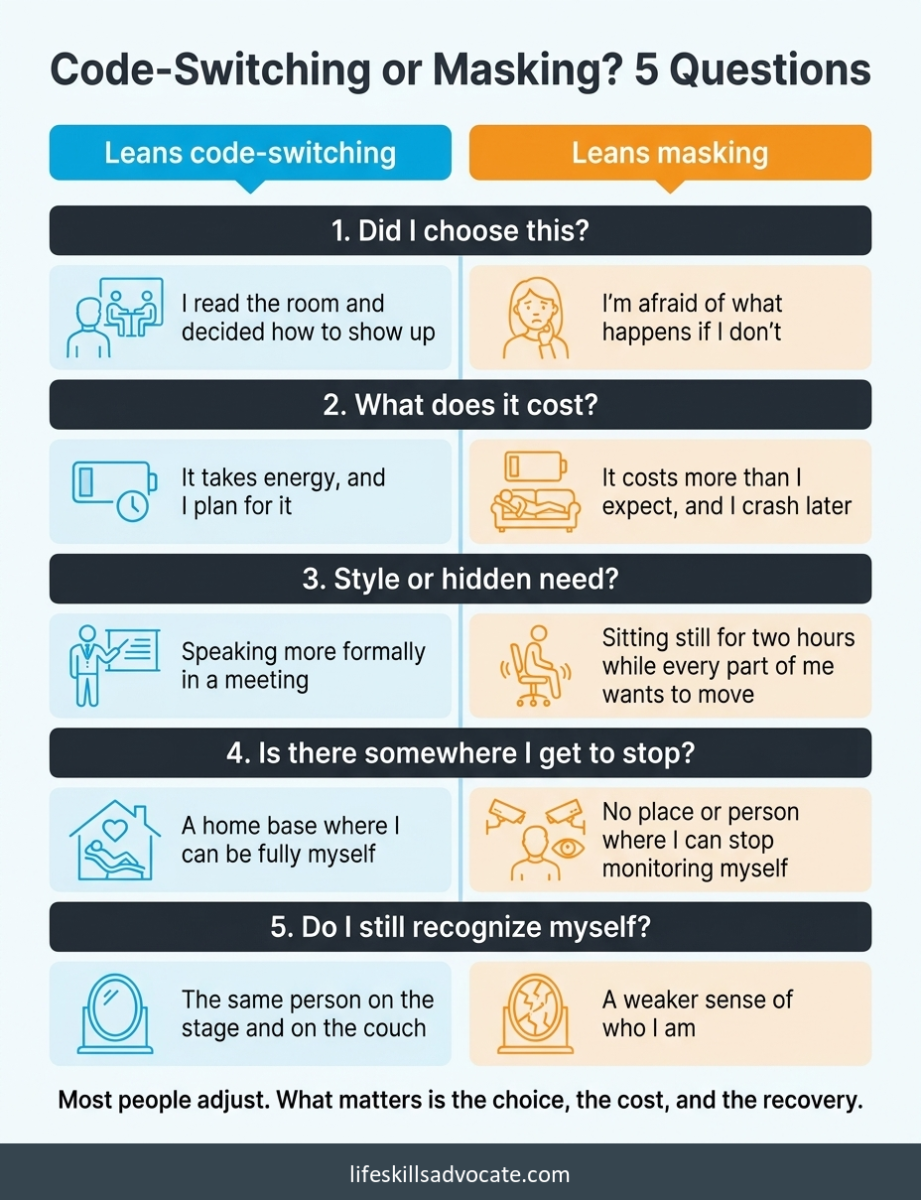
1. Did I Choose This, or Did It Feel Required?
Adjusting because you read the room and decided how you want to show up is a communication skill. Adjusting because you’re afraid of what will happen if you don’t feels different in the body, even when it looks the same to everyone else.
2. What Does It Cost, and Can I Afford It Today?
Presenting takes energy for me, and I plan for it. Masking usually costs more than you expect, and you feel it later as a crash, irritability, or an evening when you can’t do anything at all.
3. Am I Adjusting My Style, or Hiding a Need?
Speaking more formally in a meeting is a style change. Sitting through a two-hour meeting without moving while every part of you wants to get up is hiding a need. Needs you hide rarely go away. They tend to come out later, usually at home, usually with the people you love most.
4. Is There Somewhere I Get to Stop?
Healthy code-switching assumes a home base, a place where you can drop the adjustments and be fully yourself. If you can’t name a place or a person where you don’t have to monitor yourself, pay attention to that.
5. Do I Still Recognize Myself Afterward?
The adults with ADHD in the 2026 study described a weaker sense of who they were under all the adjusting. Healthy adapting leaves your sense of self intact. You know you’re the same person on the stage and on the couch.
The same five questions, side by side:
| Question | Leans code-switching | Leans masking |
|---|---|---|
| 1. Did I choose this? | You read the room and decided how you want to show up | You’re afraid of what will happen if you don’t |
| 2. What does it cost? | It takes energy, and you plan for it | It costs more than it looks like in the moment, and you feel it later as a crash, irritability, or an evening when you can’t do anything at all |
| 3. Style or hidden need? | Speaking more formally in a meeting because you chose to | Sitting through a two-hour meeting without moving while every part of you wants to get up |
| 4. Somewhere to stop? | A home base, where you can drop the adjustments and be fully yourself | You can’t name a place or a person where you don’t have to monitor yourself |
| 5. Still recognize yourself? | Your sense of self stays intact: the same person on the stage and on the couch | A weaker sense of who you are under all the adjusting |
What to Do With This
I don’t think the goal is to stop adjusting. Most of us want to show up differently at a funeral than at a birthday party. The goal is to adjust on purpose, for reasons you agree with, in amounts you can recover from.
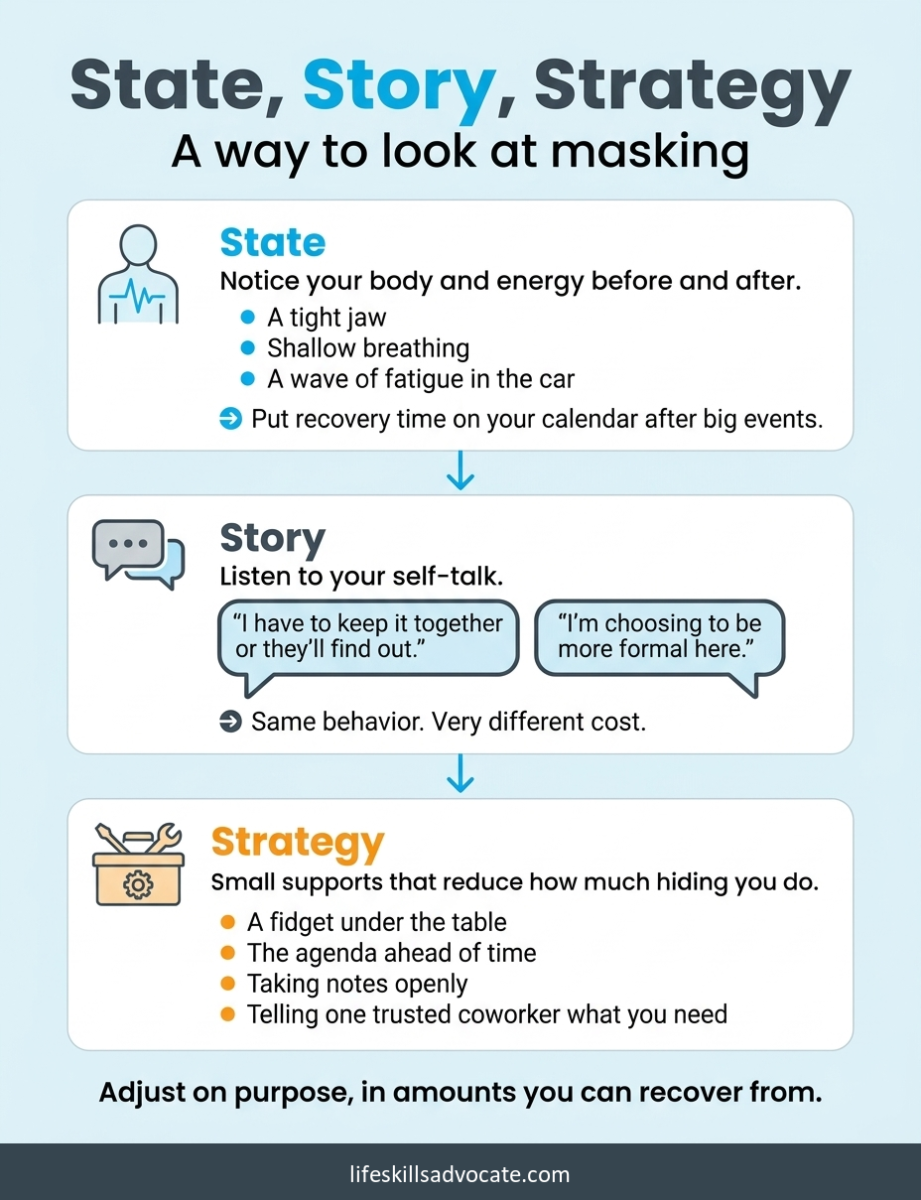
That starts with acceptance. Once you stop treating the parts of you that you’ve been hiding as problems, you can build support around them. In my coaching, I use a framework called State, Story, Strategy, and it’s a useful way to look at masking:
- State: Notice your body and energy before and after. Masking often shows up in the nervous system first: a tight jaw, shallow breathing, or the wave of fatigue when you finally sit down in the car. Put recovery time on your calendar after events you know will take a lot of masking.
- Story: Listen to your self-talk. “I have to keep it together or they’ll find out” and “I’m choosing to be more formal here” describe the same behavior, and they cost very different amounts. The words you use with yourself matter.
- Strategy: Look for small supports that reduce how much hiding you have to do: a fidget under the table, asking for the agenda ahead of time, taking notes openly, or telling one trusted coworker what you need. Each one lightens the load a little, and small changes accumulate.
Code-Switching vs. Masking: What the Research Says
The studies cited in this post, one finding per row:
| Finding | What it means | Source |
|---|---|---|
| For Black employees, code-switching at work can bring benefits, like being seen as more professional by the workplace’s standards, along with costs including drained mental energy and burnout (2019). | Adjusting to be treated fairly at work can pay off and still carry a real cost. | McCluney et al., Harvard Business Review (2019) |
| Camouflaging has three types: compensation, masking, and assimilation (2019). | Masking is one of three ways people camouflage, not the whole picture. | Hull et al. (2019) |
| A 2025 review of 24 studies found autistic adults describe camouflaging as exhausting, linked with anxiety, depression, and stress. | The costs of masking show up again and again across studies. | Summerill & Summers (2025) |
| In matched groups of 105 each (2024), autistic adults camouflaged most, and adults with ADHD camouflaged more than the comparison group, with the difference on assimilation. | Masking is not limited to autism. | van der Putten et al. (2024) |
| In a 2026 study of 202 adults with ADHD, 91.6% said they camouflage. | Most adults with ADHD in that study camouflage. | Mylett, Boucher, & Iarocci (2026) |
Frequently Asked Questions
Is code-switching the same as masking?
They overlap, since both involve adjusting how you present yourself. Code-switching is the broader term and can be neutral. Masking usually refers to hiding neurodivergent traits to avoid judgment, and it tends to cost more.
Is code-switching a skill or a coping mechanism?
It can be both. Speech-language pathologists spend a lot of time on a closely related skill called pragmatics: reading a situation and adjusting how you communicate to fit it. Knowing that a job interview calls for different language than a backyard barbecue is a sign of strong communication, and it’s something we actively teach.
Adjusting because you read the room and decided how you want to show up is a communication skill. Adjusting because you’re afraid of what will happen if you don’t feels different in the body, even when it looks the same to everyone else. Even ordinary adjusting becomes costly when it’s driven by the threat of being judged.
An adjustment you first learned to stay safe can later become one you choose, when the setting gives you more room to decide how you want to show up.
Is code-switching an ADHD thing?
Not only. Most people adjust how they show up, which is why code-switching and masking get tangled. Masking is common with ADHD, though: in a 2026 study of 202 adults with ADHD, 91.6% said they camouflage.
Is ADHD masking the same as racial code-switching?
No. Masking and racial code-switching aren’t the same thing, and one can’t stand in for the other. Much of the workplace research on code-switching focuses on the experiences of Black professionals and other people of color, who often adjust their speech, appearance, and behavior to be treated fairly in spaces built around someone else’s norms.
Is masking always bad?
No. Adults in the 2026 ADHD study said camouflaging helped some social interactions go more smoothly and helped them manage how others saw them. The 2025 review of autism research also found short-term benefits, including avoiding stigma. The concern is masking all the time, everywhere, with no recovery.
How do I start masking less?
Start with one setting and one person who feels safe. Notice what you hide there, and let one small thing show, like needing to move or needing to write things down. Often the reaction is smaller than the one you’ve been bracing for, and when it isn’t, that’s useful information too.
Going Further
If you’d like to keep exploring this, my book, You’re Not Doing It Wrong, is about building systems that fit the brain you have. My ADHD Focus Lab is a monthly membership where adults with ADHD practice this kind of reflection together. You can find more of my work at suzycarbrey.com.
About the author: Suzy Carbrey is an ADHD and executive function coach and a licensed speech-language pathologist. Before coaching, she spent five years in adult medical rehabilitation, where attention, memory, and organization were her daily clinical targets. She has her own attention and sensory processing differences, so she coaches from inside the experience.
Sources and Further Reading
- Cancino-Barros, I., Villacura-Herrera, C., & Castillo, R. D. (2025). A meta-analytic review of quantification methods for camouflaging behaviors in autistic and neurotypical individuals. Scientific Reports, 15, 22885.
- Code-switching. Encyclopaedia Britannica.
- Hull, L., Mandy, W., Lai, M.-C., Baron-Cohen, S., Allison, C., Smith, P., & Petrides, K. V. (2019). Development and validation of the Camouflaging Autistic Traits Questionnaire (CAT-Q). Journal of Autism and Developmental Disorders, 49(3), 819-833.
- McCluney, C. L., Robotham, K., Lee, S., Smith, R., & Durkee, M. (2019, November 15). The Costs of Code-Switching. Harvard Business Review.
- Mylett, M. L., Boucher, T. Q., & Iarocci, G. (2026). “I wish I could just be myself”: Experiences of social camouflaging in adults with ADHD. Research in Neurodiversity, 2, 100018.
- Summerill, J., & Summers, S. J. (2025). The consequences of social camouflaging in autistic adults: A systematic review. Research in Autism, 121-122, 202556.
- van der Putten, W. J., et al. (2024). Is camouflaging unique for autism? A comparison of camouflaging between adults with autism and ADHD. Autism Research, 17(4), 812-823. Open-access PDF.
- You’re Not Doing It Wrong – Suzy Carbrey
- ADHD Focus Lab – Suzy Carbrey
- suzycarbrey.com – Suzy Carbrey
- ADHD Masking: What It Is, What It Costs, and What Helps – Life Skills Advocate
- 12 Examples of Autistic Masking in Everyday Life – Life Skills Advocate
- 9 Ways to Recharge Your Social Battery Before and After Plans – Life Skills Advocate
- Signs of Neurodivergent Burnout and Ways to Recover – Life Skills Advocate
- Internalized Ableism or Low Motivation? How to Tell the Difference – Life Skills Advocate
- 12 ADHD Workplace Accommodations and When Each One Fits – Life Skills Advocate
- Body Scan Mindfulness Activity (free printable) – Life Skills Advocate