
You checked the time twenty minutes ago and decided to stop. Your thumb is still going.
For a lot of adults with ADHD, that gap is the whole problem. Deciding to stop and being able to start something else are two separate jobs, and the second one is where things stall. The decision landed. The body did not get the message.
It goes by other names in the room where it happens: the rabbit hole, bed rotting, being about to do the thing for three hours. Whatever you call it, the scroll is usually doing one of four jobs.
Everything below is an answer to how to stop doomscrolling matched to those four jobs, and the first four work from where you are sitting right now, phone still in hand.
TL;DR
Every answer to how to stop doomscrolling below is matched to one of four jobs the scroll is doing:
- Deciding to stop and being able to start something else are two different jobs, and the second one is where it breaks.
- Four of them work in the moment, and not one is a mental instruction: change your body position, answer the nearest body need, use an outside signal instead of noticing how you feel, and say the next step as a choice rather than a rule.
- Five more work before the next one starts: fill the empty slot in advance, shrink the task underneath the scroll, stock something that competes for the same reward, add friction on the phone and the browser, and let a depleted evening be a rest instead of a restart.
- At night, the thing to work on is the decision to keep putting bed off, not the screen.
- Some scrolling is a real reset before a transition, and it shrinks when you plan for it.
- Your screen-time total is a weaker signal than your relationship to those hours.
This is educational, not a medical or diagnostic opinion. If you are working on this with a therapist or doctor, treat it as something to bring to that conversation rather than a replacement for it.
Why Knowing How to Stop Doomscrolling Is Not the Hard Part
Most advice on this is written for the moment before you pick up the phone. The moment that needs help is the one after you have already decided to put it down and your hand has not moved.
Those are different skills. Deciding is a judgment call. Starting is task initiation, one of the executive function skills that tend to run short in ADHD brains, and it does not get easier because the decision was correct.
This is the same wall that shows up when the dishes are right there and you cannot walk over to them, which is why task paralysis and the scroll so often show up in the same afternoon.
Time blindness sits underneath it. In coaching this comes up again and again as time disappearing rather than time spent: you look up and it is three hours later, and the twenty minutes you thought you were spending never registered as a length at all.
There is a published version of the whole chain. A 2023 path analysis of 211 medical students in Hungary, published in BMC Medical Education, found that trouble staying focused and planning tasks was linked to worse sleep through a run of steps: heavy phone use, then putting tasks off, then putting bed off, then short sleep, then next-day fatigue.
Attention feeds the phone, the phone feeds the delay, the delay feeds tomorrow’s attention. Worth naming the limits of that: 211 students, one country, measured once, by self-report. It describes a loop many readers will recognize, and it does not prove which piece moves first.
So the useful question is not how to want it more. It is which job the scroll is doing this time.
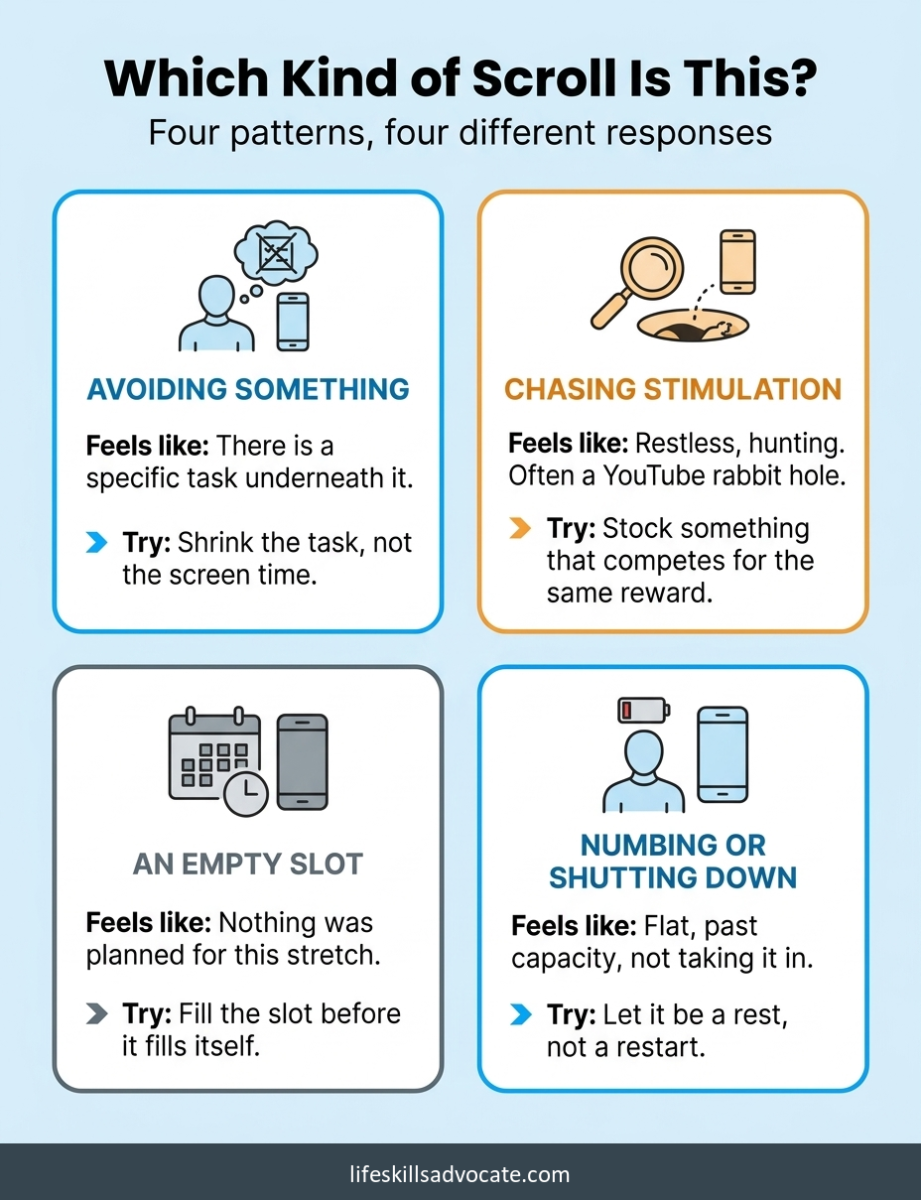
Which Kind of Scroll Is This? Four Patterns to Read First
One reason a single list of tips lands for some people and slides off others is that the same behavior runs on at least four different engines. From the outside they look identical. From the inside they feel nothing alike, and they need different responses.
| Pattern | What it feels like | What tends to help |
|---|---|---|
| Avoiding something | There is a specific task underneath it. The scroll started roughly when you thought about that task. | Shrink the task, not the screen time (#6 below) |
| Chasing stimulation | Restless, hunting for something. Often a YouTube rabbit hole or a wiki deep dive rather than short-form video. | Stock something that competes for the same reward (#7 below) |
| An empty slot | Nothing was planned for this stretch, so this became the default thing to do with it. | Fill the slot before it fills itself (#5 below) |
| Numbing or shutting down | Flat and past capacity. You are looking at the screen without taking much in. | Let it be a rest instead of a restart (#9 below) |
The second row deserves a note, because the usual framing gets it wrong for this audience. Coaching notes are full of YouTube and comparatively light on TikTok.
The recurring pattern is the long, interest-driven deep dive that starts as one question and turns into six tabs and a bibliography, which is closer to hyperfocus with a search bar than to boredom. The dopamine menu approach is built for that.
The fourth row is worth separating out too. Being flat, foggy and unable to move is a different state from being restless, and several of the nine below will be too expensive there. Shutdown states respond to rest and warmth, not to a better system.
9 Ways to Stop Doomscrolling, Starting With the Next 30 Seconds
These first four assume the worst-case version of the moment: you are already in it, you already know you want out, and the phone is still in your hand. Nothing here asks you to want it more.
1. Change Your Body Position Before You Change the Behavior
Skip the phone entirely for a second and move something bigger. Put both feet flat on the floor. Sit up. Count to three out loud and stand.
The counting matters more than it sounds like it should, because it turns a vague intention into one small action with a clear edge on it. So does the permission that goes with it: you are allowed to sit straight back down.
A stand-up you can undo is a much cheaper thing to start than one that commits you to the rest of the evening.
2. Answer the Nearest Body Need First
Not the laundry. Not the email. The bathroom, a glass of water, or turning on a light.
Body needs are the lowest-demand thing available, they are usually overdue by the time you notice, and they get you upright without asking you to be productive. Advice that jumps from the couch to the gym skips about five steps, and for a stuck brain those five steps are the entire distance.
3. Use an Outside Signal Instead of Noticing How You Feel
The signal that tells you to stop does not have to come from inside you.
Noticing is the usual starting point: notice how you feel, notice what you are looking for, notice the negative sensations. That works when reading your own internal signals is reliable. For plenty of neurodivergent readers it is the hardest step in the sequence rather than the first one, which means an approach built on noticing depends on the one thing that is offline.
Outside signals do not need inside information. Your phone’s own screen-time number is one. So is a timer someone else set, a lamp on a smart plug, a physical checkpoint (feet on the floor, bladder, thirst), or a text from a person who knows what you are working on.
If you want a version you can keep, the Time Log Worksheet is built for this. It turns “where did the evening go” into something you can look at afterwards instead of something you have to sense in real time.
4. Say the Next Step as a Choice, Not a Rule
Standard scroll advice is written almost entirely in the imperative: set a limit, turn off notifications, stay busy, put the phone away.
For readers whose nervous systems treat an instruction as pressure, including instructions they gave themselves, that wording is the barrier. The advice underneath it can be perfectly good.
The content usually survives a rewrite. The demand does not.
| The usual wording | The same idea with the demand taken out |
|---|---|
| Set a time limit and stick to it. | Pick a stopping point you would be fine with. If you blow past it, pick another one. |
| Turn off your notifications. | Which single notification would you miss if it went away today? |
| Stay busy. | What is the smallest thing you would be willing to stand up for? |
| Put your phone in another room. | Where would you be fine with the phone being for the next ten minutes? |
| You should be asleep by now. | You are allowed to be horizontal with your eyes closed. |
What Helps Before the Next Scroll Starts
The rest of how to stop doomscrolling happens earlier, in the setup rather than in the moment. Each of these five aims at a different one of the four jobs.
5. Fill the Empty Slot Before It Fills Itself
One pattern runs through LSA’s coaching notes: scrolling expands to fill unstructured time. It rarely wins a fair fight against a planned activity. It wins by being the only thing on the schedule for the hour after work, the hour after school, or the stretch between dinner and whenever bed happens.
Which means the target is the gap, not the phone. Decide the day before what that hour is for, and make it something you would plausibly say yes to while tired.
The Break Box Exercise exists for this. It is a menu of real breaks built in advance, so the reset in that gap is a decision you already made rather than whatever your thumb reaches for by default.
6. Shrink the Task Underneath the Scroll
When the scroll is avoidance, screen limits treat the wrong thing. The scroll is the exhaust. The task is the engine.
Find the task and cut it down until the first step is almost insultingly small. Not “do the taxes” but “open the folder.” Not “answer the email” but “open the email and read it once.” If the first step still feels heavy, it is still too big. Shrink it again.
7. Stock Something That Competes for the Same Reward
Removing a source of stimulation without replacing it leaves a gap the brain goes looking to refill, usually with the thing you just removed. The replacement has to compete on the same terms: available in seconds, low setup, interesting on a bad day.
That is a high bar. Learning piano is a fine goal and a poor substitute for a rabbit hole at 11pm. Building the list while you have capacity, using something like the dopamine menu, is how you make sure something is on hand when you do not.
8. Add Friction in Both Places, the Phone and the Browser
Deleting the app works right up until you open the same site in a browser thirty seconds later. In coaching, the version that holds covers both doors at once: the app comes off the phone, and you log out on the computer.
A few other things coaches use regularly: greyscale, a separate app for the one legitimate use so the main one can go, naming the places it happens (the sofa, the bed, the bathroom) and keeping the phone out of your hands there, and giving the phone a bedtime.
The standing version of this work lives in the fuller guide to ADHD and screen time management.
9. Let a Depleted Evening Be a Rest, Not a Restart
By 9pm, on a day that used everything you had, the scroll is often doing the numbing job rather than any of the other three. The instinct then is to salvage the evening: get back on track, do one useful thing, redeem the day.
That is what turns a short rest into a long one. Rest with productivity smuggled into it does not restore anything, so the need it was meant to meet is still there an hour later, and the scroll keeps going because the job never got done.
Calling it a rest on purpose is faster than salvaging. Put on the thing you have already seen. Lie down. Set a timer if the open-endedness is what worries you.
How to Stop Doomscrolling at Night, When Setup Advice Arrives Too Late
All five of those share a flaw: they have to be done hours before the moment they are meant to help. At 1am none of that setup work is available, and that is exactly when most people are reading this. The first four still are.
The research here moves the target in a useful way. A 2023 study of 313 Spanish adults aged 18 to 60, published in Behavioral Sciences, found problematic phone use had no direct link to worse sleep quality at all. The link ran entirely through bedtime procrastination, the decision to keep putting bed off.
A 2021 study of 1,104 university students in China, published in the Journal of Behavioral Addictions, found the same shape: the direct path was not significant, and rumination plus bedtime procrastination carried the effect between them.
Both are cross-sectional and self-reported, and both were run outside the US, so treat them as a description of a mechanism rather than a rate that applies to you.
What they point at is worth taking seriously anyway. The screen is the setting; the delay is what does the damage, and the delay is a task-initiation problem wearing pajamas. If that is the piece you keep hitting, the deeper version lives in ADHD and sleeping too much, where revenge bedtime procrastination gets its own section.
One piece of setup survives a bad night better than the rest, and it is the boring one: the phone sleeps somewhere other than the bed. That advice usually fails for a practical reason rather than a motivational one, which is that the phone is the alarm. Solving the alarm first is what makes the rest possible, and a standalone alarm clock is a small purchase that removes the actual blocker.
Peakeep Battery Operated Digital Alarm Clock
It runs on 4 AA batteries with no cord, so it can live anywhere in the room, and the display dims automatically at night and can be switched off entirely, which matters if a lit clock face is its own problem for you. Alarm volume has five settings.
Best for: People whose reason for sleeping next to the phone is that the phone is the alarm. It is a plain clock, not a sunrise lamp or a vibrating-pad alarm; if getting up is the harder half, those are different tools.
When the Scroll Is Doing a Job Worth Keeping
Here is the part that tends to land last and matter most.
Some scrolling is regulation rather than sabotage. The clearest example is the scroll that shows up right before a transition: before leaving the house, before starting the hard task, before bed. Watching yourself do it while the clock runs feels like self-destruction from the inside. Functionally, it is often a nervous system buying a few minutes to change gears.
The loop that makes it expensive is the one that runs afterwards. Scroll, then criticize yourself for scrolling, then feel worse, then need more regulating, then scroll longer.
The scrolling is not what grows the spiral. The second step is. That is the same mechanism behind procrastination guilt, where the guilt reliably costs more time than the delay it is about.
Which suggests something odd-sounding: budget it. Ten minutes of deliberate scroll time before a transition, timed, planned, on purpose.
Both a widely upvoted account from the ADHD community and LSA’s own coaching notes arrived at that independently, which is a stronger signal than either alone. When the break is planned, a few minutes tends to do the job. When it is stolen, it grows.
This is also the real answer to the screen-time-hours question. A study of 154,981 adolescents across 29 countries, published in the Journal of Adolescent Health, separated heavy social media use from problematic use and found the risk to wellbeing tracked with the second one rather than with raw time.
That sample is teenagers, not adults, so it does not transfer cleanly. The distinction still travels: what your relationship to those hours looks like carries more information than the number itself.
Where Coaching Fits, and Where It Does Not
The usual escalation on this topic jumps straight from a list of tips to finding a therapist, with nothing in between. Therapy is the right call when the driver underneath the scroll is anxiety, depression or trauma, and that is genuinely common. It is a different service from skill-building.
The in-between step is coaching. Executive function coaching is educational rather than medical: it works on the transition gap, the task-initiation wall, and what actual rest looks like for you, with someone who checks whether the system held. It suits people who broadly know what they want to do and keep hitting the same wall at the doing. It is not a substitute for mental health care, and a good coach will say so.
What the Research Says About How to Stop Doomscrolling and Sleep Better
| Finding | What it means | Source |
|---|---|---|
| In 313 Spanish adults aged 18 to 60, problematic smartphone use had no direct link to sleep quality. Its effect ran entirely through bedtime procrastination. | The screen is where it happens; the delay is the mechanism. Advice on how to stop doomscrolling that targets screen limits alone misses that. | Correa-Iriarte et al., Behavioral Sciences (2023) |
| In 211 Hungarian medical students, trouble staying focused and planning tasks was linked to poorer sleep through a chain of heavy phone use, task delay, bedtime delay, short sleep and next-day fatigue. | The loop many people describe informally exists as a published path model, and each link in it is a place to intervene. | Hamvai et al., BMC Medical Education (2023) |
| Across 154,981 adolescents in 29 countries, heavy social media use and problematic use were distinct. Lower wellbeing tracked with problematic use in every country studied, not with time spent. | Hours alone are a weak signal. Loss of control and preoccupation carry the risk. The sample is adolescents, so it is directional for adults. | Boer et al., Journal of Adolescent Health (2020) |
| In 1,104 Chinese university students, the direct path from heavy internet use to poor sleep was not significant; rumination and bedtime procrastination carried the effect. | A second country and sample reaching the same structure, adding rumination, which matches bedtime scrolling that is really emotional avoidance. | You et al., Journal of Behavioral Addictions (2021) |
Frequently Asked Questions
Is Doomscrolling an ADHD Thing?
It is not exclusive to ADHD, and it does show up differently. Scrolling asks for almost no task initiation to begin and quite a lot to end, which is a bad shape for a brain that finds starting and stopping expensive.
Add time blindness and the twenty minutes never registers as a length. This is a pattern description, not an identification.
Why Do I Keep Scrolling When I Know I Am Going to Be Late?
Because knowing is not the part that is broken. The decision to leave has already been made and filed; what has not happened is the transition, and transitions are where executive function costs the most.
There is often a second layer under it. Scrolling right before you have to switch gears is frequently the nervous system regulating for the switch, which is why it clusters at exactly the moments you can least afford it.
That does not make being late fine. It does mean the useful work is making the transition cheaper (things by the door, an alarm set for leaving rather than arriving, five deliberate minutes budgeted before it) rather than trying harder at a step already done.
Does Deleting the Apps Work?
Partly, and mostly when it covers both doors.
Deleting an app raises the cost of opening it, which is real and worth doing. It fails in a predictable way: the same site is thirty seconds away in a browser, and reinstalling takes about as long. The version that holds handles the phone and the computer together, so the app comes off the phone and you log out on the desktop, which means getting back in takes a password you have to go find.
Two things make it stick better. Keep a separate app for the one legitimate use, so you are not reinstalling the whole feed to check a group chat. And add something to replace the input rather than only subtracting it, because removal on its own leaves a gap that tends to get refilled by whatever is nearest.
How Many Hours Is Too Many?
The hours are a weaker signal than they look. Two people can log the same total and one is fine while the other is losing sleep. What matters is whether you can stop when you decide to.
Once You Know How to Stop Doomscrolling, Does It Stay Stopped?
Probably not in the sense of never opening a feed again, and that is a strange goal anyway. What changes is the length: how long a stretch runs before something interrupts it, and how expensive it feels afterwards.
Most people who get somewhere with this describe the same shape of progress, which is fewer three-hour disappearances and more twenty-minute ones, with occasional bad weeks that arrive alongside stress, illness or a schedule falling apart. Whether that counts as stopping depends on what you wanted from the word.
Next Steps
The scroll pattern costing you the most is usually attached to one specific hour of the day, so that hour is where this gets traction first.
- Name the hour. Pick the one stretch where this reliably happens (after work, after dinner, the last hour before bed) and write it down. One hour, not the whole day.
- Run the four-pattern read on that hour only. Avoiding something, chasing stimulation, an empty slot, or numbing out. Then take the one that matches rather than the whole list.
- Build the break menu before you need it with the Break Box Exercise, while you have the capacity to think of things you would say yes to when tired.
- If the wall is showing up in more places than the phone, the free executive functioning assessment will point at which skill is carrying the load, which beats guessing.
Further Reading
- Relationship between Problematic Smartphone Use, Sleep Quality and Bedtime Procrastination – Correa-Iriarte et al., Behavioral Sciences (2023)
- Association between impulsivity and cognitive capacity decrease, mediated by smartphone addiction and procrastination – Hamvai et al., BMC Medical Education (2023)
- Adolescents’ Intense and Problematic Social Media Use and Their Well-Being in 29 Countries – Boer et al., Journal of Adolescent Health (2020)
- Mediating effects of rumination and bedtime procrastination on the relationship between Internet addiction and poor sleep quality – You et al., Journal of Behavioral Addictions (2021)
- Signs of Executive Dysfunction and Practical Ways to Work With It – Life Skills Advocate
- Task Paralysis: Ways to Start When Your Brain Will Not – Life Skills Advocate
- How to Build a Dopamine Menu for ADHD – Life Skills Advocate
- Signs You Are in Dorsal Vagal Shutdown – Life Skills Advocate
- ADHD and Screen Time Management – Life Skills Advocate
- ADHD and Sleeping Too Much – Life Skills Advocate
- Best Alarm Clocks for ADHD – Life Skills Advocate
- How to Overcome Procrastination Guilt – Life Skills Advocate
- Break Box Exercise – Life Skills Advocate
- Time Log Worksheet – Life Skills Advocate
- Executive Function Coaching for Adults – Life Skills Advocate
- Free Executive Functioning Assessment – Life Skills Advocate