
You are twenty minutes into the one task that finally has your full attention when someone leans in with a quick question. It takes them ten seconds to ask. Forty minutes later you are still trying to find the thread you dropped.
The distance between what that interruption cost them and what it cost you is where monotropism becomes a useful word. It describes attention that commits deeply to a small number of things at a time instead of spreading thin across many, and it was proposed by autistic researchers as a way of understanding autistic experience from the inside.
It is a description of how attention is organized. It is not something anyone screens for.
The useful question is where it turns up in an ordinary week for autistic and AuDHD adults, and what is worth trying when it does.
TL;DR
Monotropism is easier to recognize in a Tuesday than in a definition, so here is where it tends to show up:
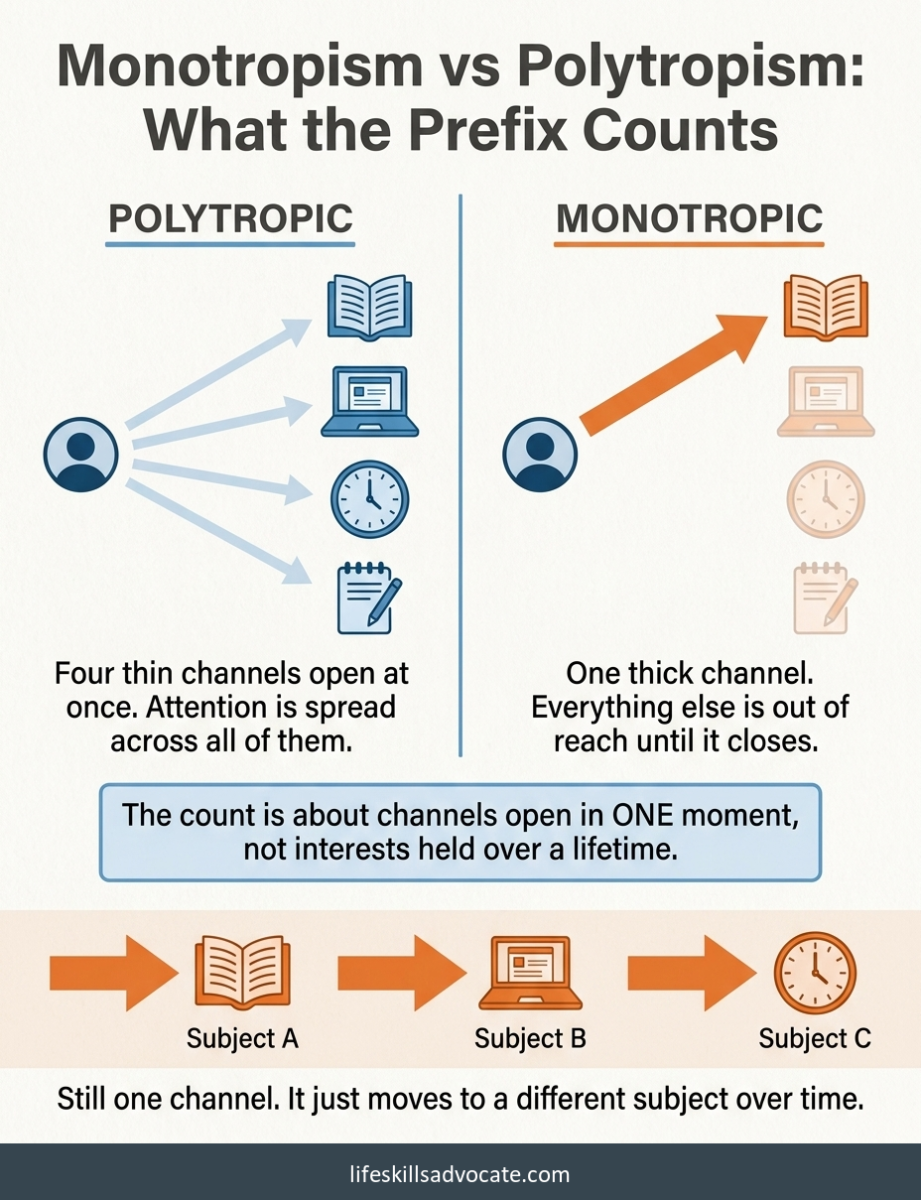
- The name misleads people. It counts how many things hold your attention at once, not how many interests you have had over a lifetime.
- Interruptions and switches cost the most: a question landing mid-task, starting one thing with another still open, finishing, and being moved along on someone else’s schedule.
- A day can disappear inside one task, and half-finished work piles up when the tunnel closes before the task does.
- It shapes how you come across in conversation, and it explains why an interest can stop holding you without that meaning anything is wrong.
- It is not the same as hyperfocus, it is not something anyone is assessed for, and the formal evidence behind it is still thin.
This is educational, not a professional evaluation. Monotropism is a way of describing attention rather than something anyone diagnoses or screens for, and it does not replace working with someone who knows you.
What Monotropism Means (and Why the Name Trips People Up)
Monotropism proposes that autistic attention tends to pour into a small number of interests at a time, and that a great deal of what gets described as autism follows from that. The idea came from Dinah Murray, Mike Lesser and Wenn Lawson, and their 2005 paper in the journal Autism argues that the first two diagnostic criteria for autism fall out of the third one, the restricted range of interests.
Attention, in this account, is a limited resource. Pour most of it into one channel and that channel gets remarkable depth. What it costs is everything outside the channel, including things you would ordinarily notice without trying.
Then the name gets in the way.
The prefix counts channels, not interests. Plenty of people meet the word, read “mono” as one thing for life, think about the six all-consuming interests they have cycled through in ten years, and rule themselves out on the spot.
The claim is about how many things can hold attention in a single moment, not how many a person collects across a lifetime. Interests rotate. The attention style stays.
Fergus Murray, who writes for the theory’s own site, has described delaying an autism assessment for years after mistaking serial monotropism for multitasking. One deep channel moving from subject to subject looked, from the inside, like doing several things at once.
The other word worth having is the one people tend to reach for on their own. An attention tunnel is what a monotropic channel feels like from inside it: the task is vivid and the room around it goes dim. Tunneling is the everyday name for the same thing, and it is why being pulled out of one lands so much harder than it looks from outside.
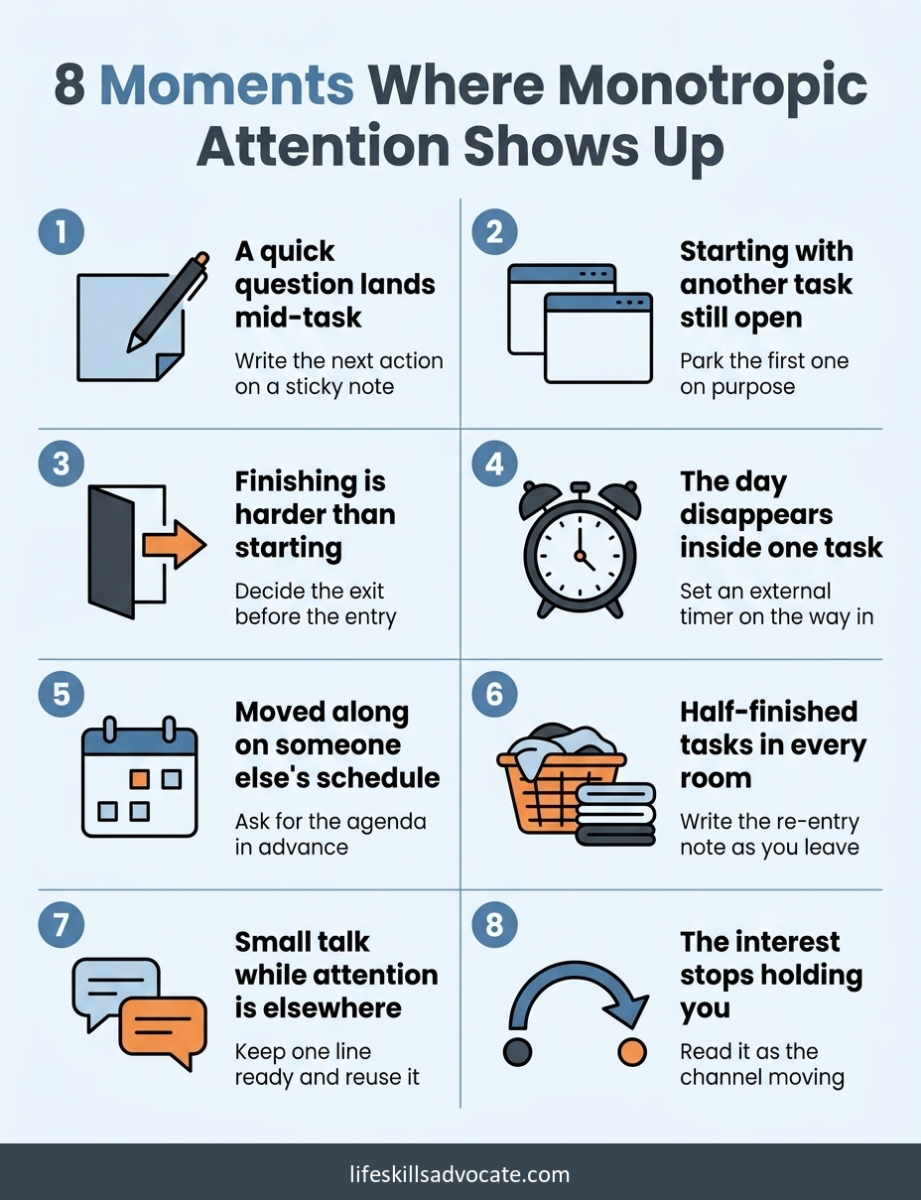
8 Everyday Moments Where Monotropic Attention Shows Up
The moments below come up again and again in executive function coaching with autistic and AuDHD adults, even when nobody in the room uses the word monotropism. Each carries a what-helps line you can run on your own attention, without needing someone else to manage the situation for you.
1. A Quick Question Lands Mid-Task
Someone needs ten seconds. What they interrupt is a channel that took twenty minutes to build, and rebuilding it is its own piece of work. That mismatch is why the reply can come out sharper than you meant it, which then costs a second conversation on top of the first.
The same mechanism is why unexpected changes land harder than scheduled ones. An interruption you knew about is half-loaded before it arrives.
What helps: before you turn to answer, write the single next physical action on a sticky note. Not the task, the action. “Open the spreadsheet” gets you back in. “Finish the report” does not.
2. Starting One Thing While Another Is Still Open
You have not finished the first thing. You have not put it down either. It sits half-open, part of your attention stays with it, and the second task gets whatever is left over. Murray’s writing calls this the monotropic split, and it is expensive in both directions at once.
What helps: park the first task on purpose. Write down where you stopped and what comes next, then close it. An ambiently open task is the costly kind. A deliberately parked one is not.
3. Finishing Is Harder Than Starting
Getting into a task is one problem. Getting out of it is a separate and often bigger one, and the two get talked about as though they were the same skill. Stopping means dismantling something that took real effort to build, with no promise it goes back up the same way tomorrow.
This is the territory of autistic inertia, where starting, stopping and switching each carry their own separate cost.
What helps: decide the exit before the entry. “I stop at the end of this section” is a decision made by a person with spare attention. Made mid-tunnel, it is a decision made by someone who has none left to spend on it.
4. The Day Disappears Inside One Task
No lunch. No water. You look up and it is dark outside, and the first thing you register is that your back hurts.
There is a mechanism behind this. Wenn Lawson, one of the theory’s original authors, wrote about it in a 2025 paper in Frontiers in Psychiatry. When all of an autistic person’s attention sits on whatever has captured their interest, Lawson argues, there may be none spare to notice interoception, the sense that reports what is going on inside the body.
The signal is still being sent. Nobody is free to pick it up.
Running a body past its limits all day is also one of the more reliable routes into an autistic meltdown later that evening.
What helps: put the signal outside yourself, and set it on the way in rather than after. A repeating alarm or a visual countdown timer does the noticing that your attention is currently too committed to do. It is also worth mapping how your own attention behaves when it is fully absorbed, so the alarm is set for a real pattern rather than a guessed one.
A 5.5 by 7 inch desk timer that shows time left as a shrinking red disk, so one glance tells you where you are without any arithmetic. It runs silently, has an optional audible alarm, and carries a play/pause button, which is useful when the interruption is the part you are trying to survive.
Best for: people who lose an afternoon inside one task and need the time signal to sit outside their own attention. Most of the range is marketed to classrooms. The PLUS line is the one the manufacturer positions for working at home or in an office, and it takes one AA battery, not included.
5. Being Moved Along on Someone Else’s Schedule
Class periods. Standups. Shift changes. A meeting that starts in four minutes. The meeting itself is rarely the expensive part; the forced exit from whatever it interrupted is, and that exit gets scheduled by someone with no way of knowing what it costs.
Task switching gets cheaper with warning and a good deal more expensive without it.
What helps: ask for agendas in advance and treat the agenda as a loading dock. When a switch is visible an hour out, part of the exit happens before anyone asks for it. In between, it is worth practicing small disruptions on purpose, at a size you choose, on a day that is otherwise going fine.
6. Half-Finished Tasks in Every Room
The laundry made it to the machine but not the dryer. Three documents sit open at 80 percent. The tunnel closed before the task did, and reopening one from cold costs more than staying inside it would have.
What helps: write the re-entry note at the moment you leave, not the moment you come back. Two lines is enough: where you stopped, and the first physical action on the way back in. Leaving is when you still have the context. Returning is when you do not.
7. Small Talk While Your Attention Is Elsewhere
Someone gets a flat “mm” and reads it as rudeness or disinterest. What they got was the last thin edge of a channel committed somewhere else entirely.
It tends to be a two-way misread, which is roughly what the double empathy problem describes: two people with different processing styles each finding the other hard to read, and each assuming the gap belongs to the other one.
What helps: keep one line ready and reuse it. “I am mid-thing and I will lose it. Can I find you in twenty minutes?” Short, true, and better than faking warmth you have no attention free for.
8. The Interest Stops Holding You
The thing that carried you for eight months goes flat, often with no particular reason you can point to. It stopped being where your attention lives, and the guilt arrives on schedule: the unfinished project, the money already spent, the people you told all about it at the time.
What helps: read it as the channel moving rather than as a failure of commitment. The project can sit. Interests come back around more often than people expect.
Monotropism and Hyperfocus Are Not the Same Thing
Hyperfocus is a state you drop into. Monotropism is a claim about how attention is set up by default, all the time, including on the ordinary days when nothing in particular has captured it. One is an episode. The other is the system the episode happens inside.
That distinction matters most for the reader working out whether they have just learned a second word for something they already had a word for. ADHD hyperfocus is usually described as an intense state that arrives around something rewarding and is hard to leave. Monotropism would say that state is simply what a monotropic channel looks like when the thing sitting in it is compelling enough.
Where the two overlap is unsettled. Autism researcher Patrick Dwyer’s review of monotropism at the Olga Tennison Autism Research Centre names flow and hyperfocus as neighboring concepts and says plainly that how far they overlap has not been worked out. Anyone drawing the line cleanly is running ahead of the evidence.
What the distinction is good for is practical. If deep focus is an occasional state, you plan around the episodes. If it is the default setting, you plan around the transitions, which is different work and the reason the list above is mostly about entering and leaving rather than about focusing harder.
Monotropism and ADHD: Why So Many AuDHD Adults Recognize It
If ADHD means distractible, how does anyone square that with losing eight hours to one thing? AuDHD readers usually arrive at monotropism holding that contradiction, and the research turns out to be more interesting than the stereotype.
In a 2024 study of 492 adults published in Neurodiversity, Dwyer, Williams, Lawson and Rivera found hyper-focus and inattention both elevated across autistic, ADHD and AuDHD groups. Rather than trading off against each other, the two were positively correlated: higher on one went with higher on the other.
The same study found hyper-focus associated with lower overall quality of life, while positive experiences of hyper-focus offset part of that association. It is a cross-sectional questionnaire study, so it reports what travels together, not what causes what.
Whether monotropism explains the autism and ADHD overlap is a separate question, and it is open. Fergus Murray, who has written the most about the connection, calls his own writing on it necessarily speculative and says it calls for further research. That hedge rarely travels with the idea, so here it is, still attached.
For the day-to-day mechanics of what happens when autism and ADHD share one brain, there is a separate post that goes further into it than this one will.
How Solid Is the Evidence for Monotropism?
Thinner than the confidence the word often gets used with, and more substantial than a piece of internet folklore. It is a descriptive theory that a great many autistic people find fits, built by autistic people, with a small formal research base underneath it.
The founding text is a theoretical paper rather than an experiment. It argues a case from existing literature; it does not test one. The strongest empirical work touching it is the 2024 study above, and even that measures hyper-focus and inattention rather than monotropism directly.
Dwyer’s OTARC review is blunt about the state of play. The concept is still vague, and it has not been connected to processes from cognitive science. Exactly one questionnaire has been built to measure it, in adults only, and as of 2025 that measure was still going through peer review. It is a research instrument, not a screener, and not something to go hunting for online to take on yourself.
That does not make the word less useful for describing your own week. It does mean the accurate sentence is “this describes how my attention seems to work,” rather than “I have been found to be monotropic.”
What the Research Says About Monotropism
| Finding | What it means | Source |
|---|---|---|
| Monotropism proposes that an atypical allocation of attention is central to autism, with the first two diagnostic criteria following from the restricted-interests criterion | The theory reframes autism around where attention goes, rather than as a list of things a person cannot do | Murray, Lesser and Lawson, Autism (2005) |
| In 492 adults, hyper-focus and inattention were both elevated across autistic, ADHD and AuDHD groups, and were positively correlated | Deep focus and distractibility are not opposites. The same attention system produces both | Dwyer, Williams, Lawson and Rivera, Neurodiversity (2024) |
| Hyper-focus predicted lower overall quality of life, while positive experiences of it offset part of that association | Monotropic attention is neither a superpower nor a problem on its own. What surrounds it decides | Dwyer, Williams, Lawson and Rivera, Neurodiversity (2024) |
| Only one measure of monotropism has been developed, in adults only, and it was still in peer review as of 2025 | The idea has strong recognition among autistic people and thin formal evidence so far | Dwyer, Olga Tennison Autism Research Centre (2025) |
| When attention is fully captured by an interest, there may be no spare attention left to notice interoception | Missing hunger, thirst, or the need for a break inside a task has a mechanism behind it | Lawson, Frontiers in Psychiatry (2025) |
Frequently Asked Questions About Monotropism
Can You Have Monotropism and Not Be Autistic?
Yes, in the sense that it describes a way attention can be organized rather than a category a person officially belongs to. Non-autistic people sit somewhere on it too.
The theory’s own position is careful here. Writing on what to do once the word fits, Fergus Murray says there is not enough data to tell whether a high degree of monotropism necessarily means someone is autistic, and that some autistic people do not feel it fits their experience at all.
Worth stating plainly: this is not something anyone screens for, and no assessment returns a monotropic result. It is a lens for describing attention, which is part of why it is safe to try on and see whether it fits.
Is Monotropism the Same as Hyperfocus?
No. Hyperfocus names a state that arrives and then ends. Monotropism names how attention is organized underneath, including on the ordinary days when nothing has captured it.
The two get conflated because they look identical from outside. Someone deep in a task is deep in a task. The difference shows up in what you predict next: if the deep state is an occasional episode, the interesting question is what triggers it, and if it is the default setup, the interesting question is what happens at every transition in and out of it.
The research has not drawn the line cleanly yet either. The 2024 study of 492 adults found hyper-focus and inattention both elevated in autistic, ADHD and AuDHD groups and positively correlated with each other, which already breaks the folk model where deep focus and distractibility sit at opposite ends of one scale. Dwyer’s review says the overlap between flow, hyperfocus and monotropic focus is unresolved.
What Is an Example of Monotropism?
A quick question lands while you are twenty minutes into something, and the recovery takes forty minutes while the question took ten seconds. That gap is monotropism in one scene. The eight moments above are the longer version.
Does Having a Word for It Change Anything?
Partly. A name makes a pattern easier to plan around, and much easier to hand to a manager or a partner without a twenty-minute preamble first.
What it does not do is make the transitions cheaper. Leaving a task still costs what it costs. Some people find the word lands as relief and some find it lands as a fresh way to feel stuck, and there is not much research on which reaction is more common or on what makes the difference.
Next Steps
Eight items is too many to act on at once. The list works if one of them is obviously yours, so pick that one and leave the rest for later.
- Name your most expensive transition this week. Not the whole pattern, one transition. Most people know which one it is before they finish reading the list.
- Write one re-entry note the next time you leave a task mid-flow, then compare how that return goes against a normal one.
- Ask for one agenda for the meeting or class that reliably lands badly, and see whether the warning changes what the switch costs you.
- For a wider read on where the friction sits, the free executive functioning assessment covers the eleven skills our resources are built around, task initiation, cognitive flexibility and self-monitoring among them, which is where most of the monotropic cost turns up.
- If you would rather work on it with someone, executive function coaching for adults is skills work rather than therapy. It builds systems around the attention style instead of trying to talk you out of having one.
If that is more than you want to take on this week, the sticky note from the first item takes ten seconds.
Further Reading
- Attention, monotropism and the diagnostic criteria for autism – Dinah Murray, Mike Lesser and Wenn Lawson, Autism (2005)
- A trans-diagnostic investigation of attention, hyper-focus, and monotropism in autism, attention dysregulation hyperactivity development, and the general population – Patrick Dwyer, Zachary Williams, Wenn Lawson and Susan Rivera, Neurodiversity (2024)
- Research by Autistic Researchers: An Insider’s View Into Autism. The Autistic Way of Being – Wenn Lawson, Frontiers in Psychiatry (2025)
- I’m Monotropic. Now What? – Fergus Murray, monotropism.org
- Monotropism: between obsessive joy and overwhelm – Patrick Dwyer, Olga Tennison Autism Research Centre
- Monotropism and ADHD – Fergus Murray and Sonny Hallett
- Autistic Inertia: A Practical Guide to Starting, Stopping and Switching – Life Skills Advocate
- AuDHD and Executive Function: What Happens When Autism and ADHD Share One Brain – Life Skills Advocate
- Task Switching and ADHD: How to Reduce the Cost of a Switch – Life Skills Advocate
- Intolerance of Uncertainty in Autism: Why It Happens and What Helps – Life Skills Advocate
- The Double Empathy Problem Explained – Life Skills Advocate
- ADHD Hyperfocus: How to Channel It and Recover From It – Life Skills Advocate
- What Is an Autistic Meltdown? A Practical Guide for Adults – Life Skills Advocate
- How My Body Pays Attention Exercise – Life Skills Advocate
- Flexible Thinking Disruptions Deck – Life Skills Advocate
- Free Executive Functioning Assessment – Life Skills Advocate
- Executive Function Coaching for Adults – Life Skills Advocate