
The calendar app that ran your week for six years now has nineteen unread reminders, and the sticky note on the fridge has been there since spring.
It is natural to wonder whether the ADHD itself changed. Sometimes something did change. More often, what changed is the life around the brain: a new job, a baby, a parent who needs help, or a retirement with no schedule at all.
So, does ADHD get worse with age? The long-term research points to a different shape. ADHD tends to come and go, and it often feels heaviest at the points in life where demands go up and outside structure goes down. Those points tend to show up in the same places for a lot of people, which makes them easier to recognise.
TL;DR
Does ADHD get worse with age? Rarely in a steady line, but it can feel worse when demands go up and outside structure goes down. These seven stages are where that tends to happen:
- Leaving school, when teachers, parents and timetables stop doing part of the planning
- Your first place, with bills, forms and appointments arriving together
- A promotion or a job that runs on messages and interruptions
- Becoming a parent
- The midlife pile-up of work, kids and aging parents
- Perimenopause and menopause, which many women describe as their hardest stretch (the research is mixed)
- Retirement, when structure drops again but so do many demands
This is educational, not a medical evaluation. A sudden change in memory or focus is worth raising with a doctor.
Does ADHD Get Worse With Age? What the Long-Term Research Shows
For most people, ADHD does not get worse with age in a straight line. It moves around.
It Tends to Come and Go
The best long-term data comes from the Multimodal Treatment Study of ADHD (the MTA study), which followed 558 children with ADHD for 16 years, to an average age of about 25. In Sibley and colleagues’ 2022 analysis of the MTA group, most participants (63.8%) moved in and out of remission over that time instead of improving or worsening steadily.
Only 9.1% stayed in remission by the end. Just 10.8% held steady at every check.
ADHD also tends to stay. A 2025 review in World Psychiatry estimates that up to 70% of people with childhood ADHD still have traits that get in the way as adults, and that about 2.5% of adults worldwide have ADHD.
The mix of traits shifts, too. Hyperactivity tends to ease over the years while inattention holds steadier, and a Dutch study of adults over 60 found that pattern carried into later life. It relied on people recalling their childhood, so treat it as a lead.
The brain’s planning systems also keep maturing into the mid-to-late 20s, the idea behind ADHD executive age. If the traits seem to have appeared from nowhere in adulthood, whether ADHD can start in adulthood is its own question.
Why It Can Still Feel Worse
If it fluctuates, why does ADHD feel worse as you get older for so many adults? It helps to think about fit: the demands of your life on one side, the supports holding them up on the other.
School came with bells, deadlines set by other people, and someone checking in. Adult life tends to add demands while taking those supports away. When the gap widens, the same brain looks like it is struggling more.
More demand is not automatically worse, though. In the same MTA group, a 2024 follow-up found that periods of remission were associated with higher environmental demands, especially at younger ages. That is a link, not proof of cause, but it matches what many adults with ADHD say: busy and structured can work better than bored.
Life transitions come up again and again in our executive function coaching.
One limit on all of this: the long-term studies stop around age 25. Most of what is known about ADHD at 40, 55 or 70 comes from one-time surveys or from people looking back.
7 Life Stages When ADHD Can Feel Worse With Age
The times ADHD can feel worse with age line up with life events more than birthdays. Each stage below adds something, takes something away, or both, and each leans on particular executive function skills. The adjustment at the end of each one is optional, there for whichever stage is costing you something right now.
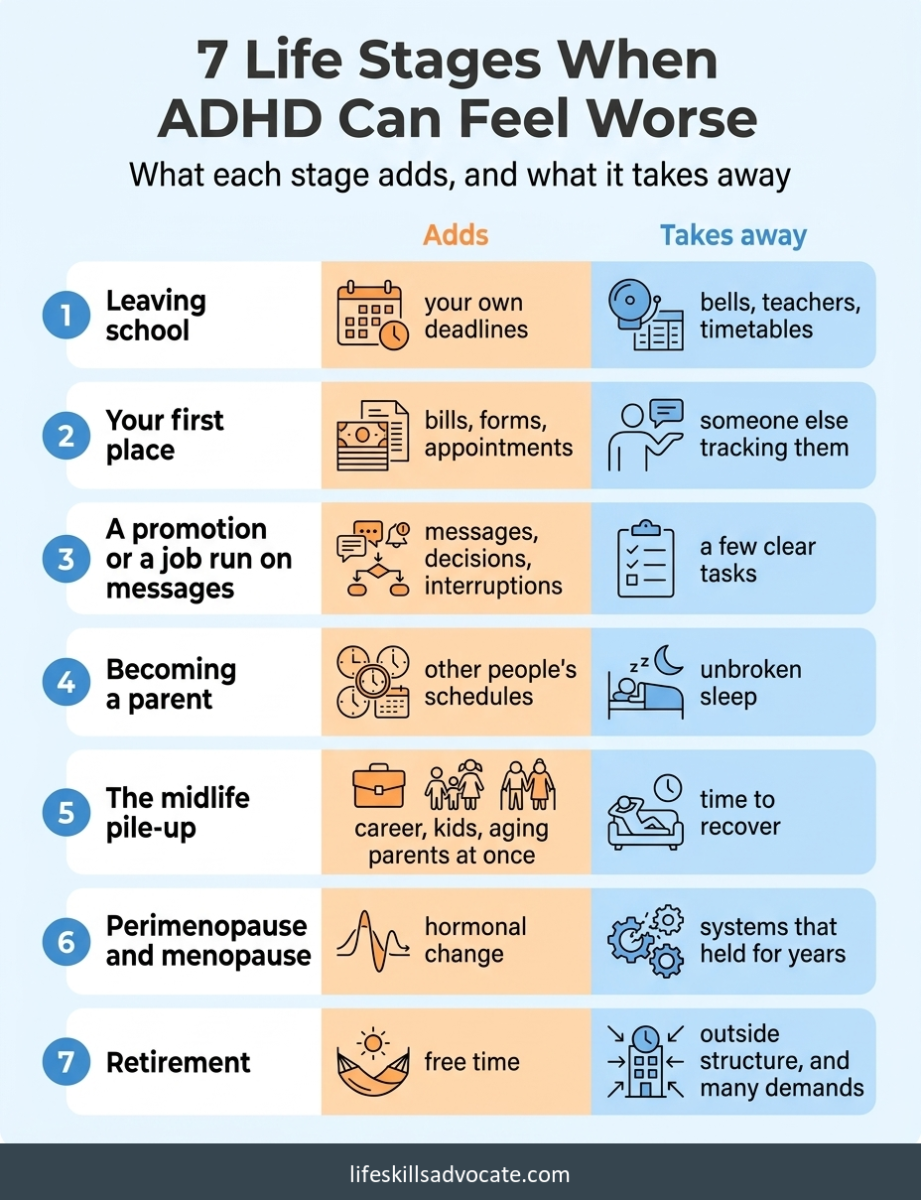
1. Leaving School Behind
It is the first week of college, or the first month of a job, and nobody is ringing a bell.
Teachers, parents and timetables used to do part of the planning: when to start, what came next, when something was due. Leaving school hands all of that back at once.
This stage leans on planning, task initiation and time management. Plenty of adults with ADHD point to it as the moment things first got harder, even when school itself had gone fine. For students, this executive function help for college students starts with that independence gap.
One adjustment: rebuild one outside deadline. A standing weekly check-in with a friend, a study partner who works alongside you (often called body doubling), or a recurring meeting with a professor or manager puts back a piece of the structure school used to supply.
2. Your First Place and Your First Bills
The lease renewal, the car registration, the dentist reminder and the electric bill all land in the same two weeks.
A first apartment turns a dozen small jobs that used to happen in the background into tasks that only happen if you remember them. It leans on working memory, organization and planning, and a miss tends to cost a late fee instead of a friendly reminder.
Something to try: pick one weekly admin hour, same day and same time, for bills, forms and appointments. A short, fixed slot is easier to start than a general plan to stay on top of things.
3. A Promotion or a Job Run on Messages
The promotion comes with a bigger title, a team, and a chat window that does not stop.
Managing the work instead of doing it swaps a few clear tasks for dozens of small decisions. Email, chat, meetings and quick questions each pull attention somewhere new. This stage leans on attentional control, working memory and cognitive flexibility, and it can catch people who did well in the old role.
The setting is often easier to change than the person.
Some of these depend on how much say you have, especially in a new role. Requests can come through one channel instead of four. Notifications can stay off between set check-in times, meeting-free blocks can protect focused work, and written follow-ups take load off memory.
Several of these are common workplace accommodations for ADHD, and some need no formal request at all. In an open office, a pair of noise-cancelling headphones cuts down on the background talk that breaks focus.
If messages are the main problem: make one place where every request lands, such as a single task list that emails and chat requests get copied into, and check it at set times where your role allows, or clear it at the same few points each day.
4. Becoming a Parent
Three a.m. feeds, a daycare pickup at 5:15, and a baby who has no interest in the to-do list.
New parenthood stacks broken sleep on top of a schedule that now partly belongs to someone else, plus constant task switching. Sleep loss hits attention hard. A meta-analysis of 70 sleep deprivation studies found the largest effects on simple attention, with working memory and processing speed also affected.
Those were lab studies of a night or two without sleep, not months of broken sleep, so they show the direction, not the size, of what new parents go through. This stage leans on attentional control, emotional control and time management. The sleep part is not up for negotiation, so the useful question is what can shift around it.
Two things to try: move the hardest thinking task to whatever hour you are most awake, even if that hour changes month to month, and get the household’s mental list out of one head. If another adult shares the household, they can take whole categories (every medical appointment, every daycare form). Either way, a shared list on the fridge or a phone can hold what nobody should have to remember alone.
5. The Midlife Pile-Up
A work deadline, a teenager who needs a ride, and a call from a parent’s doctor, all on the same Tuesday.
Midlife can bring the most demands at once: a career, children of any age, and aging parents. A CHADD article on women with ADHD in midlife names the same pile-up: aging parents, young adult children and career pressure. This stage leans on planning, organization and emotional control.
A common pattern here is someone who looks capable from the outside and spends far more effort than anyone sees to stay that way. The free ADHD Iceberg exercise is a way to map what sits under the surface. Plenty of adults are first identified in this stretch, and these signs of ADHD recognized later in life often make sense in hindsight.
Worth trying: choose one category to hand off, simplify or drop for this season. A sibling might take a parent’s appointments, the same five dinners might rotate for a while, or a volunteer role might pause until things ease.
6. Perimenopause and Menopause
Words that used to arrive on time start showing up late, and systems that held for twenty years stop holding.
Many women with ADHD describe perimenopause as their hardest stretch, and the research is more mixed than most headlines suggest. In a reader survey of 2,653 women aged 46 and older, 61% said ADHD had its biggest impact on daily life between 40 and 59, and only 3% said the same about 60 and older. Brain fog, memory trouble and feeling overwhelmed shifted most during the menopause years.
That survey was self-selected (it was sponsored by ADDitude Magazine and answered by readers), so it shows what many women report, not how common the pattern is. A smaller 2025 study of 118 adults aged 19 to 79 found something different: women’s ADHD-related difficulties were stable across age groups. It was a one-time snapshot with few men in it, so it does not settle the question either.
A geriatric neuropsychologist writing for CHADD noted that “virtually no scientific studies” have looked at how menopause affects ADHD. So the evidence today supports this much: for many women the transition is a hard stretch, and it is not yet clear how common that is or why.
Something that can help: treat this stretch like any other stage with more load. Write things down sooner, do fewer things at once, and bring specific examples of what changed to a doctor, since hormone questions belong there. In the survey, the largest group of women was first identified between 41 and 50, so this is also a common time for ADHD to be recognized.
7. Retirement and Later Life
The alarm clock goes in a drawer, and Monday looks a lot like Saturday.
Retirement removes structure again, much like leaving school, but it also removes many demands. Researchers have suggested that older adults may notice fewer everyday slips partly because of reduced demands after retirement. In a study of adults 60 and older in the Netherlands, 2.8% met full criteria for ADHD, and people aged 60 to 70 reported more traits than people aged 71 to 94.
This stage leans on planning, time management and self-monitoring. With no outside schedule, a week can drift.
If the open week is not suiting you: build a weekly shape on purpose, with a few fixed anchors like a standing coffee, a class or a volunteer shift. CHADD’s article on aging with ADHD suggests “reducing the load”: doing one thing at a time, allowing more time for tasks, and leaning on outside supports such as calendars.
What Makes Any Stage Harder
Some things make ADHD feel worse with age no matter which stage you are in. These come up a lot:
- Short or broken sleep, for any reason
- Stress that runs for weeks, such as moving house, a breakup, money trouble or a health scare
- Burnout, when effort has outrun recovery for too long (neurodivergent burnout has its own signs and its own recovery)
- Constant interruptions
- Losing a routine that worked, like a gym that closed or a commute that ended
These usually don’t mean the ADHD itself has changed. They shrink the room left over for planning and remembering, which is why the same kind of week can go fine one month and fall apart the next.
A Quick Check: What Changed?
When ADHD seems worse with age, it helps to look at the last year before looking at the brain. Find the rows that match. If one is costing you something, the last column has one support to add back. The skills named come from the 11 executive function skills LSA’s resources use; other frameworks group them differently.
| What changed in the last year? | Skill it leans on | One support to add back |
|---|---|---|
| Fewer outside deadlines (left school, went freelance, retired) | Planning, task initiation | A fixed weekly planning slot with another person |
| More inputs (new role, more channels, more messages) | Attentional control, working memory | One place where every request lands |
| Less sleep (new baby, caregiving, shift work) | Attentional control, emotional control | The hardest task moved to your best hour |
| More people to care for or manage (kids, aging parents, a team) | Planning, time management | One category handed off, simplified or paused |
| A routine ended (moving house, a new job, a closed gym) | Organization, self-monitoring | One anchor rebuilt at the same time each day |
| More paperwork (a first home, a parent’s affairs, benefits forms) | Working memory, organization | A short weekly admin hour |
To see where the hours are going now, the free Time Log Worksheet tracks how a few ordinary days get spent, which makes the row that fits easier to spot.
Where ADHD Gets Easier With Age
Does ADHD get easier with age? For a lot of people, yes, in stretches.
Stretches when the traits cause much less trouble (what the researchers call remission) are real, as the MTA numbers above show, and hyperactivity tends to ease over the years. In interviews with 17 Dutch adults over 65, the impact of ADHD seemed to have declined with age. In the women’s survey, only 3% said ADHD hit hardest at 60 or older.
Fit works in this direction too. Some adults find that more responsibility, when it comes with structure, suits them better than a slow week does. Others describe finding work that matches how their brain runs, such as a trade with hands-on tasks and clear finish lines, after school did not.
An easier stretch does not mean the ADHD has gone anywhere. It runs both ways: an easier stretch can give way when the next stage arrives, and a harder one can ease again.
Is It ADHD or Just Getting Older?
Normal aging changes some of the same skills ADHD affects. For most people, processing speed and working memory slow down with age, and research on the aging brain finds it compensates by recruiting extra activity in the frontal regions. A 55-year-old with ADHD can notice both at once: the long-standing pattern, plus the ordinary slowing most people get.
CHADD’s guide for older adults points out that ADHD forgetfulness and early memory decline can both get described as “memory problems” while coming from different processes. The same article is clear that “the vast majority of people with ADHD will not develop dementia as they get older.”
History is a useful dividing line. A pattern you can trace back to school, like losing keys or starting things late, is most likely the ADHD you have had all along. Something new, sudden or steadily worsening is worth raising with a doctor, since sleep, stress, medications, hormones and other health conditions can all play a part.
What Research Says About Whether ADHD Gets Worse With Age
| Finding | What it means | Source |
|---|---|---|
| In a study that followed 558 children with ADHD to about age 25, 63.8% moved in and out of remission over 16 years. | ADHD tends to fluctuate with age rather than steadily get worse. | Sibley et al. (2022), MTA study |
| Up to 70% of people with childhood ADHD still have impairing traits as adults (2025 review). | Most people carry ADHD into adulthood, even when it changes shape. | Cortese et al. (2025) |
| 2.8% of adults aged 60 and older in the Netherlands met full criteria for ADHD (2012). | ADHD continues into later life. | Michielsen et al. (2012) |
| In a 2023 reader survey of 2,653 women aged 46 and older, 61% said ADHD hit hardest at 40 to 59 and 3% said 60 or older. | Midlife can be a peak for many women; the data comes from one self-selected survey. | Wasserstein et al. (2023) |
| Short-term sleep loss had its largest effect on simple attention across 70 studies (2010 meta-analysis). | Stages with broken sleep tend to strain attention first. | Lim and Dinges (2010) |
FAQ
Does ADHD get better with age?
For some people it does, in stretches. In the MTA study, about 30% of children with ADHD reached full remission at some point by their mid-20s, though most of them saw it return later. Hyperactivity tends to ease over time, and the brain’s planning systems keep maturing into the mid-to-late 20s, the idea behind the 30% rule.
Later in life, retirement removes many outside demands, and older adults in Dutch interviews described ADHD’s impact as lessening with age. That is a small, qualitative study, so it shows a possibility, not a guarantee.
It tends to move both ways, though. The same research suggests ADHD tends to fluctuate, so a stretch that feels easier can give way to a harder one when the next big life change arrives, and a harder stretch can ease.
Does ADHD get worse with age in your 30s and 40s?
It can feel that way, because the 30s and 40s are when demands often peak: more responsibility at work, children, a household to run, and sometimes aging parents. For some women, perimenopause adds to the load in the 40s.
This is also a common time for adults to be identified with ADHD for the first time. The systems that carried someone through school and a first job can stop keeping up once several of those demands arrive together, and the change gets noticed.
Can more responsibility make ADHD easier?
Sometimes. In the MTA study, periods of remission were associated with higher environmental demands, especially in younger participants. That is a correlation, not proof that responsibility causes improvement.
Does ADHD get worse with age, or is it something new?
Look at the history first. A pattern you can trace back to school is most likely long-standing ADHD. A change that is new, sudden or steadily worsening deserves a doctor’s look, because sleep, stress, hormones, medications and other health conditions overlap with ADHD. Sorting those apart alone is hard, and even professionals sometimes need time to tell.
Next Steps
Naming the stage you are in points to what changed, which makes it easier to decide whether anything needs adjusting.
- Write down one thing that changed this year and the skill it leans on, using the table above.
- Track three ordinary days with the free Time Log Worksheet to see where the time goes now.
- Curious which skills are carrying the most weight? The Free Executive Functioning Assessment gives a starting picture.
- Get support for the transition itself through executive function coaching, which works on planning, routines and systems for the stage you are in. Coaching is skill-building, not therapy, so it sits alongside mental health care rather than replacing it.
Further Reading
- Variable Patterns of Remission From ADHD in the Multimodal Treatment Study of ADHD – Sibley et al., American Journal of Psychiatry (2022)
- Characteristics and Predictors of Fluctuating ADHD in the MTA – Sibley et al., Journal of Clinical Psychiatry (2024)
- ADHD in Adults: Evidence Base, Uncertainties and Controversies – Cortese et al., World Psychiatry (2025)
- Lifetime Stability of ADHD Symptoms in Older Adults – Semeijn et al. (2015)
- Prevalence of ADHD in Older Adults in The Netherlands – Michielsen et al., British Journal of Psychiatry (2012)
- The Burden of ADHD in Older Adults: A Qualitative Study – Michielsen et al., Journal of Attention Disorders
- Perimenopause, Menopause and ADHD – Wasserstein et al., Journal of the International Neuropsychological Society (2023)
- Age-Related Cognitive Complaints and Emotional Difficulties Associated With Symptoms of ADHD – Callahan et al., Frontiers in Global Women’s Health (2025)
- A Meta-Analysis of the Impact of Short-Term Sleep Deprivation on Cognitive Variables – Lim and Dinges, Psychological Bulletin (2010)
- The Adaptive Brain: Aging and Neurocognitive Scaffolding – Park and Reuter-Lorenz, Annual Review of Psychology (2009)
- Getting Older: What Does “Normal Aging” With ADHD Look Like? – CHADD (2024)
- Frenzied, Frazzled, and Overwhelmed: The Interaction of Hormones and ADHD in Women in Midlife – CHADD
- ADHD Executive Age: What the 30% Rule Really Means – Life Skills Advocate
- Can You Develop ADHD as an Adult? – Life Skills Advocate
- 7 Executive Function Strategies for College Students Who Feel Behind – Life Skills Advocate
- 12 ADHD Workplace Accommodations and When Each One Fits – Life Skills Advocate
- 8 Best Noise Cancelling Headphones for ADHD and Sensory Overload – Life Skills Advocate
- 11 Late ADHD Diagnosis Signs That Finally Made Sense in Hindsight – Life Skills Advocate
- 9 Clear Signs of Neurodivergent Burnout and Practical Ways to Recover – Life Skills Advocate
- ADHD Iceberg Exercise – Life Skills Advocate
- Time Log Worksheet – Life Skills Advocate
- Free Executive Functioning Assessment – Life Skills Advocate
- Executive Function Coaching for Adults – Life Skills Advocate