
The dishes sat in the sink for three days. Then a friend came over, sat on the couch scrolling their phone, and the sink was empty in twenty minutes. Nobody asked them to help, and they didn’t.
That’s body doubling: getting a task started and finished because another person is nearby, doing their own thing. For a lot of neurodivergent people, especially those with ADHD, autism, or both, having someone else in the room can transform the daunting into the doable.
Most people assume the other person is there to help, coach, or keep you on track. Usually they aren’t. Their job is to be there. Whether it works for you tends to come down to who that person is, what you say to them, and what you do on the days they can’t come.
TL;DR
Five things to know before you ask anyone to sit with you:
- Body doubling works best when the other person does their own thing; their job is to be there, not to help.
- Research is early: most of it is self-report, and the one controlled study on schoolwork found no clear effect, though most people preferred having the double.
- Pick the format for the task: a friend at the table, an app session with a stranger, a voice call, or a recorded video.
- Autistic and AuDHD adults often do better with lower-demand versions, like camera off, voice only, or separate rooms.
- If you rely on one person, keep one backup ready for the days they can’t make it.
This is educational, not medical advice. Body doubling is a support people try on their own, not something a professional prescribes, and what works varies a lot from person to person.
What Body Doubling Is (and Isn’t)
Body doubling sounds like a technique you have to learn. Most people who try it find they’ve done it for years: homework at the kitchen table while a parent cooked, or bills paid at a coffee shop. In one 2023 survey, about a quarter of respondents said they first learned the term while taking the survey, and many added that they had “always done it.”
The double can sit across the table, join on a video call, or show up as a recorded video. They can be a close friend or a stranger. What they don’t do is help with your task.
That part trips people up. A new double often feels useless sitting there and starts offering to help. Staying in the room is the help.
The term itself comes from ADHD coach Linda Anderson, who named it in 1996. Her original article on the body double, republished by ADDA in 2025, describes two people working alongside each other on different things. Research came much later: the first studies we could find were published in 2023 and 2024.
What the Research on Body Doubling Shows So Far
Body doubling has far more fans than studies. The research that exists is recent, small, and mostly built on what people report about themselves.
The largest look so far is a 2024 survey of 220 people by Eagle and colleagues, most of them neurodivergent. 186 of them said they were somewhat more likely or more likely to finish a task with someone else present. Many said it helped them feel less anxious or overwhelmed, or made a dull task bearable.
That is self-report. It tells us people find it useful, and it does not measure whether they got more done.
An earlier 2023 report from the same research group found people most often body doubled with friends (60%), family (40%), and coworkers (37%). One in five did it with strangers online.
The only controlled test on schoolwork is tiny.
In a 2025 lab study of 26 adults, people took reading tests once with a silent double and once alone while wearing EEG headsets. The researchers found no statistically significant difference between the two conditions. Even so, about 62% of participants preferred working with the body double.
Older research on something nearby gives a useful clue. A 1983 meta-analysis of 241 studies on “social facilitation” found that the presence of other people slightly sped up simple tasks and slowed down complex ones. The effects were small, and none of those studies tested a body double. Still, it fits what people describe: company tends to help most with tedious, familiar tasks.
There’s also a theory for why it might help with ADHD in particular. Psychologist Russell Barkley’s fact sheet on executive functioning and self-regulation argues that support works best when it is arranged “at the point of performance,” meaning the exact place and time the task happens. A body double is one way to put support right there. Cleveland Clinic’s Dr. Manos calls it “a form of external executive functioning” for the same reason.
What we don’t yet know is who benefits most, which setups work best, and whether there are long-term downsides to needing a second person for routine tasks. We couldn’t find a study that measured dopamine during a session, despite how often that claim shows up online.
Treat any confident explanation of exactly how it works as a guess.
Body Doubling Research at a Glance
| Finding about body doubling | What it means | Source |
|---|---|---|
| The term “body double” was coined in 1996 by ADHD coach Linda Anderson. | It began as a coaching idea, not a research finding. | ADDA (1996, republished 2025) |
| In a 2024 survey of 220 mostly neurodivergent adults, 186 said they were somewhat more likely or more likely to finish a task with someone present. | Most users report it helps; this is self-report, not a measured outcome. | Eagle et al. (2024) |
| Survey respondents body doubled most with friends (60%), family (40%), and coworkers (37%). | The double is usually someone the person already knows. | Eagle et al. (2023) |
| In a 2025 lab study of 26 adults, reading-test results with a silent body double did not differ significantly from working alone; about 62% preferred the body double. | Controlled evidence is small and early. | Schuenke et al. (2025) |
| Across 241 studies, other people’s presence slightly sped up simple tasks and slowed complex ones. | Body doubling may suit routine tasks better than hard new ones. | Bond & Titus (1983) |
Which Kind of Body Double Fits You?
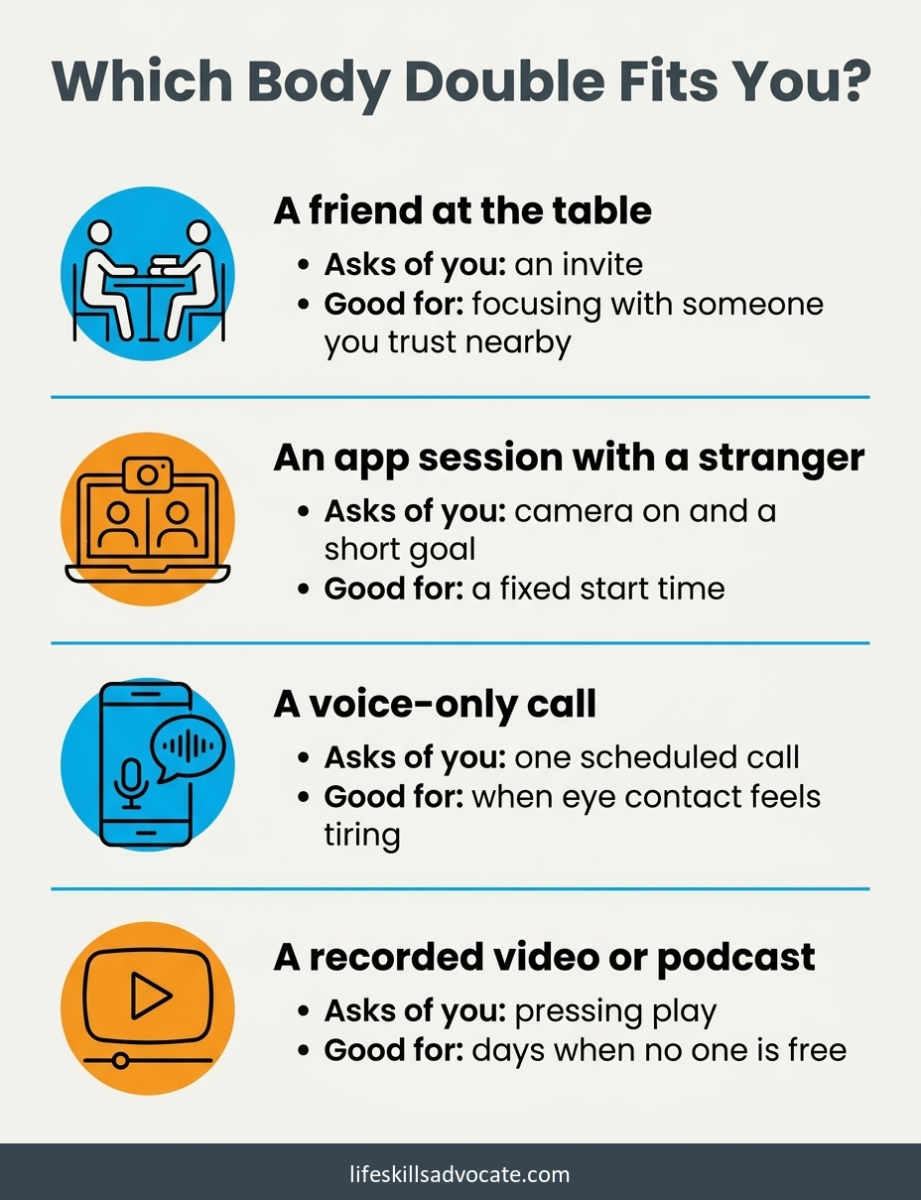
Do you need a person you know, or will any person do? That one question sorts most of the options. Some formats ask a lot of you socially and give a lot of structure back. Others ask almost nothing and give less.
| Format | What you need | Who it suits | The catch |
|---|---|---|---|
| A friend or partner in the same room | An invite and some shared space | People who focus best with someone they trust nearby | Easy to drift into chatting |
| A parent, sibling, or roommate | A home schedule that overlaps with yours | Teens doing homework; anyone doing chores at home | Family members may slide into helping or checking |
| A paid helper, such as a student or retiree | Money and a set time | People whose friends and family are busy or too distracting | Cost, and it can feel formal at first |
| A library, cafe, or coworking space | Getting out the door | People who like background company with no conversation | Noise, and no one knows your plan |
| A one-on-one matching app | Camera on and a short goal said out loud to a stranger | People who like a fixed start time and a little structure | The free tier is limited, and cameras tire some people out |
| A hosted group session | Showing up at set times | People who like a group check-in | Less personal, and the times may not fit yours |
| A voice-only or video call with a friend | Scheduling with one person | People who find eye contact or being seen tiring | Easy to stay on the call and never start |
| A recorded study-with-me or clean-with-me video, or a podcast | Pressing play | Days when no one is free, and people who find live company draining | Nobody notices if you stop |
Hiring a student or retiree to keep someone company comes straight from Anderson’s original article.
Focusmate, a matching app, pairs you with a stranger for a 25, 50, or 75-minute video session, and its free plan covers three sessions a week. ADDA also runs hosted body doubling groups.
Body doubling comes up a lot in LSA coaching, especially around schoolwork and chores. The double is often someone close by: a parent, partner, sibling, or friend. That’s the easiest place to start, as long as that person can stay out of the task.
7 Steps to Start Body Doubling
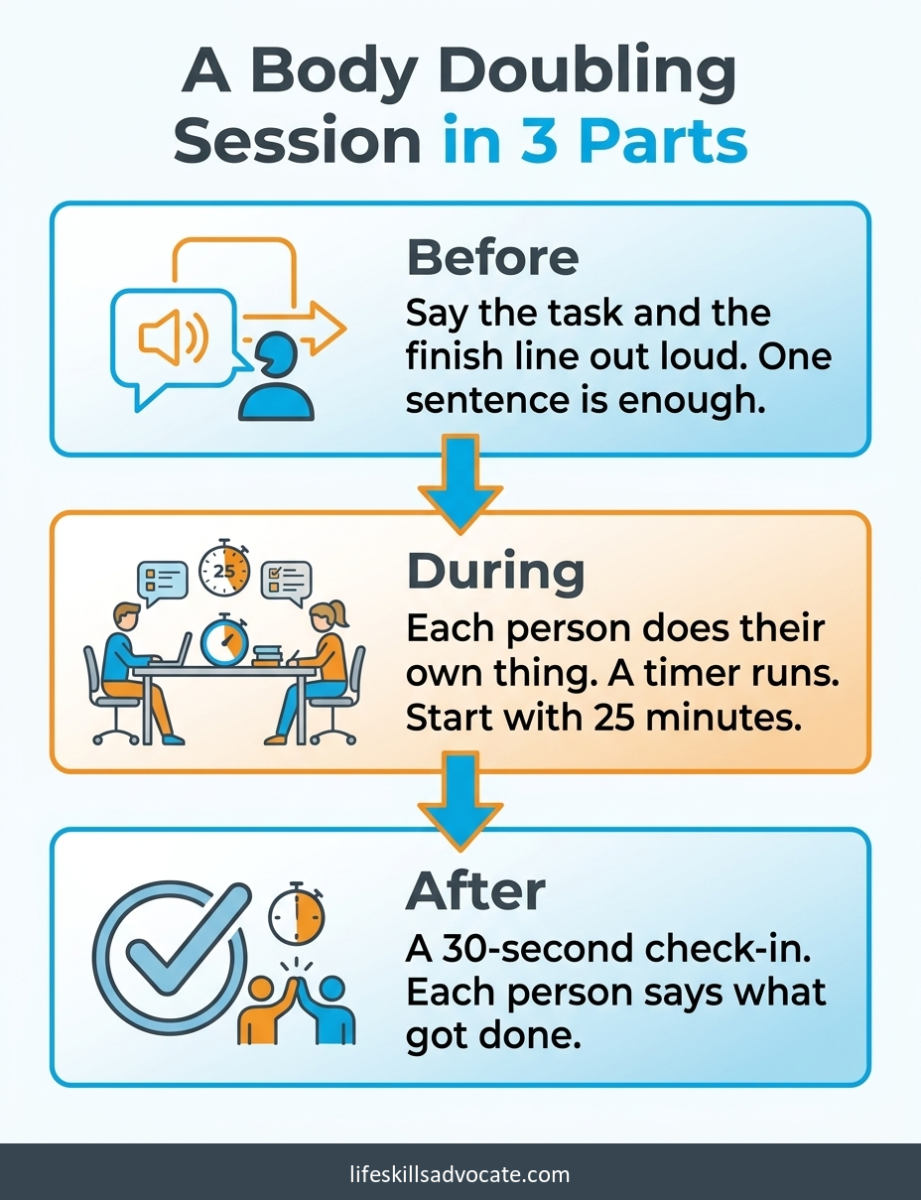
A body doubling session can be two people at one table for 25 minutes. Most of the setup is about keeping it that simple, and there’s little to lose by giving it a try for yourself.
1. Pick One Task, Ideally a Boring One
Not all tasks are created equal when it comes to having company. Tedious, familiar tasks that are hard to start (email, laundry, a reading assignment, a stack of forms) are the sweet spot. Hard, new, creative work is a weaker fit, for the social facilitation reasons above.
If you can’t tell which task to pick, a quick brain dump gets everything out of your head so you can choose one. A double mostly helps with task initiation, the getting-started part, so pick the thing you keep avoiding, not the thing you’d do anyway.
2. Pick a Person and Ask
Asking is often the hardest step. It helps to make the request small, specific, and easy to say no to:
Parents can use a version of this with a teen. It works better as an offer than an order:
If asking for anything sets off a wave of dread, the Asking for Help Workbook breaks that skill into small pieces, and these assertive communication examples show how to ask without over-apologizing.
3. Tell Them What “Helping” Means
Communication is key: set clear expectations from the start. Most body doubles want to be useful, so tell them how:
This one sentence heads off the most common problem: a well-meaning double who keeps asking questions, offering tips, or taking over.
4. Say the Plan Out Loud in the First Two Minutes
Before you start, say what you’re doing and where the finish line is. One sentence is enough:
Saying it to another person makes the plan feel real. Focusmate builds this step into its sessions for the same reason.
5. Set a Length and a Timer
Start with 25 minutes. That’s one round of the Pomodoro technique for ADHD, which pairs well with a double because both of you know when the session ends. If 25 minutes goes well three times in a row, try 50.
A timer you can both see keeps the session from depending on anyone’s sense of time. Visual timers show time shrinking instead of counting it, and a 60-minute desk timer like the Time Timer MOD gives you one without anyone picking up a phone.
6. Close With a 30-Second Check-In
When the timer goes off, each person says what they got done. That’s it.
The check-in turns a vague “that was nice” into something you can see. If you want to make a small reward part of it, the Rewarding Success Worksheet helps you pick ones you’ll look forward to.
7. Try It Three Times Before You Judge It
As with most new routines, we recommend trying it at least three times before deciding whether it helps. The first session is often awkward for both people.
After the third try, notice three things. Did you finish more than usual? Did you feel drained afterward? Did you feel watched, or relieved?
A session that gets the task done but leaves you exhausted may still be worth it for some tasks and not for others.
Body Doubling for Autistic and AuDHD Adults: Lower-Demand Versions
For a lot of autistic and AuDHD adults, the deciding factor is the social cost. Another person in the room can mean small talk, eye contact, being looked at, and noise, and any of those can use up the energy the task needed.
Body doubling can be turned down a lot and still work. Lower-demand versions include:
- Camera off, or voice only
- Separate rooms with the doors open, so you can hear someone moving around
- No eye contact and no small talk, agreed on ahead of time
- A scheduled double instead of a drop-in, so there are no surprises
- Talking only at the very start and the very end of the session
- A recorded video, where nobody can see you at all
Some autistic adults compare it to parallel play: two people doing separate things side by side, with no pressure to interact. That framing helps when “working with someone” sounds like a group project.
If you notice that the double’s presence starts to feel like a demand, that’s worth paying attention to. For people who experience demand avoidance in adults, a plan said out loud to someone else can turn into one more expectation to push against. Keeping the plan private, or writing it down instead of saying it, can help.
Sensory setup matters too. Noise-cancelling headphones let you keep a person nearby while muting the sounds they make.
The evidence here is thin. In the 2024 survey, 82 of the 220 respondents identified as autistic, and the authors warned that their results may not apply the same way across neurodivergent communities. A 2026 study of how autistic adults describe autistic inertia found that people named having someone present as one way to get moving. There is no autism-specific outcome research yet, so the only way to know is to try a low-demand version and see.
When No One Can Be Your Body Double
A body double doesn’t have to be someone you know, or even someone live. On days when nobody is around, a few substitutes cover a lot of the same ground:
- Recorded study-with-me or clean-with-me videos on YouTube, or a podcast where the host works or cleans along with you
- A matching app session with a stranger. In a 2025 study of ADHD college students, participants described using Focusmate, StudyStream, and Twitch “Study with Me” streams this way.
- A voice note to a friend saying what you’re about to do, with a promise to text when you’re done
- Saying the plan out loud to an empty room. It sounds silly, and it still makes the plan more concrete.
If you use a screen reader, some of these sites can be hard to work with, and muting on the site may not be easy. A microphone with its own physical mute switch is one workaround people suggest.
For the days when even pressing play feels impossible, our guide to task paralysis covers other ways to get unstuck.
A gamified workbook of small starting missions for the times a body double isn’t available.
Best for: teens and young adults who start fine with company and want that same traction solo.
Why Body Doubling Sometimes Backfires
Body doubling doesn’t suit everyone, and CHADD says so plainly: with a friend as your double, you can end up socializing instead of working. In the 2024 survey, one participant described it as “usually more distracting than helpful,” partly out of fear of being judged.
Some patterns that tend to cause trouble:
- Feeling watched. If you get self-conscious with someone in the room, a voice call or recorded video may work better.
- A chatty double. Both people stall. Go back to the step 3 script.
- A double who criticizes, even lightly. Critical or judgmental body doubles can make the session feel unsafe and cut into what gets done.
- The wrong task. Complex or creative work may go worse with company, so save the double for routine tasks.
- No plan, no check-in. Without steps 4 and 6, the session drifts.
The person matters more than how productive they are. A double you feel safe around, even one who gets little done, usually beats one who works hard and makes you feel judged.
It also helps to sort your tasks. Some go better with company and some go better alone, and that list can be different for every person.
Is It a Problem to Need a Body Double?
If you can only start certain tasks when someone else is around, is that something to work on, or just how you work? There are two fair ways to look at it.
Behavior analysts ask whether a double works like an environmental change (the way headphones change a room) or like a prompt (a cue that gets a behavior started). The difference matters because prompts are usually faded on purpose over time. When someone can’t start without a specific prompt, the field calls it prompt dependency. That’s why the first version of this guide suggested treating it as one support among several, rather than the only one.
The other view says needing people is ordinary. Writer and professor Devon Price makes that case in an essay titled “Being Socially Motivated Is Not a Disorder,” pointing out that people have worked side by side for most of human history.
We think both views have something to offer. Needing a person to get things done is ordinary. The practical risk is logistics: if one person is your only way to start, then one cancellation, move, or bad week stops everything.
So keep what works. Then build one backup, like a recorded video or an app session, that you’ve tried at least once before you need it.
If you want more independence for certain tasks, a step-down ladder can help. Move to the next rung only when the current one feels easy:
- A person in the room
- A person on a call
- A recorded video
- Saying the plan out loud to yourself
- Working alone, then texting someone when you’re done
Plenty of people stay on rung one for some tasks for good. If you’d like help building the parts that a body double can’t cover, executive function coaching works on those skills one session at a time. Coaching is educational and skills-focused, and it is not therapy.
Frequently Asked Questions
Does body doubling work for autistic people?
Many autistic adults report that body doubling helps, especially lower-demand versions like voice-only calls, separate rooms, or recorded videos. In the largest survey so far, 82 of the 220 respondents identified as autistic, so autistic people are part of the existing evidence.
There is no autism-specific outcome research yet, and the social cost of having another person nearby varies a lot from one autistic person to the next. Camera-off calls, separate rooms, and talking only at the start and end are easy places to begin. The only way to know is to try one and notice how much energy it takes.
Is body doubling only for ADHD?
No. The 2024 survey included autistic, dyspraxic, and other neurodivergent adults, and anyone who finds tasks easier with company can try it.
Can a pet count as a body double?
Some people say a dog or cat in the room helps them get started, and a few even count a robot vacuum running nearby. There’s no research on pets in this role. What probably matters is a steady presence that makes no demands, and a pet can’t remind you of your plan.
How long should a body doubling session last?
Start a body doubling session at 25 minutes. That’s long enough to make progress and short enough to say yes to.
Focusmate offers 25, 50, and 75-minute sessions, which is a reasonable range to try. Run three sessions at one length before you change it. If you keep running out of steam, go shorter; if you keep wanting to keep going, try 50. A visual timer you can both see saves either person from watching the clock.
Do I have to talk to my body double?
No. A one-sentence plan at the start and a short check-in at the end is plenty. The rest can be silent, and for many people silence is what makes it work.
Talking in the middle is where many sessions go sideways. One question turns into a conversation, and 25 minutes later both people have a nice chat and no finished work. If your double is a talker, agree before you start that any questions wait until the timer goes off.
Some pairs like a little background chatter for very boring tasks, like folding laundry or sorting mail. That’s fine as long as the task keeps moving. If the work stops, the talking is the first thing to cut. Over a few sessions, most pairs find their own level.
Next Steps
The first session is the hard one, so make it small enough that it’s hard to say no to.
- Write down one task and one person right now. Then send the step 2 script.
- No one comes to mind? Try one recorded study-with-me video or a free Focusmate session this week.
- If asking is the sticking point, the Asking for Help Workbook walks through it step by step.
- Want to build the skills around it? Executive function coaching for adults works on starting, planning, and follow-through.
- Curious where your executive function strengths sit? Our free executive functioning assessment is a good place to start.
Further Reading
- An Investigation of Body Doubling with Neurodivergent Participants – Eagle, Baltaxe-Admony, and Ringland (2024)
- Proposing Body Doubling as a Continuum of Space/Time and Mutuality – Eagle, Baltaxe-Admony, and Ringland (2023)
- Body doubling and reading performance in adults with and without ADHD – Schuenke, Dickenson, and Moore (2025)
- Virtual body doubling among ADHD students in post-secondary education – Arnold et al. (2025)
- Social Facilitation: A Meta-Analysis of 241 Studies – Bond and Titus (1983)
- Autistic inertia study – Ward et al. (2026)
- The Body Double – Linda Anderson, ADDA
- Could a Body Double Help You Increase Your Productivity? – CHADD
- Body Doubling for ADHD – Cleveland Clinic
- The Important Role of Executive Functioning and Self-Regulation in ADHD – Russell A. Barkley
- Being Socially Motivated Is Not a Disorder – Devon Price
- Focusmate – Focusmate
- Time Timer MOD – Time Timer
- Executive Functioning Skills 101: The Basics of Task Initiation – Life Skills Advocate
- 12 Assertive Communication Examples for Neurodivergent Teens and Young Adults – Life Skills Advocate
- Managing Distractions With the Pomodoro Technique for ADHD – Life Skills Advocate
- The Power of Visual Timers – Life Skills Advocate
- Pathological Demand Avoidance in Adults – Life Skills Advocate
- Best Noise Cancelling Headphones for ADHD and Sensory Overload – Life Skills Advocate
- Task Paralysis: Ways to Start When Your Brain Won’t Let You – Life Skills Advocate
- Brain Dump Strategy – Life Skills Advocate
- Rewarding Success Worksheet – Life Skills Advocate
- Asking for Help Workbook – Life Skills Advocate
- Task Initiation Workbook – Life Skills Advocate
- Executive Function Coaching for Adults – Life Skills Advocate
- Free Executive Functioning Assessment – Life Skills Advocate